Maxwell model
Model of viscoelastic material
In fluid mechanics, a Maxwell model is the simplest model viscoelastic material showing properties of a typical liquid. It shows viscous flow on the long timescale, but additional elastic resistance to fast deformations. It is named for James Clerk Maxwell who proposed the model in 1867. It is also known as a Maxwell fluid. A generalization of the scalar relation to a tensor equation lacks motivation from more microscopic models and does not comply with the concept of material objectivity. However, these criteria are fulfilled by the Upper-convected Maxwell model.
01Definition
The Maxwell model is represented by a purely viscous damper and a purely elastic spring connected in series, as shown in the diagram. If, instead, we connect these two elements in parallel, we get the generalized model of a solid Kelvin-Voigt material.
In Maxwell configuration, under an applied axial stress, the total stress σtotal and the total strain εtotal can be defined as follows:
![{\begin{aligned}\sigma _{\mathrm {total} }&=\sigma _{\rm {D}}=\sigma _{\rm {S}}\\[2pt]\varepsilon _{\mathrm {total} }&=\varepsilon _{\rm {D}}+\varepsilon _{\rm {S}}\end{aligned}}](https://wikimedia.org/api/rest_v1/media/math/render/svg/e8c4b2ede29bab94d6d876c5c10bbcdf090e3826)

In a Maxwell material, stress σ, strain ε and their rates of change with respect to time t are governed by equations of the form:


The equation can be applied either to the shear stress or to the uniform tension in a material. In the former case, the viscosity corresponds to that for a Newtonian fluid. In the latter case, it has a slightly different meaning relating stress and rate of strain.
The model is usually applied to the case of small deformations. For the large deformations we should include some geometrical non-linearity. For the simplest way of generalizing the Maxwell model, refer to the upper-convected Maxwell model.

02Effect of a sudden deformation
If a Maxwell material is suddenly deformed and held to a strain of ε0, then the stress decays on a characteristic timescale of 
If we free the material at time t1, then the elastic element will spring back by the value of

Since the viscous element would not return to its original length, the irreversible component of deformation can be simplified to the expression below:
![\varepsilon _{\mathrm {irreversible} }=\varepsilon _{0}\left[1-\exp \left(-{\frac {E}{\eta }}t_{1}\right)\right].](https://wikimedia.org/api/rest_v1/media/math/render/svg/a8d432cb17a953ececadbac66b26ca40bbbbba61)
03Effect of a sudden stress
If a Maxwell material is suddenly subjected to a stress σ0, then the elastic element would suddenly deform and the viscous element would deform with a constant rate:
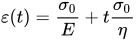
If at some time t1 we released the material, then the deformation of the elastic element would be the spring-back deformation and the deformation of the viscous element would not change:
![{\begin{aligned}\varepsilon _{\mathrm {reversible} }&={\frac {\sigma _{0}}{E}},\\[2pt]\varepsilon _{\mathrm {irreversible} }&=t_{1}{\frac {\sigma _{0}}{\eta }}.\end{aligned}}](https://wikimedia.org/api/rest_v1/media/math/render/svg/04a912d9b66039e27748c6c29ae065b5aa45803f)
The Maxwell model does not exhibit creep since it models strain as linear function of time.
If a small stress is applied for a sufficiently long time, then the irreversible strains become large. Thus, Maxwell material is a type of liquid.

04Effect of a constant strain rate
If a Maxwell material is subject to a constant strain rate 

In general

05Dynamic modulus
The complex dynamic modulus of a Maxwell material would be:

Thus, the components of the dynamic modulus are:
![{\begin{aligned}E_{1}(\omega )&={\frac {E\eta ^{2}\omega ^{2}}{\eta ^{2}\omega ^{2}+E^{2}}}\\[2pt]&=E{\frac {\left({\frac {\eta }{E}}\right)^{2}\omega ^{2}}{\left({\frac {\eta }{E}}\right)^{2}\omega ^{2}+1}}=E{\frac {\tau ^{2}\omega ^{2}}{\tau ^{2}\omega ^{2}+1}}\\[10pt]E_{2}(\omega )&={\frac {\omega E^{2}\eta }{\eta ^{2}\omega ^{2}+E^{2}}}\\[2pt]&=E{\frac {\left({\frac {\eta }{E}}\right)\omega }{\left({\frac {\eta }{E}}\right)^{2}\omega ^{2}+1}}=E{\frac {\tau \omega }{\tau ^{2}\omega ^{2}+1}}\end{aligned}}](https://wikimedia.org/api/rest_v1/media/math/render/svg/d5551867f2d534e1bf1338ba0ffdbe8c0fb29bbc)
As shown, E can be factored out to put the components in terms of the relaxation time constant τ.
Sources and credits
This article is adapted from the Wikipedia article “Maxwell model”, written by its contributors and licensed under CC BY-SA 4.0. Fathomly has changed the layout, removed citation markers, navigation and maintenance notices, and adjusted punctuation. This adapted version is shared under the same license. For references, see the original article.
Images, from Wikimedia Commons:
- Maxwell relax spectra.PNG by Unknown author, PD
- Maxwell diagram.svg by Pekaje at English Wikipedia, Public domain
Fathomly is not affiliated with or endorsed by the Wikimedia Foundation. Spotted a problem? Tell us.
