Generalized Maxwell model
Linear model for viscoelasticity

The generalized Maxwell model also known as the Maxwell-Wiechert model (after James Clerk Maxwell and E Wiechert) is the most general form of the linear model for viscoelasticity. In this model, several Maxwell elements are assembled in parallel. It takes into account that the relaxation does not occur at a single time, but in a set of times. Due to the presence of molecular segments of different lengths, with shorter ones contributing less than longer ones, there is a varying time distribution. The Wiechert model shows this by having as many spring-dashpot Maxwell elements as are necessary to accurately represent the distribution. The figure on the right shows the generalised Wiechert model.
The generalized Maxwell model is widely applied to describe how materials deform under mechanical stress when both elastic and viscous effects are present. It assumes linear viscoelastic behavior and is suitable for cases involving small deformations. Because of its ability to represent complex time-dependent responses, the model is commonly used in the study of polymers, soft tissues, and other viscoelastic solids. The model can be expressed either in the time domain using a relaxation function or in the frequency domain through a complex modulus, making it adaptable for use in experimental and computational analyses. In engineering practice, it is often implemented using a Prony series to simulate viscoelastic behavior in finite element analysis.
01General model form
A common mathematical formulation of the generalized Maxwell model uses a discrete relaxation spectrum, where each Maxwell element contributes a term to the overall stress relaxation behavior. This leads to a Prony series representation of the relaxation modulus:

where Gi is the modulus and 𝜏i is the relaxation time associated with the ith Maxwell element. This method works well when the number of relaxation times in the material is already known or can be estimated from experiments. A common rule of thumb is to include about one relaxation mode for each decade of time or frequency. More advanced statistical tools can also be used to find the smallest number of modes that still give a good fit, while avoiding overfitting and keeping the model physically realistic.
Solids
Given 


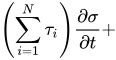
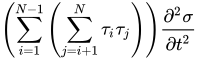
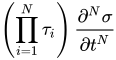
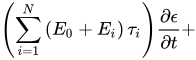
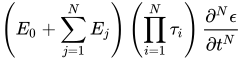
The general form for the model for solids is given by :
General Maxwell Solid Model (1)








Example: standard linear solid model
Following the above model with 

Fluids
Given
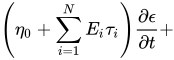
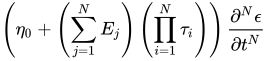
The general form for the model for fluids is given by:
General Maxwell Fluid Model (4)



Example: three parameter fluid
The analogous model to the standard linear solid model is the three parameter fluid, also known as the Jeffreys model:
Three Parameter Maxwell Fluid Model (6)
02Comparison of Linear Viscoelastic Models
| Model | Configuration | Best for | Limitation |
|---|---|---|---|
| Maxwell model | Spring and dashpot in series | Describing stress relaxation | Fails to model creep accurately; predicts unbounded strain under constant stress |
| Kelvin-Voigt model | Spring and dashpot in parallel | Describing creep (delayed strain under constant stress) | Cannot describe stress relaxation behavior |
| Generalized Maxwell model | Multiple Maxwell elements in parallel | Modeling realistic stress relaxation and frequency-dependent behavior | Requires fitting many parameters for accurate behavior |
Sources and credits
This article is adapted from the Wikipedia article “Generalized Maxwell model”, written by its contributors and licensed under CC BY-SA 4.0. Fathomly has changed the layout, removed citation markers, navigation and maintenance notices, and adjusted punctuation. This adapted version is shared under the same license. For references, see the original article.
Images, from Wikimedia Commons:
- Weichert.svg by Pekaje at English Wikipedia, Public domain
Fathomly is not affiliated with or endorsed by the Wikimedia Foundation. Spotted a problem? Tell us.