Magnetic diffusion
Type of motion of magnetic fields
Magnetic diffusion refers to the motion of magnetic fields, typically in the presence of a conducting solid or fluid such as a plasma. The motion of magnetic fields is described by the magnetic diffusion equation and is due primarily to induction and diffusion of magnetic fields through the material. The magnetic diffusion equation is a partial differential equation commonly used in physics. Understanding the phenomenon is essential to magnetohydrodynamics and has important consequences in astrophysics, geophysics, and electrical engineering.
01Equation
The magnetic diffusion equation (also referred to as the induction equation) is


In the case of a non-uniform conductivity the magnetic diffusion equation is


02Derivation
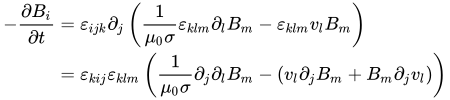
Starting from the generalized Ohm's law:





![{\begin{aligned}{\frac {\partial \mathbf {B} }{\partial t}}+\left(\mathbf {v} \cdot \nabla \right)\mathbf {B} &=\left(\mathbf {B} \cdot \nabla \right)\mathbf {v} -\mathbf {B} \left(\nabla \cdot \mathbf {v} \right)+{\frac {1}{\mu _{0}\sigma }}\nabla ^{2}\mathbf {B} \\[1ex]\longrightarrow \quad {\frac {D\mathbf {B} }{Dt}}&=\left(\mathbf {B} \cdot \nabla \right)\mathbf {v} -\mathbf {B} \left(\nabla \cdot \mathbf {v} \right)+{\frac {1}{\mu _{0}\sigma }}\nabla ^{2}\mathbf {B} \end{aligned}}](https://wikimedia.org/api/rest_v1/media/math/render/svg/0e26ce4a351e842695683fc1c223bec92a6443fc)


03Limiting Cases
In some cases it is possible to neglect one of the terms in the magnetic diffusion equation. This is done by estimating the magnetic Reynolds number


 | Physical Condition | Dominating Term | Magnetic Diffusion Equation | Examples |
|---|---|---|---|---|
 | Large electrical conductivity, large length scales or high plasma velocity. | The inductive term dominates in this case. The motion of magnetic fields is determined by the flow of the plasma. This is the case for most naturally occurring plasmas in the universe. |  | The Sun  or the core of the earth or the core of the earth  |
 | Small electrical conductivity, small length scales or low plasma velocity. | The diffusive term dominates in this case. The motion of the magnetic field obeys the typical (nonconducting) fluid diffusion equation. |  | Solar flares or created in laboratories using mercury or other liquid metals. |
Relation to Skin Effect
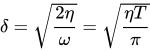
At low frequencies, the skin depth 

04Examples and Visualization
For the limit 


For the limit 

05Diffusion Times for Stationary Conductors
For stationary conductors 
Sources and credits
This article is adapted from the Wikipedia article “Magnetic diffusion”, written by its contributors and licensed under CC BY-SA 4.0. Fathomly has changed the layout, removed citation markers, navigation and maintenance notices, and adjusted punctuation. This adapted version is shared under the same license. For references, see the original article.
Images, from Wikimedia Commons:
- Magnetic shear flow.gif by Dustinso92, CC BY-SA 4.0
Fathomly is not affiliated with or endorsed by the Wikimedia Foundation. Spotted a problem? Tell us.