Induction equation
Concept in magnetohydrodynamics
In magnetohydrodynamics, the induction equation is a partial differential equation that relates the magnetic field and velocity of an electrically conductive fluid such as a plasma. It can be derived from Maxwell's equations and Ohm's law, and plays a major role in plasma physics and astrophysics, especially in dynamo theory.
01Mathematical statement
Maxwell's equations describing the Faraday's and Ampere's laws read:
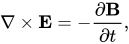

is the electric field.
is the magnetic field.
is the vacuum permeability.
is the electric current density.
The displacement current can be neglected in a plasma as it is negligible compared to the current carried by the free charges. The only exception to this is for exceptionally high frequency phenomena: for example, for a plasma with a typical electrical conductivity of 107 mho/m, the displacement current is smaller than the free current by a factor of 103 for frequencies below 2×10¹⁴ Hz.
The electric field can be related to the current density using the Ohm's law:

is the velocity field.
is the electric conductivity of the fluid.
Combining these three equations, eliminating

Here 

If the fluid moves with a typical speed 


The ratio of these quantities, which is a dimensionless parameter, is called the magnetic Reynolds number:

02Perfectly-conducting limit
For a fluid with infinite electric conductivity, 
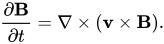
This is taken to be a good approximation in dynamo theory, used to explain the magnetic field evolution in the astrophysical environments such as stars, galaxies and accretion discs.
03Convective limit
More generally, the equation for the perfectly-conducting limit applies in regions of large spatial scale rather than infinite electric conductivity, (i.e.,
04Diffusive limit
For very small magnetic Reynolds numbers, the diffusive term overcomes the convective term. For example, in an electrically resistive fluid with large values of 
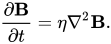
It is common to define a dissipation time scale 
Sources and credits
This article is adapted from the Wikipedia article “Induction equation”, written by its contributors and licensed under CC BY-SA 4.0. Fathomly has changed the layout, removed citation markers, navigation and maintenance notices, and adjusted punctuation. This adapted version is shared under the same license. For references, see the original article.
Fathomly is not affiliated with or endorsed by the Wikimedia Foundation. Spotted a problem? Tell us.

