Lucas sequence
Certain constant-recursive integer sequences
In mathematics, the Lucas sequences 


where 


More generally, Lucas sequences
Famous examples of Lucas sequences include the Fibonacci numbers, Mersenne numbers, Pell numbers, Lucas numbers, Jacobsthal numbers, and a superset of Fermat numbers (see below). Lucas sequences are named after the French mathematician Édouard Lucas.
01Recurrence relations
Given two integer parameters

and

It is not hard to show that for 
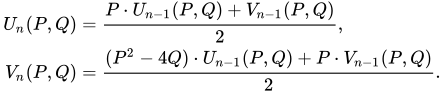
The above relations can be stated in matrix form as follows:



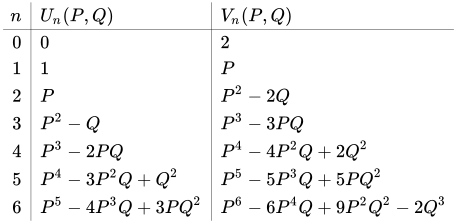
Initial terms of Lucas sequences
02Explicit expressions
The characteristic equation of the recurrence relation for Lucas sequences

It has the discriminant 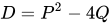

Thus:

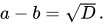
Note that the sequence 

Distinct roots
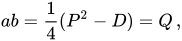
When 
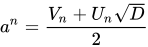
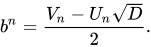
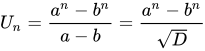
It follows that the terms of Lucas sequences can be expressed in terms of a and b as follows

Repeated root
The case 




03Properties
Generating functions
The ordinary generating functions are


Pell equations
When 


Relations between sequences with different parameters
- For any number c, the sequences
and
with
- have the same discriminant as



- For any number c, we also have


Other relations
The terms of Lucas sequences satisfy relations that are generalizations of those between Fibonacci numbers 


Fast computation
Various analogues of exponentiation by squaring can be used to calculate Lucas sequences efficiently, in 


(6) and (7) allow fast calculation of V independent of U using double-and-add. The relation 
Another
Divisibility properties
Among the consequences is that 


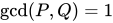
Other divisibility properties are as follows:
- If n is an odd multiple of m, then
divides
.
- Let N be an integer relatively prime to 2Q. If the smallest positive integer r for which N divides
exists, then the set of n for which N divides
is exactly the set of multiples of r.
- If P and Q are even, then
are always even except
.
- If P is odd and Q is even, then
- If P is even and Q is odd, then the parity of
- If P and Q are odd, then
- If p is an odd prime, then
(see Legendre symbol).
- If p is an odd prime which divides P and Q, then p divides
.
- If p is an odd prime which divides P but not Q, then p divides
- If p is an odd prime which divides Q but not P, then p never divides
- If p is an odd prime which divides D but not PQ, then p divides
- If p is an odd prime which does not divide PQD, then p divides
, where
.
The last fact generalizes Fermat's little theorem. These facts are used in the Lucas-Lehmer primality test.
Like Fermat's little theorem, the converse of the last fact holds often, but not always; there exist composite numbers n relatively prime to D and dividing 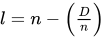
A prime factor of a term in a Lucas sequence which does not divide any earlier term in the sequence is called primitive.
Carmichael's theorem states that all but finitely many of the terms in a Lucas sequence have a primitive prime factor. Indeed, Carmichael (1913) showed that if D is positive and n is not 1, 2 or 6, then
04Specific names
The Lucas sequences for some values of P and Q have specific names:
- Un(1, −1) : Fibonacci numbers
- Vn(1, −1) : Lucas numbers
- Un(2, −1) : Pell numbers
- Vn(2, −1) : Pell-Lucas numbers (companion Pell numbers)
- Un(2, 1) : Counting numbers
- Un(1, −2) : Jacobsthal numbers
- Vn(1, −2) : Jacobsthal-Lucas numbers
- Un(3, 2) : Mersenne numbers 2n − 1
- Vn(3, 2) : Numbers of the form 2n + 1, which include the Fermat numbers
- Un(6, 1) : The square roots of the square triangular numbers.
- Un(x, −1) : Fibonacci polynomials
- Vn(x, −1) : Lucas polynomials
- Un(2x, 1) : Chebyshev polynomials of second kind
- Vn(2x, 1) : Chebyshev polynomials of first kind multiplied by 2
- Un(x + 1, x) : Repunits in base x
- Vn(x + 1, x) : xn + 1
Some Lucas sequences have entries in the On-Line Encyclopedia of Integer Sequences:
−1 3 OEIS: A214733 1 −1 OEIS: A000045 OEIS: A000032 1 1 OEIS: A128834 OEIS: A087204 1 2 OEIS: A107920 OEIS: A002249 2 −1 OEIS: A000129 OEIS: A002203 2 1 OEIS: A001477 OEIS: A007395 2 2 OEIS: A009545 2 3 OEIS: A088137 2 4 OEIS: A088138 2 5 OEIS: A045873 3 −5 OEIS: A015523 OEIS: A072263 3 −4 OEIS: A015521 OEIS: A201455 3 −3 OEIS: A030195 OEIS: A172012 3 −2 OEIS: A007482 OEIS: A206776 3 −1 OEIS: A006190 OEIS: A006497 3 1 OEIS: A001906 OEIS: A005248 3 2 OEIS: A000225 OEIS: A000051 3 5 OEIS: A190959 4 −3 OEIS: A015530 OEIS: A080042 4 −2 OEIS: A090017 4 −1 OEIS: A001076 OEIS: A014448 4 1 OEIS: A001353 OEIS: A003500 4 2 OEIS: A007070 OEIS: A056236 4 3 OEIS: A003462 OEIS: A034472 4 4 OEIS: A001787 5 −3 OEIS: A015536 5 −2 OEIS: A015535 5 −1 OEIS: A052918 OEIS: A087130 5 1 OEIS: A004254 OEIS: A003501 5 4 OEIS: A002450 OEIS: A052539 6 1 OEIS: A001109 OEIS: A003499


05Applications
- Lucas sequences are used in probabilistic Lucas pseudoprime tests, which are part of the commonly used Baillie-PSW primality test.
- Lucas sequences are used in some primality proof methods, including the Lucas-Lehmer and Lucas-Lehmer-Riesel tests and the hybrid N−1/N+1 methods such as those in Brillhart-Lehmer-Selfridge 1975.
- LUC is a public-key cryptosystem based on Lucas sequences that implements the analogs of ElGamal (LUCELG), Diffie-Hellman (LUCDIF), and RSA (LUCRSA). The encryption of the message in LUC is computed as a term of certain Lucas sequence, instead of using modular exponentiation as in RSA or Diffie-Hellman. However, it is argued that many of the supposed security advantages of LUC over cryptosystems based on modular exponentiation are either not present, or not as substantial as claimed.
06Generalizations
The sequence 


07Software
- SageMath implements
Sources and credits
This article is adapted from the Wikipedia article “Lucas sequence”, written by its contributors and licensed under CC BY-SA 4.0. Fathomly has changed the layout, removed citation markers, navigation and maintenance notices, and adjusted punctuation. This adapted version is shared under the same license. For references, see the original article.
Fathomly is not affiliated with or endorsed by the Wikimedia Foundation. Spotted a problem? Tell us.