Neighbourhood system
Concept in mathematics
In topology and related areas of mathematics, the neighbourhood system, complete system of neighbourhoods, or neighbourhood filter 

01Definitions
Neighbourhood of a point or set
An open neighbourhood of a point (or subset) 


Importantly, a "neighbourhood" does not have to be an open set; those neighbourhoods that also happen to be open sets are known as "open neighbourhoods." Similarly, a neighbourhood that is also a closed (respectively, compact, connected, etc.) set is called a closed neighbourhood (respectively, compact neighbourhood, connected neighbourhood, etc.). There are many other types of neighbourhoods that are used in topology and related fields like functional analysis. The family of all neighbourhoods having a certain "useful" property often forms a neighbourhood basis, although many times, these neighbourhoods are not necessarily open. Locally compact spaces, for example, are those spaces that, at every point, have a neighbourhood basis consisting entirely of compact sets.
Neighbourhood filter
The neighbourhood system for a point (or non-empty subset) 

Neighbourhood basis
A neighbourhood basis or local basis (or neighbourhood base or local base) for a point 


Equivalently, 




Neighbourhood subbasis
A neighbourhood subbasis at 


02Examples
If 


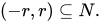
![(-2,2),\;[-2,2],\;[-2,\infty ),\;[-2,2)\cup \{10\},\;[-2,2]\cup \mathbb {Q} ,\;\mathbb {R}](https://wikimedia.org/api/rest_v1/media/math/render/svg/1ff465c9efb1e39369a9bbe8071ee416b008df07)


If 


Neighbourhood bases
In any topological space, the neighbourhood system for a point is also a neighbourhood basis for the point. The set of all open neighbourhoods at a point forms a neighbourhood basis at that point.
For any point 

Given a space 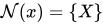
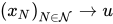
In the weak topology on the space of measures on a space 




Seminormed spaces and topological groups
In a seminormed space, that is a vector space with the topology induced by a seminorm, all neighbourhood systems can be constructed by translation of the neighbourhood system for the origin,

This is because, by assumption, vector addition is separately continuous in the induced topology. Therefore, the topology is determined by its neighbourhood system at the origin. More generally, this remains true whenever the space is a topological group or the topology is defined by a pseudometric.
03Properties
Suppose 


Sources and credits
This article is adapted from the Wikipedia article “Neighbourhood system”, written by its contributors and licensed under CC BY-SA 4.0. Fathomly has changed the layout, removed citation markers, navigation and maintenance notices, and adjusted punctuation. This adapted version is shared under the same license. For references, see the original article.
Fathomly is not affiliated with or endorsed by the Wikimedia Foundation. Spotted a problem? Tell us.