Accumulation point
Cluster point in a topological space
In mathematics, a limit point, accumulation point, or cluster point of a set in a topological space
is a point
that can be "approximated" by points of
in the sense that every neighbourhood of
contains a point of
other than
itself. A limit point of a set
does not itself have to be an element of
There is also a closely related concept for sequences. A cluster point or accumulation point of a sequence
in a topological space
is a point
such that, for every neighbourhood
of
there are infinitely many natural numbers
such that
This definition of a cluster or accumulation point of a sequence generalizes to nets and filters.
The similarly named notion of a limit point of a sequence (respectively, a limit point of a filter, a limit point of a net) by definition refers to a point that the sequence converges to (respectively, the filter converges to, the net converges to). Importantly, although "limit point of a set" is synonymous with "cluster/accumulation point of a set", this is not true for sequences (nor nets or filters). That is, the term "limit point of a sequence" is not synonymous with "cluster/accumulation point of a sequence".
The limit points of a set should not be confused with adherent points (also called points of closure) for which every neighbourhood of contains some point of
. Unlike for limit points, an adherent point
of
may have a neighbourhood not containing points other than
itself. A limit point can be characterized as an adherent point that is not an isolated point.
Limit points of a set should also not be confused with boundary points. For example, is a boundary point (but not a limit point) of the set
in
with standard topology. However,
is a limit point (though not a boundary point) of interval
in
with standard topology (for a less trivial example of a limit point, see the first caption).
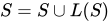
This concept profitably generalizes the notion of a limit and is the underpinning of concepts such as closed set and topological closure. Indeed, a set is closed if and only if it contains all of its limit points, and the topological closure operation can be thought of as an operation that enriches a set by uniting it with its limit points.
01Definition
Accumulation points of a set
Let be a subset of a topological space
A point
in
is a limit point or cluster point or accumulation point of the set
if every neighbourhood of
contains at least one point of
different from
itself.
It does not make a difference if we restrict the condition to open neighbourhoods only. It is often convenient to use the "open neighbourhood" form of the definition to show that a point is a limit point and to use the "general neighbourhood" form of the definition to derive facts from a known limit point.
If is a
space (such as a metric space), then
is a limit point of
if and only if every neighbourhood of
contains infinitely many points of
In fact,
spaces are characterized by this property.
If is a Fréchet-Urysohn space (which all metric spaces and first-countable spaces are), then
is a limit point of
if and only if there is a sequence of points in
whose limit is
In fact, Fréchet-Urysohn spaces are characterized by this property.
The set of limit points of is called the derived set of
Special types of accumulation point of a set
If every neighbourhood of contains infinitely many points of
then
is a specific type of limit point called an ω-accumulation point of
If every neighbourhood of contains uncountably many points of
then
is a specific type of limit point called a condensation point of
If every neighbourhood of
is such that the cardinality of
equals the cardinality of
then
is a specific type of limit point called a complete accumulation point of
Accumulation points of sequences and nets
In a topological space a point
is said to be a cluster point or accumulation point of a sequence
if, for every neighbourhood
of
there are infinitely many
such that
It is equivalent to say that for every neighbourhood
of
and every
there is some
such that
If
is a metric space or a first-countable space (or, more generally, a Fréchet-Urysohn space), then
is a cluster point of
if and only if
is a limit of some subsequence of
The set of all cluster points of a sequence is sometimes called the limit set.
Note that there is already the notion of limit of a sequence to mean a point to which the sequence converges (that is, every neighborhood of
contains all but finitely many elements of the sequence). That is why we do not use the term limit point of a sequence as a synonym for accumulation point of the sequence.
The concept of a net generalizes the idea of a sequence. A net is a function where

is a directed set and
is a topological space. A point
is said to be a cluster point or accumulation point of a net
if, for every neighbourhood
of
and every
there is some
such that
equivalently, if
has a subnet which converges to
Cluster points in nets encompass the idea of both condensation points and ω-accumulation points. Clustering and limit points are also defined for filters.

02Relation between accumulation point of a sequence and accumulation point of a set
Every sequence in
is by definition just a map
so that its image
can be defined in the usual way.
- If there exists an element
that occurs infinitely many times in the sequence,
is an accumulation point of the sequence. But
need not be an accumulation point of the corresponding set
For example, if the sequence is the constant sequence with value
we have
and
is an isolated point of
and not an accumulation point of
- If no element occurs infinitely many times in the sequence, for example if all the elements are distinct, any accumulation point of the sequence is an
-accumulation point of the associated set
Conversely, given a countable infinite set in
we can enumerate all the elements of
in many ways, even with repeats, and thus associate with it many sequences
that will satisfy
- Any
-accumulation point of
is an accumulation point of any of the corresponding sequences (because any neighborhood of the point will contain infinitely many elements of
and hence also infinitely many terms in any associated sequence).
- A point
that is not an
-accumulation point of
cannot be an accumulation point of any of the associated sequences without infinite repeats (because
has a neighborhood that contains only finitely many (possibly even none) points of
and that neighborhood can only contain finitely many terms of such sequences).

03Properties
Every limit of a non-constant sequence is an accumulation point of the sequence. And by definition, every limit point is an adherent point.
The closure of a set
is a disjoint union of its limit points
and isolated points
; that is,
A point is a limit point of
if and only if it is in the closure of
We use the fact that a point is in the closure of a set if and only if every neighborhood of the point meets the set. Now, is a limit point of
if and only if every neighborhood of
contains a point of
other than
if and only if every neighborhood of
contains a point of
if and only if
is in the closure of
If we use to denote the set of limit points of
then we have the following characterization of the closure of
: The closure of
is equal to the union of
and
This fact is sometimes taken as the definition of closure.
("Left subset") Suppose is in the closure of
If
is in
we are done. If
is not in
then every neighbourhood of
contains a point of
and this point cannot be
In other words,
is a limit point of
and
is in
("Right subset") If is in
then every neighbourhood of
clearly meets
so
is in the closure of
If
is in
then every neighbourhood of
contains a point of
(other than
), so
is again in the closure of
This completes the proof.
A corollary of this result gives us a characterisation of closed sets: A set is closed if and only if it contains all of its limit points.
Proof 1: is closed if and only if
is equal to its closure if and only if
if and only if
is contained in
Proof 2: Let be a closed set and
a limit point of
If
is not in
then the complement to
comprises an open neighbourhood of
Since
is a limit point of
any open neighbourhood of
should have a non-trivial intersection with
However, a set can not have a non-trivial intersection with its complement. Conversely, assume
contains all its limit points. We shall show that the complement of
is an open set. Let
be a point in the complement of
By assumption,
is not a limit point, and hence there exists an open neighbourhood
of
that does not intersect
and so
lies entirely in the complement of
Since this argument holds for arbitrary
in the complement of
the complement of
can be expressed as a union of open neighbourhoods of the points in the complement of
Hence the complement of
is open.
No isolated point is a limit point of any set.
ProofIf is an isolated point, then
is a neighbourhood of
that contains no points other than
A space is discrete if and only if no subset of
has a limit point.
If is discrete, then every point is isolated and cannot be a limit point of any set. Conversely, if
is not discrete, then there is a singleton
that is not open. Hence, every open neighbourhood of
contains a point
and so
is a limit point of
If a space has the trivial topology and
is a subset of
with more than one element, then all elements of
are limit points of
If
is a singleton, then every point of
is a limit point of
As long as is nonempty, its closure will be
It is only empty when
is empty or
is the unique element of
Sources and credits
This article is adapted from the Wikipedia article “Accumulation point”, written by its contributors and licensed under CC BY-SA 4.0. Fathomly has changed the layout, removed citation markers, navigation and maintenance notices, and adjusted punctuation. This adapted version is shared under the same license. For references, see the original article.
Images, from Wikimedia Commons:
- Rational sequence with 2 accumulation points.svg by Jochen Burghardt, CC BY-SA 3.0
- Diagonal argument.svg by Cronholm144, CC BY-SA 3.0
Fathomly is not affiliated with or endorsed by the Wikimedia Foundation. Spotted a problem? Tell us.