Lepcha script
Abugida used to write the Lepcha language

The Lepcha script, or Róng script, is an abugida used by the Lepcha people to write the Lepcha language. Unusually for an abugida, syllable-final consonants are written as diacritics.
01History
Lepcha is derived from the Tibetan script, and may have some Burmese influence. According to tradition, it was devised at the beginning of the 18th century by prince Chakdor Namgyal of the Namgyal dynasty of Sikkim, or by scholar Thikúng Men Salóng in the 17th century. Early Lepcha manuscripts were written in vertical columns from top to bottom. When they were later written horizontally, the letters were reoriented 90° anticlockwise (compared to their Tibetan prototypes) to maintain their alignment with the direction of writing. This resulted in the script's unuusal method of writing final consonants, as conjunct forms (ligatures) became superposed diacritics.
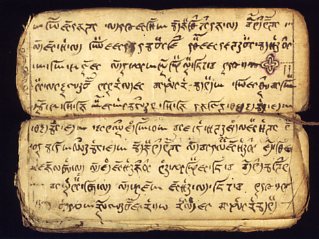
02Typology
As in most other Brahmic scripts, the short vowel /-a/ is not written; other vowels are written with diacritics before (/-i, -o/), after (/-ā, -u/), or under (/-e/) the initial consonant. The length mark, however, is written over the initial, as well as any final consonant diacritic, and fuses with /-o/ and /-u/. (When fused as /-ō/, however, it lies below any final consonant.) Initial vowels do not have separate letters, but are written with the vowel diacritics on an &-shaped zero-consonant letter.
There are postposed diacritics for medial /-y-/ and /-r-/, which may be combined (krya). For medial /-l-/, however, there are seven dedicated conjunct letters. That is, there is a special letter for /kla/ which does not resemble the letter for /ka/. (Only /gla/ is written with a straightforward diacritic.)
One of the final letters, /-ŋ/, is an exception to these patterns. First, unlike the other finals, final /-ŋ/ is written to the left of the initial consonant rather than on top, occurring even before preposed vowels. That is, /kiŋ/ is written "ngki". Second, there is no inherent vowel before /-ŋ/: even short /-a-/ must be written, with a diacritic unique to this situation. (It appears to be the diacritic for long /-ā/ rotated 180° around the consonant letter.) That is, /kaŋ/ is written "ngka", rather than "ngk" as would be expected from the general pattern.
03Letters
As an abugida, a basic letter represents both a consonant followed by an inherent vowel. In Lepcha, the inherent vowel is /a/. To start a syllable with a vowel, the appropriate vowel diacritic is added to the vowel-carrier ᰣ. A vowel-carrier with no diacritic represents the sound /a/.
Consonants
| ᰀ ka IPA: /ka/ | ᰂ kha IPA: /kʰa/ | ᰃ ga IPA: /ga/ | ᰅ nga IPA: /ŋa/ | |
| ᰆ ca IPA: /ca/ | ᰇ cha IPA: /cʰa/ | ᰈ ja IPA: /dʒa/ | ᰉ nya IPA: /nja/ | |
| ᰊ ta IPA: /ta/ | ᰋ tha IPA: /tʰa/ | ᰌ da IPA: /da/ | ᰍ na IPA: /na/ | |
| ᱍ tta IPA: /ʈa/ | ᱎ ttha IPA: /ʈʰa/ | ᱏ dda IPA: /ɖa/ | ||
| ᰎ pa IPA: /pa/ | ᰐ pha IPA: /pʰa/ | ᰑ fa IPA: /fa/ | ᰓ ba IPA: /ba/ | ᰕ ma IPA: /ma/ |
| ᰗ tsa IPA: /ta/ | ᰘ tsha IPA: /tʃa/ | ᰙ dza IPA: /dˢa/ | ||
| ᰚ ya IPA: /ja/ | ᰛ ra IPA: /ra/ | ᰜ la IPA: /la/ | ᰝ ha IPA: /ha/ | |
| ᰟ va IPA: /va/ | ᰡ sha IPA: /ʃa/ | ᰠ sa IPA: /sa/ | ᰢ wa IPA: /ua/ | |
| ᰁ kla IPA: /kla/ | ᰄ gla IPA: /gla/ | ᰞ hla IPA: /hla/ | ||
| ᰏ pla IPA: /pla/ | ᰒ fla IPA: /fla/ | ᰔ bla IPA: /bla/ | ᰖ mla IPA: /mla/ |
A consonant cluster can be formed by adding one of the subjoiners to a base letter.
| y subjoiner ᰤ y | ᰜ + ◌ ᰤ ᰜᰤ lya | r subjoiner ᰥ r | ᰜ + ◌ ᰥ ᰜ ᰥ la |
| ᰭ k | ᰮ m | ᰯ l | ᰰ n | ᰱ p | ᰲ r | ᰳ t | ᰴ ng | ᰵ ng |
| ᰜᰭ lak | ᰜᰮ lam | ᰜᰯ lal | ᰜᰰ lan | ᰜᰱ lap | ᰜᰲ lar | ᰜᰳ lat | ᰜᰴ lang | ᰜᰵᰫ lúng |
Vowels
| ᰶ â IPA: /ə/ | ᰦ á IPA: /a/ | ᰧ i IPA: /i/ | ᰧ ᰶ í IPA: /i/ | ᰨ o IPA: /o/ | ᰩ ó IPA: /ɔ/ | ᰪ u IPA: /ɯ/ | ᰫ ú IPA: /u/ | ᰬ e/ä IPA: /e~ɛ/ | |
| ᰣ | ᰣᰶ | ᰣᰦ | ᰣᰧ | ᰣᰧᰶ | ᰣᰨ | ᰣᰩ | ᰣᰪ | ᰣᰫ | ᰣᰬ |
| ᰜ la | ᰜᰶ lâ | ᰜᰦ lá | ᰜᰧ li | ᰜᰧᰶ lí | ᰜᰨ lo | ᰜᰩ ló | ᰜᰪ lu | ᰜᰫ lú | ᰜᰬ le |
04Numerals
| 0 ᱀ | 1 ᱁ | 2 ᱂ | 3 ᱃ | 4 ᱄ | 5 ᱅ | 6 ᱆ | 7 ᱇ | 8 ᱈ | 9 ᱉ |
05Unicode
Lepcha script was added to the Unicode Standard in April, 2008 with the release of version 5.1.
The Unicode block for Lepcha is U+1C00, U+1C4F:
| Lepcha[1][2] Official Unicode Consortium code chart (PDF) | ||||||||||||||||
| 0 | 1 | 2 | 3 | 4 | 5 | 6 | 7 | 8 | 9 | A | B | C | D | E | F | |
| U+1C0x | ᰀ | ᰁ | ᰂ | ᰃ | ᰄ | ᰅ | ᰆ | ᰇ | ᰈ | ᰉ | ᰊ | ᰋ | ᰌ | ᰍ | ᰎ | ᰏ |
| U+1C1x | ᰐ | ᰑ | ᰒ | ᰓ | ᰔ | ᰕ | ᰖ | ᰗ | ᰘ | ᰙ | ᰚ | ᰛ | ᰜ | ᰝ | ᰞ | ᰟ |
| U+1C2x | ᰠ | ᰡ | ᰢ | ᰣ | ᰤ | ᰥ | ᰦ | ᰧ | ᰨ | ᰩ | ᰪ | ᰫ | ᰬ | ᰭ | ᰮ | ᰯ |
| U+1C3x | ᰰ | ᰱ | ᰲ | ᰳ | ᰴ | ᰵ | ᰶ | ᰷ | ᰻ | ᰼ | ᰽ | ᰾ | ᰿ | |||
| U+1C4x | ᱀ | ᱁ | ᱂ | ᱃ | ᱄ | ᱅ | ᱆ | ᱇ | ᱈ | ᱉ | ᱍ | ᱎ | ᱏ | |||
| Notes | ||||||||||||||||
Sources and credits
This article is adapted from the Wikipedia article “Lepcha script”, written by its contributors and licensed under CC BY-SA 4.0. Fathomly has changed the layout, removed citation markers, navigation and maintenance notices, and adjusted punctuation. This adapted version is shared under the same license. For references, see the original article.
Images, from Wikimedia Commons:
- Lepcha Mingzat.png by Symphonicallyu, CC0
- Róng manuscript.JPG by Unknown authorUnknown author, Public domain
Fathomly is not affiliated with or endorsed by the Wikimedia Foundation. Spotted a problem? Tell us.