Laughlin wavefunction
Ansatz in condensed matter physics
In condensed matter physics, the Laughlin wavefunction is an ansatz, proposed by Robert Laughlin for the ground state of a two-dimensional electron gas placed in a uniform background magnetic field in the presence of a uniform jellium background when the filling factor of the lowest Landau level is 


01Context and analytical expression
If we ignore the jellium and mutual Coulomb repulsion between the electrons as a zeroth order approximation, we have an infinitely degenerate lowest Landau level (LLL) and with a filling factor of 1/n, we'd expect that all of the electrons would lie in the LLL. Turning on the interactions, we can make the approximation that all of the electrons lie in the LLL. If 
![\langle z_{1},z_{2},z_{3},\ldots ,z_{N}\mid n,N\rangle =\psi _{n,N}(z_{1},z_{2},z_{3},\ldots ,z_{N})=D\left[\prod _{1\leqslant i<j\leqslant N}\left(z_{i}-z_{j}\right)^{n}\right]\prod _{k=1}^{N}\exp \left(-\mid z_{k}\mid ^{2}\right)](https://wikimedia.org/api/rest_v1/media/math/render/svg/72633839c39ddbc7d929698c92daf9bc187c2b3d)
where position is denoted by
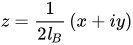
in (Gaussian units)

and 


02True ground state in FQHE at ν = 1/3
Consider 




03Parent Hamiltonian and Haldane Pseudopotentials
While the Laughlin wave function was initially proposed as a highly successful ansatz, its central role in the theory of the fractional quantum Hall effect was cemented by F. Duncan Haldane, who demonstrated that it is the unique, exact zero-energy ground state of a specific "parent" Hamiltonian. This approach reverse-engineers the Hamiltonian from the known properties of the wave function, providing a powerful theoretical framework and a benchmark for numerical studies.
The construction is based on the properties of interacting particles in the lowest Landau level. In a strong magnetic field, the kinetic energy is quenched, and the physics is dominated by the interaction potential. The states of two interacting particles can be decomposed into states of definite relative angular momentum, l. The core insight lies in the structure of the Laughlin wave function itself: due to the Jastrow factor 
Haldane's idea was to build a Hamiltonian that penalizes any pair of particles that has a relative angular momentum less than m. This is achieved using Haldane pseudopotentials, which can be thought of as a projection of the interaction potential onto states of definite relative angular momentum. The parent Hamiltonian is constructed as a sum of projection operators:

where:
- The sum is over all pairs of particles (i,j).
is the operator that projects the pair (i,j) onto a state with relative angular momentum l.
are positive coefficients (
) representing the energy cost for a pair to be found in the l-th relative angular momentum channel. For the parent Hamiltonian, only the
need to be non-zero.
This Hamiltonian is a sum of positive semi-definite operators, so its energy eigenvalues are always non-negative. A ground state with zero energy can only exist if it is annihilated by every term in the sum. This means the ground state wavefunction |Ψ0⟩ must satisfy:

The Laughlin ν = 1/m state, by its very construction, perfectly satisfies this condition. It contains no components where any pair of particles has relative angular momentum less than m. Therefore, the Laughlin state is an exact zero-energy eigenstate of this parent Hamiltonian. Furthermore, for a given number of particles, it can be shown that the Laughlin state is the unique, densest state (i.e., the state with the most particles per unit of magnetic flux) that satisfies this set of conditions. This makes it the unique ground state of this idealized Hamiltonian.
This formalism is extremely powerful. It proves that there exists a local Hamiltonian for which the Laughlin state is the exact ground state, solidifying its physical relevance. It also provides a crucial tool for exact diagonalization studies. The ground state of a more realistic interaction, like the Coulomb potential, can be computed numerically and its overlap with the ideal Laughlin state can be calculated. A large overlap indicates that the Laughlin state is an excellent approximation to the true ground state of the system.

04Energy of interaction for two particles
The Laughlin wavefunction is the multiparticle wavefunction for quasiparticles. The expectation value of the interaction energy for a pair of quasiparticles is

where the screened potential is (see Static forces and virtual-particle exchange § Coulomb potential between two current loops embedded in a magnetic field)

where 


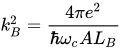
where 

The interaction energy evaluates to:

To obtain this result we have made the change of integration variables
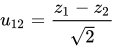
and
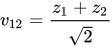
and noted (see Common integrals in quantum field theory)
![{1 \over \left(2\pi \right)^{2}\;2^{2n}\;n!}\int d^{2}z_{1}\;d^{2}z_{2}\;\mid z_{1}-z_{2}\mid ^{2n}\;\exp \left[-2\left(\mid z_{1}\mid ^{2}+\mid z_{2}\mid ^{2}\right)\right]\;{\mathcal {J}}_{0}\left({\sqrt {2}}\;{k\mid z_{1}-z_{2}\mid }\right)=](https://wikimedia.org/api/rest_v1/media/math/render/svg/3c2d3b7f868aba752a4ef9c00749b9bf7bfc5511)
![{1 \over \left(2\pi \right)^{2}\;2^{n}\;n!}\int d^{2}u_{12}\;d^{2}v_{12}\;\mid u_{12}\mid ^{2n}\;\exp \left[-2\left(\mid u_{12}\mid ^{2}+\mid v_{12}\mid ^{2}\right)\right]\;{\mathcal {J}}_{0}\left({2}k\mid u_{12}\mid \right)=](https://wikimedia.org/api/rest_v1/media/math/render/svg/b96ab64f1028a97d4c44a6ea8592a52198bb1f47)
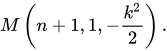
The interaction energy has minima for (Figure 1)
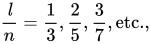
and
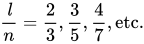
For these values of the ratio of angular momenta, the energy is plotted in Figure 2 as a function of
Sources and credits
This article is adapted from the Wikipedia article “Laughlin wavefunction”, written by its contributors and licensed under CC BY-SA 4.0. Fathomly has changed the layout, removed citation markers, navigation and maintenance notices, and adjusted punctuation. This adapted version is shared under the same license. For references, see the original article.
Images, from Wikimedia Commons:
- 101017 Expectation value vs l.jpg by Complexica (talk), CC BY-SA 3.0
- 101021 energy vs n.jpg by Complexica (talk), CC BY-SA 3.0
Fathomly is not affiliated with or endorsed by the Wikimedia Foundation. Spotted a problem? Tell us.