Landau's function
Mathematical function
In mathematics, Landau's function g(n), named after Edmund Landau, is defined for every natural number n to be the largest order of an element of the symmetric group Sn. Equivalently, g(n) is the largest least common multiple (lcm) of any partition of n, or the maximum number of times a permutation of n elements can be recursively applied to itself before it returns to its starting sequence.
For instance, 5 = 2 + 3 and lcm(2,3) = 6. No other partition of 5 yields a bigger lcm, so g(5) = 6. An element of order 6 in the group S5 can be written in cycle notation as (1 2) (3 4 5). Note that the same argument applies to the number 6, that is, g(6) = 6. There are arbitrarily long sequences of consecutive numbers n, n + 1, ..., n + m on which the function g is constant.
The integer sequence g(0) = 1, g(1) = 1, g(2) = 2, g(3) = 3, g(4) = 4, g(5) = 6, g(6) = 6, g(7) = 12, g(8) = 15, ... (sequence A000793 in the OEIS) is named after Edmund Landau, who proved in 1902 that
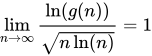
(where ln denotes the natural logarithm). Equivalently (using little-o notation), 
More precisely,

If 




The statement that
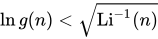
for all sufficiently large n is equivalent to the Riemann hypothesis.
It can be shown that

with the only equality between the functions at n = 0, and indeed

Sources and credits
This article is adapted from the Wikipedia article “Landau's function”, written by its contributors and licensed under CC BY-SA 4.0. Fathomly has changed the layout, removed citation markers, navigation and maintenance notices, and adjusted punctuation. This adapted version is shared under the same license. For references, see the original article.
Fathomly is not affiliated with or endorsed by the Wikimedia Foundation. Spotted a problem? Tell us.