Lagrange bracket
Lagrange brackets are certain expressions closely related to Poisson brackets that were introduced by Joseph Louis Lagrange from 1808 to 1810 for the purposes of mathematical formulation of classical mechanics, but unlike the Poisson brackets, have fallen out of use.
01Definition
Suppose that (q1, ..., qn, p1, ..., pn) is a system of canonical coordinates on a phase space. If each of them is expressed as a function of two variables, u and v, then the Lagrange bracket of u and v is defined by the formula
![[u,v]_{p,q}=\sum _{i=1}^{n}\left({\frac {\partial q_{i}}{\partial u}}{\frac {\partial p_{i}}{\partial v}}-{\frac {\partial p_{i}}{\partial u}}{\frac {\partial q_{i}}{\partial v}}\right).](https://wikimedia.org/api/rest_v1/media/math/render/svg/e05cf21cdb0f56601481458108913aab286f8349)
02Properties
- Lagrange brackets do not depend on the system of canonical coordinates (q, p). If (Q,P) = (Q1, ..., Qn, P1, ..., Pn) is another system of canonical coordinates, so that
is a canonical transformation, then the Lagrange bracket is an invariant of the transformation, in the sense that
Therefore, the subscripts indicating the canonical coordinates are often omitted.
- If Ω is the symplectic form on the 2n-dimensional phase space W and u1,...,u2n form a system of coordinates on W, the symplectic form can be written as
where the matrix
represents the components of Ω, viewed as a tensor, in the coordinates u. This matrix is the inverse of the matrix formed by the Poisson brackets
of the coordinates u.
- As a corollary of the preceding properties, coordinates (Q1, ..., Qn, P1, ..., Pn) on a phase space are canonical if and only if the Lagrange brackets between them have the form
![[Q_{i},Q_{j}]_{p,q}=0,\quad [P_{i},P_{j}]_{p,q}=0,\quad [Q_{i},P_{j}]_{p,q}=-[P_{j},Q_{i}]_{p,q}=\delta _{ij}.](https://wikimedia.org/api/rest_v1/media/math/render/svg/beb6a6f9cf25ec9d855845b153d7b81c97394963)
03Lagrange matrix in canonical transformations
The concept of Lagrange brackets can be expanded to that of matrices by defining the Lagrange matrix.
Consider the following canonical transformation:
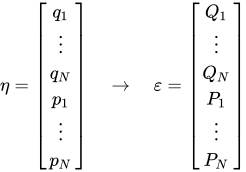
Defining 


![{\mathcal {L}}_{ij}(\eta )=[M^{T}JM]_{ij}=\sum _{k=1}^{N}\left({\frac {\partial \varepsilon _{k}}{\partial \eta _{i}}}{\frac {\partial \varepsilon _{N+k}}{\partial \eta _{j}}}-{\frac {\partial \varepsilon _{N+k}}{\partial \eta _{i}}}{\frac {\partial \varepsilon _{k}}{\partial \eta _{j}}}\right)=\sum _{k=1}^{N}\left({\frac {\partial Q_{k}}{\partial \eta _{i}}}{\frac {\partial P_{k}}{\partial \eta _{j}}}-{\frac {\partial P_{k}}{\partial \eta _{i}}}{\frac {\partial Q_{k}}{\partial \eta _{j}}}\right)=[\eta _{i},\eta _{j}]_{\varepsilon }](https://wikimedia.org/api/rest_v1/media/math/render/svg/b6da3a9319956cb3558bee0a6dc6efc054f401d0)
The Lagrange matrix satisfies the following known properties: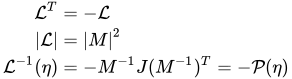

![\sum _{k=1}^{2N}\{\eta _{i},\eta _{k}\}[\eta _{k},\eta _{j}]=-\delta _{ij}](https://wikimedia.org/api/rest_v1/media/math/render/svg/cc66924f661f0d8deef403c52a795fd322ebcfe7)
The invariance of Lagrange bracket can be expressed as: ![{\textstyle [\eta _{i},\eta _{j}]_{\varepsilon }=[\eta _{i},\eta _{j}]_{\eta }=J_{ij}](https://wikimedia.org/api/rest_v1/media/math/render/svg/b5acafa81fa45d4ddf2bb1310d47fd8f8ca64938)

Sources and credits
This article is adapted from the Wikipedia article “Lagrange bracket”, written by its contributors and licensed under CC BY-SA 4.0. Fathomly has changed the layout, removed citation markers, navigation and maintenance notices, and adjusted punctuation. This adapted version is shared under the same license. For references, see the original article.
Fathomly is not affiliated with or endorsed by the Wikimedia Foundation. Spotted a problem? Tell us.

