LCP array
Auxiliary data structure to the suffix array in computer science
In computer science, the longest common prefix array (LCP array) is an auxiliary data structure to the suffix array. It stores the lengths of the longest common prefixes (LCPs) between all pairs of consecutive suffixes in a sorted suffix array.
For example, if A := [aab, ab, abaab, b, baab] is a suffix array, the longest common prefix between A[1] = aab and A[2] = ab is a which has length 1, so H[2] = 1 in the LCP array H. Likewise, the LCP of A[2] = ab and A[3] = abaab is ab, so H[3] = 2.
Augmenting the suffix array with the LCP array allows one to efficiently simulate top-down and bottom-up traversals of the suffix tree, speeds up pattern matching on the suffix array and is a prerequisite for compressed suffix trees.
01History
The LCP array was introduced in 1993, by Udi Manber and Gene Myers alongside the suffix array in order to improve the running time of their string search algorithm.

02Definition
Let 



![S[i,j]](https://wikimedia.org/api/rest_v1/media/math/render/svg/38fe7fdd57ab786563cca51767a3b9717fc63f92)


![S[A[i],n]](https://wikimedia.org/api/rest_v1/media/math/render/svg/e89f0c5adad729871361ebe2d17887d6dbc7df3b)
Let 


![H[1,n]](https://wikimedia.org/api/rest_v1/media/math/render/svg/b93dc8fd1c83d5307ca8b50c298f49c5ad830dea)
![H[1]](https://wikimedia.org/api/rest_v1/media/math/render/svg/00e6e2fb8c90db51d8018b7bb51f5fb8cd8b4a4d)
![H[i]=\operatorname {lcp} (S[A[i-1],n],S[A[i],n])](https://wikimedia.org/api/rest_v1/media/math/render/svg/5cc6bdada8a3b89419ce2f2a61b7a9f10dd934b1)

![H[i]](https://wikimedia.org/api/rest_v1/media/math/render/svg/c3e0d1e646ae278fb8ce6fc87c85e9cf2f61fcd0)
Difference between LCP array and suffix array:
- Suffix array: Represents the lexicographic rank of each suffix of an array.
- LCP array: Contains the maximum length prefix match between two consecutive suffixes, after they are sorted lexicographically.
03Example
Consider the string 
| i | 1 | 2 | 3 | 4 | 5 | 6 | 7 |
|---|---|---|---|---|---|---|---|
| S[i] | b | a | n | a | n | a | $ |
and its corresponding sorted suffix array
| i | 1 | 2 | 3 | 4 | 5 | 6 | 7 |
|---|---|---|---|---|---|---|---|
| A[i] | 7 | 6 | 4 | 2 | 1 | 5 | 3 |
Suffix array with suffixes written out underneath vertically:
| i | 1 | 2 | 3 | 4 | 5 | 6 | 7 |
|---|---|---|---|---|---|---|---|
| A[i] | 7 | 6 | 4 | 2 | 1 | 5 | 3 |
| S[A[i], n][1] | $ | a | a | a | b | n | n |
| S[A[i], n][2] | $ | n | n | a | a | a | |
| S[A[i], n][3] | a | a | n | $ | n | ||
| S[A[i], n][4] | $ | n | a | a | |||
| S[A[i], n][5] | a | n | $ | ||||
| S[A[i], n][6] | $ | a | |||||
| S[A[i], n][7] | $ |
Then the LCP array 
| i | 1 | 2 | 3 | 4 | 5 | 6 | 7 |
|---|---|---|---|---|---|---|---|
| H[i] | undefined | 0 | 1 | 3 | 0 | 0 | 2 |
So, for example, ![H[4]=3](https://wikimedia.org/api/rest_v1/media/math/render/svg/30276ca7a7c2f8d5a8cc5ef51adac7562887610c)

![A[3]=S[4,7]={\textrm {ana\$}}](https://wikimedia.org/api/rest_v1/media/math/render/svg/eb06b9b28785a78033cf14be34c08ae307922278)
![A[4]=S[2,7]={\textrm {anana\$}}](https://wikimedia.org/api/rest_v1/media/math/render/svg/fd882d6d9d757bc43d310f6960159fd480c9b5f4)

04Efficient construction algorithms
LCP array construction algorithms can be divided into two different categories: algorithms that compute the LCP array as a byproduct to the suffix array and algorithms that use an already constructed suffix array in order to compute the LCP values.
Manber & Myers (1993) provide an algorithm to compute the LCP array alongside the suffix array in 

Assuming that each text symbol takes one byte and each entry of the suffix or LCP array takes 4 bytes, the major drawback of their algorithm is a large space occupancy of 


Gog & Ohlebusch (2011) provide two algorithms that although being theoretically slow (
As of 2012, the currently fastest linear-time LCP array construction algorithm is due to Fischer (2011), which in turn is based on one of the fastest suffix array construction algorithms (SA-IS) by Nong, Zhang & Chan (2009). Fischer & Kurpicz (2017) based on Yuta Mori's DivSufSort is even faster.
05Applications
As noted by Abouelhoda, Kurtz & Ohlebusch (2004) several string processing problems can be solved by the following kinds of tree traversals:
- bottom-up traversal of the complete suffix tree
- top-down traversal of a subtree of the suffix tree
- suffix tree traversal using the suffix links.
Kasai et al. (2001) show how to simulate a bottom-up traversal of the suffix tree using only the suffix array and LCP array. Abouelhoda, Kurtz & Ohlebusch (2004) enhance the suffix array with the LCP array and additional data structures and describe how this enhanced suffix array can be used to simulate all three kinds of suffix tree traversals. Fischer & Heun (2007) reduce the space requirements of the enhanced suffix array by preprocessing the LCP array for range minimum queries. Thus, every problem that can be solved by suffix tree algorithms can also be solved using the enhanced suffix array.
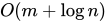
Deciding if a pattern 



The LCP array is also an essential part of compressed suffix trees which provide full suffix tree functionality like suffix links and lowest common ancestor queries. Furthermore, it can be used together with the suffix array to compute the Lempel-Ziv LZ77 factorization in
The longest repeated substring problem for a string 

![S[A[i],A[i]+v_{max}-1]](https://wikimedia.org/api/rest_v1/media/math/render/svg/8b18a63f8f35b5b0c82c7982d837c38208fbf4b8)
The remainder of this section explains two applications of the LCP array in more detail: How the suffix array and the LCP array of a string can be used to construct the corresponding suffix tree and how it is possible to answer LCP queries for arbitrary suffixes using range minimum queries on the LCP array.
Find the number of occurrences of a pattern
In order to find the number of occurrences of a given string 

- We use binary search against the suffix array of
- Now to speed up the search, we use LCP array, specifically a special version of the LCP array (LCP-LR below).
The issue with using standard binary search (without the LCP information) is that in each of the 

The LCP-LR array helps improve this to 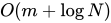
At any point during the binary search algorithm, we consider, as usual, a range 


The trick now is that LCP-LR is precomputed such that an 

We already know (from the previous step) that 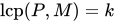
- Case 1:
, i.e.
- Case 2:
, i.e.
.
- Case 3:
. So M and M' are both identical with
th character.
- We continue recursively.
The overall effect is that no character of
We still need to precompute LCP-LR so it is able to tell us in 
The key to this is to realize that only certain ranges 



Moreover, there is a straightforward recursive algorithm to compute the
To sum up:
- It is possible to compute LCP-LR in
space from LCP.
- Using LCP-LR during binary search helps accelerate the search procedure from
to
.
- We can use two binary searches to determine the left and right end of the match range for
Suffix tree construction
Given the suffix array 


Let 


Start with 
![A[i+1]](https://wikimedia.org/api/rest_v1/media/math/render/svg/5067226facfa2d04549a72ccf78ba34b53654ec3)
![A[i]](https://wikimedia.org/api/rest_v1/media/math/render/svg/2a0d7a8a3371fad84f7032042e8d1e1caf6aa15e)
![d(v)\leq H[i+1]](https://wikimedia.org/api/rest_v1/media/math/render/svg/775c2d4103bcc3cbe18c655923628ec02e3a8f47)
We need to distinguish two cases:
: This means that the concatenation of the labels on the root-to-
In this case, insertof node
with
. Thus the edge label consists of the remaining characters of suffix
This creates the partial suffix tree.
: This means that the concatenation of the labels on the root-to-
Let
- Delete the edge
.
- Add a new internal node
and a new edge
with label
. The new label consists of the missing characters of the longest common prefix of
- Connect
that is labeled
. The new label consists of the remaining characters of the deleted edge
- Add
that is labeled
- This creates the partial suffix tree
A simple amortization argument shows that the running time of this algorithm is bounded by
The nodes that are traversed in step 

LCP queries for arbitrary suffixes
The LCP array 
![A[i]=j\Leftrightarrow A^{-1}[j]=i](https://wikimedia.org/api/rest_v1/media/math/render/svg/32d47b22e737330c5f75732c0d8b477726bfac6d)
![S[j,n]](https://wikimedia.org/api/rest_v1/media/math/render/svg/b134859673b224a90d07a632e8e8096d0c20b43b)
![A^{-1}[j]](https://wikimedia.org/api/rest_v1/media/math/render/svg/d05d3160e765c3e25c2e4d7adec7bbd17f07339d)
Because of the lexicographic order of the suffix array, every common prefix of the suffixes ![S[i,n]](https://wikimedia.org/api/rest_v1/media/math/render/svg/08c1fae47959d98bfb9d7e6efcf4073dd2e51617)
![A^{-1}[i]](https://wikimedia.org/api/rest_v1/media/math/render/svg/e3f83ac613fafda5ff36e58f136b78a0910a14c5)
![H[A^{-1}[i]+1,A^{-1}[j]]](https://wikimedia.org/api/rest_v1/media/math/render/svg/8ee836541a92c8b69d19a06e2238b4e0f6ae3945)
Thus given a string 
![A^{-1}[i]<A^{-1}[j]](https://wikimedia.org/api/rest_v1/media/math/render/svg/d343949558aa0c037d127464c115833d0eb4fcfc)
![\operatorname {LCP} (i,j)=H[\operatorname {RMQ} _{H}(A^{-1}[i]+1,A^{-1}[j])]](https://wikimedia.org/api/rest_v1/media/math/render/svg/fee0a3ae9d89d6d5d45dc1969e9840902dccfb26)
Sources and credits
This article is adapted from the Wikipedia article “LCP array”, written by its contributors and licensed under CC BY-SA 4.0. Fathomly has changed the layout, removed citation markers, navigation and maintenance notices, and adjusted punctuation. This adapted version is shared under the same license. For references, see the original article.
Images, from Wikimedia Commons:
- Constructing the suffix tree of banana based on the suffix array and the LCP array - Case 1.pdf by Schlag.sebastian, CC BY-SA 3.0
- Constructing the suffix tree of banana based on the suffix array and the LCP array - Case 2.pdf by Schlag.sebastian, CC BY-SA 3.0
Fathomly is not affiliated with or endorsed by the Wikimedia Foundation. Spotted a problem? Tell us.