Koenigs function
In mathematics, the Koenigs function is a function arising in complex analysis and dynamical systems. Introduced in 1884 by the French mathematician Gabriel Koenigs, it gives a canonical representation as dilations of a univalent holomorphic mapping, or a semigroup of mappings, of the unit disk in the complex numbers into itself.
01Existence and uniqueness of Koenigs function
Let D be the unit disk in the complex numbers. Let f be a holomorphic function mapping D into itself, fixing the point 0, with f not identically 0 and f not an automorphism of D, i.e. a Möbius transformation defined by a matrix in SU(1,1).
By the Denjoy-Wolff theorem, f leaves invariant each disk |z | < r and the iterates of f converge uniformly on compacta to 0: in fact for 0 < r < 1,

for |z | ≤ r with M(r ) < 1. Moreover f '(0) = λ with 0 < |λ| < 1.
Koenigs (1884) proved that there is a unique holomorphic function h defined on D, called the Koenigs function, such that h(0) = 0, h '(0) = 1 and Schröder's equation is satisfied,

The function h is the uniform limit on compacta of the normalized iterates, 
Moreover, if f is univalent, so is h.
As a consequence, when f (and hence h) are univalent, D can be identified with the open domain U = h(D). Under this conformal identification, the mapping f becomes multiplication by λ, a dilation on U.
Proof
- Uniqueness. If k is another solution then, by analyticity, it suffices to show that k = h near 0. Let
- near 0. Thus H(0) =0, H'(0)=1 and, for |z | small,
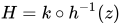

- Substituting into the power series for H, it follows that H(z) = z near 0. Hence h = k near 0.
- Existence. If
then by the Schwarz lemma

- On the other hand,
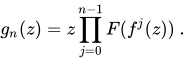
- Hence gn converges uniformly for |z| ≤ r by the Weierstrass M-test since

- Univalence. By Hurwitz's theorem, since each gn is univalent and normalized, i.e. fixes 0 and has derivative 1 there, their limit h is also univalent.
02Koenigs function of a semigroup
Let ft (z) be a semigroup of holomorphic univalent mappings of D into itself fixing 0 defined for t ∈ [0, ∞) such that
is not an automorphism for s > 0
is jointly continuous in t and z


Each fs with s > 0 has the same Koenigs function, cf. iterated function. In fact, if h is the Koenigs function of f = f1, then h(fs(z)) satisfies Schroeder's equation and hence is proportion to h.
Taking derivatives gives

Hence h is the Koenigs function of fs.
03Structure of univalent semigroups
On the domain U = h(D), the maps fs become multiplication by 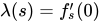


a holomorphic function on D with v(0) = 0 and v'(0) = μ.
Then

so that

and

the flow equation for a vector field.
Restricting to the case with 0 < λ < 1, the h(D) must be starlike so that
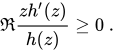
Since the same result holds for the reciprocal,

so that v(z) satisfies the conditions of Berkson & Porta (1978)

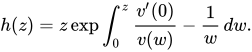
Conversely, reversing the above steps, any holomorphic vector field v(z) satisfying these conditions is associated to a semigroup ft, with
Sources and credits
This article is adapted from the Wikipedia article “Koenigs function”, written by its contributors and licensed under CC BY-SA 4.0. Fathomly has changed the layout, removed citation markers, navigation and maintenance notices, and adjusted punctuation. This adapted version is shared under the same license. For references, see the original article.
Fathomly is not affiliated with or endorsed by the Wikimedia Foundation. Spotted a problem? Tell us.