Joukowsky transform
In mathematics, a type of conformal map

In applied mathematics, the Joukowsky transform (sometimes transliterated Joukovsky, Joukowski or Zhukovsky) is a conformal map historically used to understand some principles of airfoil design. It is named after Nikolai Zhukovsky, who published it in 1910.
The transform and its right-inverse are

where 


In aerodynamics, the transform is used to solve for the two-dimensional potential flow around a class of airfoils known as Joukowsky airfoils. A Joukowsky airfoil is generated in the complex plane (


Joukowsky airfoils have a cusp at their trailing edge. A closely related conformal mapping, the Kármán-Trefftz transform, generates the broader class of Kármán-Trefftz airfoils by controlling the trailing edge angle. When a trailing edge angle of zero is specified, the Kármán-Trefftz transform reduces to the Joukowsky transform.
01General Joukowsky transform
The Joukowsky transform of any complex number
![{\begin{aligned}z&=x+iy=\zeta +{\frac {1}{\zeta }}\\&=\chi +i\eta +{\frac {1}{\chi +i\eta }}\\[2pt]&=\chi +i\eta +{\frac {\chi -i\eta }{\chi ^{2}+\eta ^{2}}}\\[2pt]&=\chi \left(1+{\frac {1}{\chi ^{2}+\eta ^{2}}}\right)+i\eta \left(1-{\frac {1}{\chi ^{2}+\eta ^{2}}}\right).\end{aligned}}](https://wikimedia.org/api/rest_v1/media/math/render/svg/8e2b2f8c9848f1657d05a4cc14dd96c9a3e87507)
So the real (

![{\begin{aligned}x&=\chi \left(1+{\frac {1}{\chi ^{2}+\eta ^{2}}}\right),\\[2pt]y&=\eta \left(1-{\frac {1}{\chi ^{2}+\eta ^{2}}}\right).\end{aligned}}](https://wikimedia.org/api/rest_v1/media/math/render/svg/f0a50c5ba8c65bcd954c518839f845f2acb3e598)
Sample Joukowsky airfoil
The transformation of all complex numbers on the unit circle is a special case.
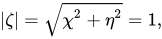
which gives
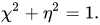
So the real component becomes 

Thus the complex unit circle maps to a flat plate on the real-number line from −2 to +2.
Transformations from other circles make a wide range of airfoil shapes.
![Example of a Kármán-Trefftz transform. The circle above in the \\zeta</math>-plane"}},"i":0}}]}' id="mweg">-plane is transformed into the Kármán-Trefftz airfoil below, in the z</math>-plane"}},"i":0}}]}' id="mwew">-plane. The parameters used are: and Note that the airfoil in the -plane has been normalised using the chord length.](https://upload.wikimedia.org/wikipedia/commons/thumb/5/5b/Karman_Trefftz_transform.svg/500px-Karman_Trefftz_transform.svg.png)
02Velocity field and circulation for the Joukowsky airfoil
The solution to potential flow around a circular cylinder is analytic and well known. It is the superposition of uniform flow, a doublet, and a vortex.
The complex conjugate velocity 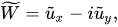

where
is the complex coordinate of the centre of the circle,
is the freestream velocity of the fluid,

is the radius of the circle, calculated using
,
is the circulation, found using the Kutta condition, which reduces in this case to

The complex velocity 

Here 


03Kármán-Trefftz transform
The Kármán-Trefftz transform is a conformal map closely related to the Joukowsky transform. While a Joukowsky airfoil has a cusped trailing edge, a Kármán-Trefftz airfoil, which is the result of the transform of a circle in the 
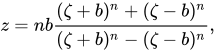
| A |
where 



The derivative 
![{\frac {dz}{d\zeta }}={\frac {4n^{2}}{\zeta ^{2}-1}}{\frac {\left(1+{\frac {1}{\zeta }}\right)^{n}\left(1-{\frac {1}{\zeta }}\right)^{n}}{\left[\left(1+{\frac {1}{\zeta }}\right)^{n}-\left(1-{\frac {1}{\zeta }}\right)^{n}\right]^{2}}}.](https://wikimedia.org/api/rest_v1/media/math/render/svg/9e8c37052334854a67b3388bf8047e96fbc966a3)
Background
First, add and subtract 2 from the Joukowsky transform, as given above:
![{\begin{aligned}z+2&=\zeta +2+{\frac {1}{\zeta }}={\frac {1}{\zeta }}(\zeta +1)^{2},\\[3pt]z-2&=\zeta -2+{\frac {1}{\zeta }}={\frac {1}{\zeta }}(\zeta -1)^{2}.\end{aligned}}](https://wikimedia.org/api/rest_v1/media/math/render/svg/ef1652730dc32a9ba2669f06a26a1aa45cb43455)
Dividing the left and right hand sides gives
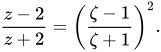
The right hand side contains (as a factor) the simple second-power law from potential flow theory, applied at the trailing edge near 
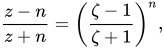
which is the Kármán-Trefftz transform. Solving for
04Symmetrical Joukowsky airfoils
In 1943 Hsue-shen Tsien published a transform of a circle of radius 


The parameter 
Sources and credits
This article is adapted from the Wikipedia article “Joukowsky transform”, written by its contributors and licensed under CC BY-SA 4.0. Fathomly has changed the layout, removed citation markers, navigation and maintenance notices, and adjusted punctuation. This adapted version is shared under the same license. For references, see the original article.
Images, from Wikimedia Commons:
- Joukowsky transform.svg by Krishnavedala, CC BY-SA 4.0
- Karman Trefftz transform.svg by Kraaiennest, CC BY-SA 3.0
Fathomly is not affiliated with or endorsed by the Wikimedia Foundation. Spotted a problem? Tell us.