Johnson graph
Class of undirected graphs defined from systems of sets

In mathematics, Johnson graphs are a special class of undirected graphs defined from systems of sets. The vertices of the Johnson graph 


01Special cases
- Both
and
are the complete graph Kn.
is the octahedral graph.
is the complement of the Petersen graph, hence the line graph of K5. More generally, for all
is the line graph of Kn and the complement of the Kneser graph

02Graph-theoretic properties
- For all
, any pair of vertices at distance
share
elements in common.
- It is also known that the Johnson graph
-vertex-connected.
- Any maximal clique is either of the form
for a
and
, or of the form
for a
-element set
, or of the form
in the edge case
.
- The clique number of
, or, by the above explicit description of maximal cliques,
- The clique cover number of
for
,
for
and
for
but is not known in general.
- The chromatic number of
- Each Johnson graph is locally grid, meaning that the induced subgraph of the neighbors of any vertex is a rook's graph. More precisely, in the Johnson graph
rook's graph.



03Automorphism group
There is a distance-transitive subgroup of 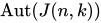




04Intersection array
As a consequence of being distance-transitive, 

where:

It turns out that unless 
05Eigenvalues and eigenvectors
- The characteristic polynomial of
- where


- The eigenvectors of
06Johnson scheme
The Johnson graph
The Johnson scheme is also related to another family of distance-transitive graphs, the odd graphs, whose vertices are 
07Open problems
The vertex-expansion properties of Johnson graphs, as well as the structure of the corresponding extremal sets of vertices of a given size, are not fully understood. However, an asymptotically tight lower bound on expansion of large sets of vertices was recently obtained.
In general, determining the chromatic number of a Johnson graph is an open problem.
Sources and credits
This article is adapted from the Wikipedia article “Johnson graph”, written by its contributors and licensed under CC BY-SA 4.0. Fathomly has changed the layout, removed citation markers, navigation and maintenance notices, and adjusted punctuation. This adapted version is shared under the same license. For references, see the original article.
Images, from Wikimedia Commons:
- Johnson graph J(5,2).svg by Watchduck You can name the author as "T. Piesk", "Tilman Piesk" or "Watchduck"., CC0
Fathomly is not affiliated with or endorsed by the Wikimedia Foundation. Spotted a problem? Tell us.