Grassmann graph
Class of simple graphs defined from vector spaces
In graph theory, Grassmann graphs are a special class of simple graphs defined from systems of subspaces. The vertices of the Grassmann graph Jq(n, k) are the k-dimensional subspaces of an n-dimensional vector space over a finite field of order q; two vertices are adjacent when their intersection is (k − 1)-dimensional.
Many of the parameters of Grassmann graphs are q-analogs of the parameters of Johnson graphs, and Grassmann graphs have several of the same graph properties as Johnson graphs.
01Graph-theoretic properties
- Jq(n, k) is isomorphic to Jq(n, n − k).
- For all 0 ≤ d ≤ diam(Jq(n,k)), the intersection of any pair of vertices at distance d is (k − d)-dimensional.
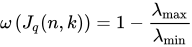
- The clique number of Jq(n,k) is given by an expression in terms its least and greatest eigenvalues λ min and λ max:
02Automorphism group
There is a distance-transitive subgroup of 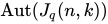

In fact, unless 
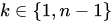


![\operatorname {Aut} (J_{q}(n,k))\cong \operatorname {Sym} ([n]_{q})](https://wikimedia.org/api/rest_v1/media/math/render/svg/28c02950d46777cc245a7bd54e7ca44a9aefbaae)
03Intersection array
As a consequence of being distance-transitive, 


for all
.
for all
.
04Spectrum
- The characteristic polynomial of
.
Sources and credits
This article is adapted from the Wikipedia article “Grassmann graph”, written by its contributors and licensed under CC BY-SA 4.0. Fathomly has changed the layout, removed citation markers, navigation and maintenance notices, and adjusted punctuation. This adapted version is shared under the same license. For references, see the original article.
Fathomly is not affiliated with or endorsed by the Wikimedia Foundation. Spotted a problem? Tell us.
