Orthoptic (geometry)
All points for which two tangents of a curve intersect at 90° angles

In the geometry of curves, an orthoptic is the set of points for which two tangents of a given curve meet at a right angle.
Examples:
- The orthoptic of a parabola is its directrix (proof: see below),
- The orthoptic of an ellipse
is the director circle
(see below),
- The orthoptic of a hyperbola
is the director circle
(in case of a ≤ b there are no orthogonal tangents, see below),
- The orthoptic of an astroid
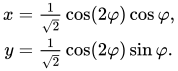
is a quadrifolium with the polar equation
(see below).
Generalizations:
- An isoptic is the set of points for which two tangents of a given curve meet at a fixed angle (see below).
- An isoptic of two plane curves is the set of points for which two tangents meet at a fixed angle.
- Thales' theorem on a chord PQ can be considered as the orthoptic of two circles which are degenerated to the two points P and Q.
01Orthoptic of a parabola
Any parabola can be transformed by a rigid motion (angles are not changed) into a parabola with equation 


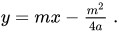
If a tangent contains the point (x0, y0), off the parabola, then the equation




02Orthoptic of an ellipse and hyperbola
Ellipse
Let 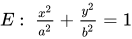
- The tangents to the ellipse
at the vertices and co-vertices intersect at the 4 points
, which lie on the desired orthoptic curve (the circle
- The tangent at a point
of the ellipse
(see tangent to an ellipse). If the point is not a vertex this equation can be solved for y:
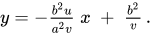
Using the abbreviations
 | I |
and the equation 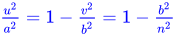

 | II |
and the equation of a non vertical tangent is



If a tangent contains the point 

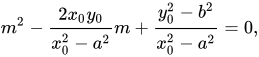

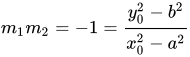

.
Hyperbola
The ellipse case can be adopted nearly exactly to the hyperbola case. The only changes to be made are to replace 

, where a > b.


03Orthoptic of an astroid
An astroid can be described by the parametric representation


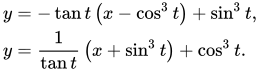
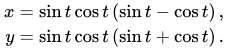
Elimination of the parameter t yields the implicit representation




04Isoptic of a parabola, an ellipse and a hyperbola
Below the isotopics for angles α ≠ 90° are listed. They are called α-isoptics. For the proofs see below.
Equations of the isoptics
- Parabola:
The α-isoptics of the parabola with equation y = ax2 are the branches of the hyperbola

- Ellipse:
The α-isoptics of the ellipse with equation x2/a2 + y2/b2 = 1 are the two parts of the degree-4 curve

- Hyperbola:
The α-isoptics of the hyperbola with the equation x2/a2 − y2/b2 = 1 are the two parts of the degree-4 curve

Proofs
- Parabola:
A parabola y = ax2 can be parametrized by the slope of its tangents m = 2ax:
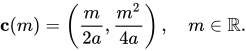
The tangent with slope m has the equation
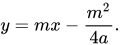
The point (x0, y0) is on the tangent if and only if
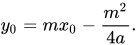
This means the slopes m1, m2 of the two tangents containing (x0, y0) fulfil the quadratic equation

If the tangents meet at angle α or 180° − α, the equation
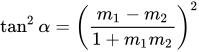
must be fulfilled. Solving the quadratic equation for m, and inserting m1, m2 into the last equation, one gets

This is the equation of the hyperbola above. Its branches bear the two isoptics of the parabola for the two angles α and 180° − α.
- Ellipse:
In the case of an ellipse x2/a2 + y2/b2 = 1 one can adopt the idea for the orthoptic for the quadratic equation
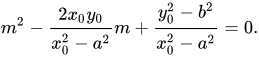
Now, as in the case of a parabola, the quadratic equation has to be solved and the two solutions m1, m2 must be inserted into the equation
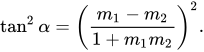
Rearranging shows that the isoptics are parts of the degree-4 curve:

- Hyperbola:
The solution for the case of a hyperbola can be adopted from the ellipse case by replacing b2 with −b2 (as in the case of the orthoptics, see above).
To visualize the isoptics, see implicit curve.

Sources and credits
This article is adapted from the Wikipedia article “Orthoptic (geometry)”, written by its contributors and licensed under CC BY-SA 4.0. Fathomly has changed the layout, removed citation markers, navigation and maintenance notices, and adjusted punctuation. This adapted version is shared under the same license. For references, see the original article.
Images, from Wikimedia Commons:
- Parabel-orthop.svg by Ag2gaeh, CC BY-SA 4.0
- Orthoptic-ellipse-s.svg by Ag2gaeh, CC BY-SA 4.0
- Orthoptic-hyperbola-s.svg by Ag2gaeh, CC BY-SA 4.0
- Orthoptic locus of a circle, ellipses and hyperbolas.gif by Cmapm, CC BY-SA 3.0
- Orthoptic-astroid.svg by Ag2gaeh, CC BY-SA 4.0
- Isoptic-80-parabola-s.svg by Ag2gaeh, CC BY-SA 4.0
- Isoptic-ellipse-s.svg by Ag2gaeh, CC BY-SA 4.0
- Isoptic-hyperbola-s.svg by Ag2gaeh, CC BY-SA 4.0
Fathomly is not affiliated with or endorsed by the Wikimedia Foundation. Spotted a problem? Tell us.