Astroid
Curve generated by rolling a circle inside another circle with 4x or (4/3)x the radius

In mathematics, an astroid is a particular type of roulette curve: a hypocycloid with four cusps. Specifically, it is the locus of a point on a circle as it rolls inside a fixed circle with four times the radius. By double generation, it is also the locus of a point on a circle as it rolls inside a fixed circle with 4/3 times the radius. It can also be defined as the envelope of a line segment of fixed length that moves while keeping an end point on each of the axes. It is therefore the envelope of the moving bar in the Trammel of Archimedes.
Its modern name comes from the Greek word for "star". It was proposed, originally in the form of "Astrois", by Joseph Johann von Littrow in 1838. The curve had a variety of names, including tetracuspid (still used), cubocycloid, and paracycle. It is nearly identical in form to the evolute of an ellipse.
01Equations
If the radius of the fixed circle is a then the equation is given by

![{\begin{aligned}x=a\cos ^{3}t&={\frac {a}{4}}\left(3\cos \left(t\right)+\cos \left(3t\right)\right),\\[2ex]y=a\sin ^{3}t&={\frac {a}{4}}\left(3\sin \left(t\right)-\sin \left(3t\right)\right).\end{aligned}}](https://wikimedia.org/api/rest_v1/media/math/render/svg/e1de9e465b10ce90fd11a5a9f0280d38b7e42855)
The pedal equation with respect to the origin is
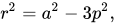
the Whewell equation is
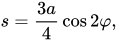

The polar equation is
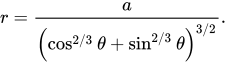
The astroid is a real locus of a plane algebraic curve of genus zero. It has the equation

The astroid is, therefore, a real algebraic curve of degree six.

02Derivation of the polynomial equation
The polynomial equation may be derived from Leibniz's equation by elementary algebra:
Cube both sides:
![{\begin{aligned}x^{6/3}+3x^{4/3}y^{2/3}+3x^{2/3}y^{4/3}+y^{6/3}&=a^{6/3}\\[1.5ex]x^{2}+3x^{2/3}y^{2/3}\left(x^{2/3}+y^{2/3}\right)+y^{2}&=a^{2}\\[1ex]x^{2}+y^{2}-a^{2}&=-3x^{2/3}y^{2/3}\left(x^{2/3}+y^{2/3}\right)\end{aligned}}](https://wikimedia.org/api/rest_v1/media/math/render/svg/e3e4eba6f43f8232684b00797f45f50324982a38)
Cube both sides again:

But since:

It follows that
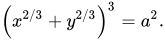
Therefore:



03Metric properties
- Area enclosed
- Length of curve
- Volume of the surface of revolution of the enclose area about the x-axis.
- Area of surface of revolution about the x-axis
- Radius of the outscribed circle
- Radius of the inscribed circle


![The envelope of a ladder (coloured lines in the top-right quadrant) sliding down a vertical wall, and its reflections (other quadrants) is an astroid. The midpoints trace out a circle while other points trace out ellipses similar to the previous figure. //upload.wikimedia.org/wikipedia/commons/b/b6/Sliding_ladder_in_astroid.svg?utm_source=en.wikipedia.org&utm_campaign=index&utm_content=original</span>"}]]}' id="mwHA">In the SVG file, hover over a ladder to highlight it.](https://thumb.wikimedia.org/wikipedia/commons/thumb/b/b6/Sliding_ladder_in_astroid.svg/500px-Sliding_ladder_in_astroid.svg.png)
04Properties
The astroid has four cusp singularities in the real plane, the points on the star. It has two more complex cusp singularities at infinity, and four complex double points, for a total of ten singularities.
The dual curve to the astroid is the cruciform curve with equation 
The astroid has only one tangent line in each oriented direction, making it an example of a hedgehog.

Sources and credits
This article is adapted from the Wikipedia article “Astroid”, written by its contributors and licensed under CC BY-SA 4.0. Fathomly has changed the layout, removed citation markers, navigation and maintenance notices, and adjusted punctuation. This adapted version is shared under the same license. For references, see the original article.
Images, from Wikimedia Commons:
- Astroid.svg by Unknown author, Public domain
- HypotrochoidOn4.gif by en:w:User:Sam Derbyshire, Public domain
- Astroid created with Elipses with a plus b const.svg by MichaelFrey, CC BY-SA 3.0
- Sliding ladder in astroid.svg by Cmglee, CC BY-SA 4.0
- Normal lines to the ellipse.svg by Adam majewski, CC BY-SA 4.0
Fathomly is not affiliated with or endorsed by the Wikimedia Foundation. Spotted a problem? Tell us.


