Integral linear operator
Mathematical function
In mathematical analysis, an integral linear operator is a linear operator T given by integration; i.e.,
where is called an integration kernel.
More generally, an integral bilinear form is a bilinear functional that belongs to the continuous dual space of , the injective tensor product of the locally convex topological vector spaces (TVSs) X and Y. An integral linear operator is a continuous linear operator that arises in a canonical way from an integral bilinear form.
These maps play an important role in the theory of nuclear spaces and nuclear maps.
01Definition - Integral forms as the dual of the injective tensor product
Let X and Y be locally convex TVSs, let denote the projective tensor product,
denote its completion, let
denote the injective tensor product, and
denote its completion.
Suppose that
denotes the TVS-embedding of
into its completion and let
be its transpose, which is a vector space-isomorphism. This identifies the continuous dual space of
as being identical to the continuous dual space of
.
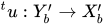
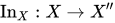
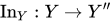
Let denote the identity map and
denote its transpose, which is a continuous injection. Recall that
is canonically identified with
, the space of continuous bilinear maps on
. In this way, the continuous dual space of
can be canonically identified as a vector subspace of
, denoted by
. The elements of
are called integral (bilinear) forms on
. The following theorem justifies the word integral.
Theorem, The dual J(X, Y) of consists of exactly of the continuous bilinear forms u on
of the form
where S and T are respectively some weakly closed and equicontinuous (hence weakly compact) subsets of the duals and
, and
is a (necessarily bounded) positive Radon measure on the (compact) set
.
There is also a closely related formulation of the theorem above that can also be used to explain the terminology integral bilinear form: a continuous bilinear form on the product
of locally convex spaces is integral if and only if there is a compact topological space
equipped with a (necessarily bounded) positive Radon measure
and continuous linear maps
and
from
and
to the Banach space
such that
,
i.e., the form can be realised by integrating (essentially bounded) functions on a compact space.
02Integral linear maps
A continuous linear map is called integral if its associated bilinear form is an integral bilinear form, where this form is defined by
. It follows that an integral map
is of the form:
for suitable weakly closed and equicontinuous subsets S and T of and
, respectively, and some positive Radon measure
of total mass ≤ 1.
The above integral is the weak integral, so the equality holds if and only if for every
,
.
Given a linear map , one can define a canonical bilinear form
, called the associated bilinear form on
, by
.
A continuous map
is called integral if its associated bilinear form is an integral bilinear form. An integral map
is of the form, for every
and
:
for suitable weakly closed and equicontinuous aubsets and
of
and
, respectively, and some positive Radon measure
of total mass
.
Relation to Hilbert spaces
The following result shows that integral maps "factor through" Hilbert spaces.
Proposition: Suppose that is an integral map between locally convex TVS with Y Hausdorff and complete. There exists a Hilbert space H and two continuous linear mappings
and
such that
.
Furthermore, every integral operator between two Hilbert spaces is nuclear. Thus a continuous linear operator between two Hilbert spaces is nuclear if and only if it is integral.
Sufficient conditions
Every nuclear map is integral. An important partial converse is that every integral operator between two Hilbert spaces is nuclear.
Suppose that A, B, C, and D are Hausdorff locally convex TVSs and that ,
, and
are all continuous linear operators. If
is an integral operator then so is the composition
.
If is a continuous linear operator between two normed space then
is integral if and only if
is integral.
Suppose that is a continuous linear map between locally convex TVSs.
If
is integral then so is its transpose
. Now suppose that the transpose
of the continuous linear map
is integral. Then
is integral if the canonical injections
(defined by
value at x) and
are TVS-embeddings (which happens if, for instance,
and
are barreled or metrizable).
Properties
Suppose that A, B, C, and D are Hausdorff locally convex TVSs with B and D complete. If ,
, and
are all integral linear maps then their composition
is nuclear.
Thus, in particular, if X is an infinite-dimensional Fréchet space then a continuous linear surjection
cannot be an integral operator.
Sources and credits
This article is adapted from the Wikipedia article “Integral linear operator”, written by its contributors and licensed under CC BY-SA 4.0. Fathomly has changed the layout, removed citation markers, navigation and maintenance notices, and adjusted punctuation. This adapted version is shared under the same license. For references, see the original article.
Fathomly is not affiliated with or endorsed by the Wikimedia Foundation. Spotted a problem? Tell us.