Integer square root
Greatest integer less than or equal to square root
In number theory, the integer square root (isqrt) of a non-negative integer n is the non-negative integer m which is the greatest integer less than or equal to the square root of n,

For example,

01Introductory remark
Let 

Algorithms that compute (the decimal representation of) 
Algorithms that compute 
Choose any 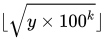
For example (setting 
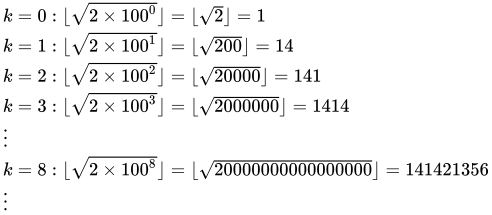
Compare the results with

It appears that the multiplication of the input by 
To compute the (entire) decimal representation of 

Assume that in the next program (
Then 
- import math # assume isqrt computation as given here def sqrtForever(y: int): """ Print sqrt(y), without halting """ result = math.isqrt(y) print(str(result) + ".", end="") # print result, followed by a decimal point while True: # repeat forever ... y *= 100 # theoretical example: overflow is ignored result = math.isqrt(y) print(str(result % 10), end="") # print last digit of result
The conclusion is that algorithms which compute isqrt() are computationally equivalent to algorithms which compute sqrt().
Another derivation of
02Basic algorithms
The integer square root of a non-negative integer

For example, 

Algorithm using linear search
The following Python programs are straightforward implementations.
- def isqrt(y: int) -> int: """ Integer square root (linear search, ascending) """ # initial underestimate, L <= isqrt(y) L = 0 while (L + 1) * (L + 1) <= y: L += 1 return L def isqrt(y: int) -> int: """ Integer square root (linear search, descending) """ # initial overestimate, isqrt(y) <= R R = y while (R * R > y): R -= 1 return R
Linear search using addition
In the program above (linear search, ascending) one can replace multiplication by addition, using the equivalence

- def isqrt(y: int) -> int: """ Integer square root (linear search, ascending) using addition """ L = 0 a = 1 d = 3 while a <= y: a = a + d d = d + 2 L = L + 1 return L
Algorithm using binary search
Linear search sequentially checks every value until it hits the smallest 

A speed-up is achieved by using binary search instead.
- def isqrt(y: int) -> int: """ Integer square root (binary search) """ L = 0 # lower bound of the square root R = y + 1 # upper bound of the square root while (L != R - 1): M = (L + R) // 2 # midpoint to test if (M * M <= y): L = M else: R = M return L
Numerical examples
,
.
- Using binary search the computation of
converges to
in
iteration steps via the
sequence
![{\begin{aligned}&[0,131073]\to [0,65536]\to [0,32768]\to [0,16384]\to [0,8192]\to [0,4096]\rightarrow [0,2048]\to [0,1024]\to [0,512]\\&\to [256,512]\to [256,384]\to [320,384]\to [352,384]\to [352,368]\to [360,368]\to [360,364]\to [362,364]\to [362,363]\end{aligned}}](https://wikimedia.org/api/rest_v1/media/math/render/svg/0459946268c71504f398c034dbac9a8ffcd29190)
- The computation of
converges to
in
steps via the
- Linear search (ascending, starting from
) needs 1414 steps.
![{\begin{aligned}&[0,2000001]\to [0,1000000]\to [0,500000]\to [0,250000]\to [0,125000]\to [0,62500]\to [0,31250]\to [0,15625]\\&\to [0,7812]\to [0,3906]\to [0,1953]\to [976,1953]\to [976,1464]\to [1220,1464]\to [1342,1464]\to [1403,1464]\\&\to [1403,1433]\to [1403,1418]\to [1410,1418]\to [1414,1418]\to [1414,1416]\to [1414,1415]\end{aligned}}](https://wikimedia.org/api/rest_v1/media/math/render/svg/73ae88da1f7d9984ece4341630565bf73023c500)
03Algorithm using Newton's method
One way of calculating 



The sequence 

Using only integer division
For computing 
Let 


Proof of convergence
1. Positivity:
All terms are positive integers: 
2. Monotonicity:
- If
, then
;
- so
.
- Hence the sequence decreases.
- If
, then
;
- so
.
- Hence the sequence increases or stays the same.
3. Boundedness:
The sequence is bounded below by 1 and above by 
4. Stabilization / Oscillation: A bounded monotone integer sequence either stabilizes or oscillates between two consecutive integers:
or
.
5. Integer "Fixed-point" Condition: At stabilization or oscillation:
.
- This ensures that the sequence is either at
6. Conclusion:
The sequence eventually stabilizes at 
Remark:
is a perfect square.
- If
Example implementation
- def isqrt(n: int, x0: int = 1) -> int: """ isqrt via Newton-Heron iteration with specified initial guess. Uses 2-cycle oscillation detection. Preconditions: n >= 0 # isqrt(0) = 0 x0 > 0, defaults to 1 # initial guess Output: isqrt(n) """ assert n >= 0 and x0 > 0, "Invalid input" # isqrt(0) = 0; isqrt(1) = 1 if n < 2: return n prev2 = -1 # x_{i-2} prev1 = x0 # x_{i-1} while True: x1 = (prev1 + n // prev1) // 2 # Case 1: converged (steady value) if x1 == prev1: return x1 # Case 2: oscillation (2-cycle) if x1 == prev2 and x1 != prev1: # We’re flipping between prev1 and prev2 # Choose the smaller one (the true integer sqrt) return min(prev1, x1) # Move forward prev2, prev1 = prev1, x1
Numerical examples
The call isqrt(2000000) converges to
.
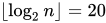
One iteration is gained by setting x0 to 



04Digit-by-digit algorithm
The traditional pen-and-paper algorithm for computing the square root 
Using bitwise operations
If working in base 2, the choice of digit is simplified to that between 0 (the "small candidate") and 1 (the "large candidate"), and digit manipulations can be expressed in terms of binary shift operations. With * being multiplication, << being left shift, and >> being logical right shift, a recursive algorithm to find the integer square root of any natural number is:
- def isqrt_recursive(n: int) -> int: assert n >= 0, "n must be a non-negative integer" if n < 2: return n # Recursive call: small_cand = isqrt_recursive(n >> 2) << 1 # same as 2 * isqrt(n // 4) large_cand = small_cand + 1 if large_cand * large_cand > n: return small_cand else: return large_cand
Equivalent non-recursive program:
- def isqrt_iterative(x: int) -> int: """ Guy, Martin (1985). "Fast integer square root by Mr. Woo's abacus algorithm" """ assert x >= 0, "x must be a non-negative integer" op = x; res = 0 # note: i << 1 is 2 * i, i << 2 is 4 * i, # i >> 1 is i // 2, and i >> 2 is i // 4... # "one" starts at the highest power of four <= x one = 1 while one <= op: one <<= 2 one >>= 2 while one != 0: dltasqr = res + one if op >= dltasqr: op -= dltasqr res += one << 1 res >>= 1 one >>= 2 return res
See Methods of computing square roots § Binary numeral system (base 2) for an example.
05Karatsuba square root algorithm
The Karatsuba square root algorithm applies the same divide-and-conquer principle as the Karatsuba multiplication algorithm to compute integer square roots. The method was formally analyzed by Paul Zimmermann (1999). It recursively splits the input number into high and low halves, computes the square root of the higher half, and then determines the lower half algebraically.
Algorithm
Paul Zimmermann (1999) gives the following algorithm.


Because only one recursive call is made per level, the total complexity remains 
Comparison with Karatsuba multiplication
| Property | Karatsuba multiplication | Karatsuba-style square root |
|---|---|---|
| Recursive calls per level | 3 | 1 |
| Recurrence |  |  |
| Asymptotic complexity |  | |
| Key operation | Three partial multiplications and recombination | One recursive square root and algebraic correction |
Use and history
The Karatsuba-style square root is mainly used for arbitrary-precision arithmetic on very large integers, where it combines efficiently with Burnikel-Ziegler division and Karatsuba multiplication. It was first analyzed formally by Paul Zimmermann (1999). Earlier practical work includes Martin Guy (1985), and recursive versions appear in Donald Knuth (1998). Modern GMP and MPIR libraries implement similar recursive techniques.
Implementation in Python
The Python program below implements Zimmermann’s algorithm. Given an integer 


- def SqrtRem(n: int, word_bits: int = 32) -> tuple[int, int]: """ Implementation based on Zimmermann's Karatsuba-style integer square root algorithm [Zimmermann, 1999]. It recursively splits the input n into "limbs" of size `word_bits` and combines partial results to compute the integer square root. Args: n (int): Non-negative integer to compute the square root of. word_bits (int, optional): Number of bits per "limb" or chunk used when recursively splitting n. Default is 32. Each limb represents a fixed-size part of n for the algorithm. Returns: tuple[int, int]: s = integer square root of n, r = remainder (n - s*s). Notes: The limb size controls recursion granularity. Larger word_bits reduces recursion depth but increases the size of subproblems; smaller word_bits increases recursion depth but works on smaller chunks. Reference: Zimmermann, P. (1999). "Karatsuba Square Root", Research report #3805, Inria. Archived: https://inria.hal.science/inria-00072854v1/file/RR-3805.pdf """ if n < 0: raise ValueError("n must be non-negative") if n == 0: return 0, 0 # trivial case # Determine number of word-sized limbs (mimics “limb” splitting in Zimmermann) limblen = (n.bit_length() + word_bits - 1) // word_bits # Base case: single limb, compute directly if limblen <= 1: s = isqrt(n) # any isqrt, e.g., math.isqrt or custom r = n - s*s return s, r # --- Step 1: Split n into high and low parts --- half_limbs = limblen // 2 shift = half_limbs * word_bits hi = n >> shift # high half, corresponds to a3*b + a2 lo = n & ((1 << shift) - 1) # low half, corresponds to a1*b + a0 # --- Step 2: Recursive call on the high part --- s_high, r_high = SqrtRem(hi, word_bits) # approximate sqrt of high half # --- Step 3: Recombine to approximate full sqrt --- quarter = shift // 2 numerator = (r_high << quarter) | (lo >> quarter) # simulate Zimmermann’s DivRem step denominator = s_high << 1 # 2*s' term q = numerator // denominator if denominator else 0 # integer division s_candidate = (s_high << quarter) + q # recombine high and low # --- Step 4: Verification and correction --- # Ensure remainder is non-negative and s*s <= n < (s+1)*(s+1) s = s_candidate r = n - s*s while r < 0: # overestimate correction s -= 1 r = n - s*s while (s + 1)*(s + 1) <= n: # underestimate correction s += 1 r = n - s*s return s, r
Example usage
- for n in [(2**32) + 5, 12345678901234567890, (1 << 1512) - 1]: s, r = SqrtRem(n) print(f"SqrtRem({n}) = {s}, remainder = {r}")
| Computation |
|---|
|
SqrtRem(4294967301) = 65536, remainder = 5 |
|
SqrtRem(12345678901234567890) = 3513641828, remainder = 5763386306 |
|
SqrtRem(143665816004337822710282600285310394341474369045835074863414468709543787931907367746179403311452034095731304066234112071267510472464260955153084575408147254672957261763907982395337943906645864229014250227057207826232751957053220218983971305018634078800548055251973907806245884614087189937340865371691338441989956445051526543084039211962387469415699218979531585795574920384684004258007709014706216763392717018544247025174258411677231986785008489302218244095) = 379032737378102767370356320425415662904513187772631008578870126471203845870697482014374611530431269030880793627229265919475483409207718357286202948008100864063587640630090308972232735749901964068667724412528434753635948938919935, remainder = 758065474756205534740712640850831325809026375545262017157740252942407691741394964028749223060862538061761587254458531838950966818415436714572405896016201728127175281260180617944465471499803928137335448825056869507271897877839870 |
06In programming languages
Some programming languages dedicate an explicit operation to the integer square root calculation in addition to the general case or can be extended by libraries to this end.
| Programming language | Example use | Version introduced |
|---|---|---|
| Chapel | BigInteger.sqrt(result, n); BigInteger.sqrtRem(result, remainder, n); | Unknown |
| Common Lisp | (isqrt n) | Unknown |
| Crystal | Math.isqrt(n) | 1.2 |
| Java | n.sqrt() (BigInteger only) | 9 |
| Julia | isqrt(n) | 0.3 |
| Maple | isqrt(n) | Unknown |
| PARI/GP | sqrtint(n) | 1.35a (as isqrt) or before |
| PHP | sqrt($num) | 4 |
| Python | math.isqrt(n) | 3.8 |
| Racket | (integer-sqrt n) (integer-sqrt/remainder n) | Unknown |
| Ruby | Integer.sqrt(n) | 2.5.0 |
| Rust | n.isqrt() n.checked_isqrt() | 1.84.0 |
| SageMath | isqrt(n) | Unknown |
| Scheme | (exact-integer-sqrt n) | R6RS |
| Tcl | isqrt($n) | 8.5 |
| Zig | std.math.sqrt(n) | Unknown |
07Continued fraction of √c based on isqrt
The computation of the simple continued fraction of 

Let 

If
![{\sqrt {c}}=[a_{0}].](https://wikimedia.org/api/rest_v1/media/math/render/svg/7e8813c63addbcd1aa50c87dda2395a55815a73d)
Otherwise, the continued fraction is periodic:
,
where the overline indicates the repeating part.
The continued fraction can be obtained by the following recurrence, which uses only integer arithmetic:
- For
,


Since there are only finitely many possible triples 
Implementation in Python
On input 
![[a0,(a1,a2,...,am)]](https://wikimedia.org/api/rest_v1/media/math/render/svg/66eeb5a9ef7c42841305b7eae12f91607d3e70a2)
- def continued_fraction_sqrt(c: int) -> tuple[int, tuple[int, ...]]: """ Compute the continued fraction of sqrt(c) using integer arithmetic. Returns [a0, (a1, a2, ..., am)] where the second element is the periodic part. For perfect squares, the period is empty. """ a0 = isqrt(c) # Perfect square: return period empty if a0 * a0 == c: return (a0, ()) m, d, a = 0, 1, a0 period = [] seen = set() while True: m_next = d * a - m d_next = (c - m_next * m_next) // d a_next = (a0 + m_next) // d_next if (m_next, d_next, a_next) in seen: break seen.add((m_next, d_next, a_next)) period.append(a_next) m, d, a = m_next, d_next, a_next return (a0, tuple(period))
Example usage
- for c in list(range(0, 18)) + [114] + [4097280036]: cf = continued_fraction_sqrt(c) print(f"sqrt({c}): {cf}")
Output
Input (c) Output (cf) Continued fraction 0 [0] 1 [1] 2 [1; (2,)] 3 [1; (1, 2)] 4 [2] 5 [2; (4,)] 6 [2; (2, 4)] 7 [2; (1, 1, 1, 4)] 8 [2; (1, 4)] 9 [3] 10 [3; (6,)] 11 [3; (3, 6)] 12 [3; (2, 6)] 13 [3; (1, 1, 1, 1, 6)] 14 [3; (1, 2, 1, 6)] 15 [3; (1, 6)] 16 [4] 17 [4; (8,)] 114 [10; (1, 2, 10, 2, 1, 20)] 4097280036 [64009; (1, 1999, 3, 4, 1, 499, 3, 1, 3, 3, 1, 124, ...
..., 3, 1, 3, 499, 1, 4, 3, 1999, 1, 128018)]
period: 13,032 terms


![{\sqrt {2}}=[1;{\overline {2}}]](https://wikimedia.org/api/rest_v1/media/math/render/svg/aae2d1b5c0f41eda1f3c1cfcc21e1ad7f341d3ed)
![{\sqrt {3}}=[1;{\overline {1,2}}]](https://wikimedia.org/api/rest_v1/media/math/render/svg/e7bd0812a227752b8182d5cb50a2cdce4c5c021e)

![{\sqrt {5}}=[2;{\overline {4}}]](https://wikimedia.org/api/rest_v1/media/math/render/svg/47ba076c0528f68e1549344273e6215bb689d2cc)
![{\sqrt {6}}=[2;{\overline {2,4}}]](https://wikimedia.org/api/rest_v1/media/math/render/svg/466379c1249f9405879c14fdff9731456eaf2b56)
![{\sqrt {7}}=[2;{\overline {1,1,1,4}}]](https://wikimedia.org/api/rest_v1/media/math/render/svg/a4f7213f0ed15ad5f0c92a896c5841868cbd215a)
![{\sqrt {8}}=[2;{\overline {1,4}}]](https://wikimedia.org/api/rest_v1/media/math/render/svg/5776647a863298419feec0d0c69d2b6db1692fee)

![{\sqrt {10}}=[3;{\overline {6}}]](https://wikimedia.org/api/rest_v1/media/math/render/svg/9a7679da429849b02be27771a43019e03201a5be)
![{\sqrt {11}}=[3;{\overline {3,6}}]](https://wikimedia.org/api/rest_v1/media/math/render/svg/f89524609f68613e65e787bab0405469480508d4)
![{\sqrt {12}}=[3;{\overline {2,6}}]](https://wikimedia.org/api/rest_v1/media/math/render/svg/ab34741a687391b6ecbc63cd1c1ac54b3e0539f0)
![{\sqrt {13}}=[3;{\overline {1,1,1,1,6}}]](https://wikimedia.org/api/rest_v1/media/math/render/svg/76a76a9f6684d3e141dd7f988562c51fcdba6964)
![{\sqrt {14}}=[3;{\overline {1,2,1,6}}]](https://wikimedia.org/api/rest_v1/media/math/render/svg/187160f9a8feefb37d0b5427c751e982c5e25913)
![{\sqrt {15}}=[3;{\overline {1,6}}]](https://wikimedia.org/api/rest_v1/media/math/render/svg/c52fb46e9965e3a1dc5bed538ab52867eea2a29d)

![{\sqrt {17}}=[4;{\overline {8}}]](https://wikimedia.org/api/rest_v1/media/math/render/svg/deb181ba9423422e52e958d46ae9391941dff135)
![{\sqrt {114}}=[10;{\overline {1,2,10,2,1,20}}]](https://wikimedia.org/api/rest_v1/media/math/render/svg/ff3723c5738fb0c027655c893c68277309046be8)
Sources and credits
This article is adapted from the Wikipedia article “Integer square root”, written by its contributors and licensed under CC BY-SA 4.0. Fathomly has changed the layout, removed citation markers, navigation and maintenance notices, and adjusted punctuation. This adapted version is shared under the same license. For references, see the original article.
Fathomly is not affiliated with or endorsed by the Wikimedia Foundation. Spotted a problem? Tell us.