Incircle and excircles
Circles tangent to all three sides of a triangle

In geometry, the incircle or inscribed circle of a triangle is the largest circle that can be contained in the triangle; it touches (is tangent to) the three sides. The center of the incircle is a triangle center called the triangle's incenter.
An excircle or escribed circle of the triangle is a circle lying outside the triangle, tangent to one of its sides and tangent to the extensions of the other two. Every triangle has three distinct excircles, each tangent to one of the triangle's sides.
The center of the incircle, called the incenter, can be found as the intersection of the three internal angle bisectors. The center of an excircle is the intersection of the internal bisector of one angle (at vertex A, for example) and the external bisectors of the other two. The center of this excircle is called the excenter relative to the vertex A, or the excenter of A. Because the internal bisector of an angle is perpendicular to its external bisector, it follows that the center of the incircle together with the three excircle centers form an orthocentric system.
01Incircle and Incenter
Suppose 


Also let 


Incenter
The incenter is the point where the internal angle bisectors of 


Trilinear coordinates
The trilinear coordinates for a point in the triangle is the ratio of all the distances to the triangle sides. Because the incenter is the same distance from all sides of the triangle, the trilinear coordinates for the incenter are

Barycentric coordinates
The barycentric coordinates for a point in a triangle give weights such that the point is the weighted average of the triangle vertex positions.
Barycentric coordinates for the incenter are given by




Cartesian coordinates
The Cartesian coordinates of the incenter are a weighted average of the coordinates of the three vertices using the side lengths of the triangle relative to the perimeter (that is, using the barycentric coordinates given above, normalized to sum to unity) as weights. The weights are positive so the incenter lies inside the triangle as stated above. If the three vertices are located at 



Distances to the vertices
Denote the incenter of
The distance from vertex

Derivation of the formula stated above
Use the Law of sines in the triangle 
We get 

It follows that 
The equality with the second expression is obtained the same way.
The distances from the incenter to the vertices combined with the lengths of the triangle sides obey the equation

Additionally,


Other properties
The collection of triangle centers may be given the structure of a group under coordinate-wise multiplication of trilinear coordinates; in this group, the incenter forms the identity element.
Incircle and its radius properties
Distances between vertex and nearest touchpoints
The distances from a vertex to the two nearest touchpoints are equal; for example from vertex 
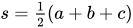
Similarly, the tangency points of the incircle divide the sides into segments of lengths 

Radius
The radius of a triangle's incircle is called the inradius. For a triangle with sides of length 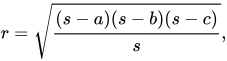
Relation to area of the triangle
The radius of the incircle is related to the area of the triangle. The ratio of the area of the incircle to the area of the triangle is less than or equal to 
Suppose
Now, the incircle is tangent to 

Therefore, 
Similarly, 


Since these three triangles decompose 


For an alternative formula, consider 



Other properties
If the altitudes from sides of lengths 


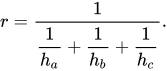
The product of the incircle radius
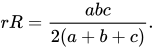
Some relations among the sides, incircle radius, and circumcircle radius are:

Any line through a triangle that splits both the triangle's area and its perimeter in half goes through the triangle's incenter (the center of its incircle). There are either one, two, or three of these for any given triangle.
The incircle radius is no greater than one-ninth the sum of the altitudes.
The squared distance from the incenter 
![{\overline {OI}}^{2}=R(R-2r)={\frac {a\,b\,c\,}{a+b+c}}\left[{\frac {a\,b\,c\,}{(a+b-c)\,(a-b+c)\,(-a+b+c)}}-1\right]](https://wikimedia.org/api/rest_v1/media/math/render/svg/bb15cf80e70231de35ac2c6a332123c6e5ab377a)


The incenter lies in the medial triangle (whose vertices are the midpoints of the sides).
Gergonne triangle and point
The Gergonne triangle (of
This Gergonne triangle, 
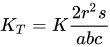


The three lines 


The Gergonne point of a triangle has a number of properties, including that it is the symmedian point of the Gergonne triangle.
Trilinear coordinates for the vertices of the intouch triangle are given by
![{\begin{array}{rccccc}T_{A}=&0&:&\sec ^{2}{\frac {B}{2}}&:&\sec ^{2}{\frac {C}{2}}\\[2pt]T_{B}=&\sec ^{2}{\frac {A}{2}}&:&0&:&\sec ^{2}{\frac {C}{2}}\\[2pt]T_{C}=&\sec ^{2}{\frac {A}{2}}&:&\sec ^{2}{\frac {B}{2}}&:&0.\end{array}}](https://wikimedia.org/api/rest_v1/media/math/render/svg/949f82b5b26d8e1a2abe6b5d6440082f4b8cee3e)
Trilinear coordinates for the Gergonne point are given by



02Excircles and excenters
An excircle or escribed circle of the triangle is a circle lying outside the triangle, tangent to one of its sides, and tangent to the extensions of the other two. Every triangle has three distinct excircles, each tangent to one of the triangle's sides.
The center of an excircle is the intersection of the internal bisector of one angle (at vertex
Trilinear coordinates of excenters
While the incenter of 
Exradii
The radii of the excircles are called the exradii.
The exradius of the excircle opposite 

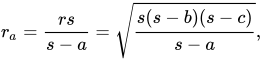
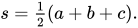
See Heron's formula.
Derivation of exradii formula
Source:
Let the excircle at side 


So, by symmetry, denoting

By the Law of Cosines, we have
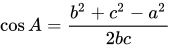
Combining this with the identity 

But 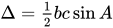
![{\begin{aligned}\Delta &={\tfrac {1}{4}}{\sqrt {-a^{4}-b^{4}-c^{4}+2a^{2}b^{2}+2b^{2}c^{2}+2a^{2}c^{2}}}\\[5mu]&={\tfrac {1}{4}}{\sqrt {(a+b+c)(-a+b+c)(a-b+c)(a+b-c)}}\\[5mu]&={\sqrt {s(s-a)(s-b)(s-c)}},\end{aligned}}](https://wikimedia.org/api/rest_v1/media/math/render/svg/e17e05c79be64264f2af1be5ecf1d02950827252)
Combining this with 

Similarly, 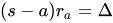
![{\begin{aligned}&r_{a}^{2}={\frac {s(s-b)(s-c)}{s-a}}\\[4pt]&\implies r_{a}={\sqrt {\frac {s(s-b)(s-c)}{s-a}}}.\end{aligned}}](https://wikimedia.org/api/rest_v1/media/math/render/svg/ba686fd7b853925eb08592fc095e9bf4b0113bb9)
Other properties
From the formulas above one can see that the excircles are always larger than the incircle and that the largest excircle is the one tangent to the longest side and the smallest excircle is tangent to the shortest side. Further, combining these formulas yields:
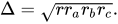
Other excircle properties
The circular hull of the excircles is internally tangent to each of the excircles and is thus an Apollonius circle. The radius of this Apollonius circle is 
The following relations hold among the inradius 

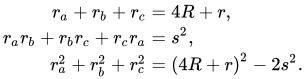
The circle through the centers of the three excircles has radius 
If 

Nagel triangle and Nagel point
The Nagel triangle or extouch triangle of
The three line segments 



The splitters intersect in a single point, the triangle's Nagel point 
Trilinear coordinates for the vertices of the extouch triangle are given by
![{\begin{array}{rccccc}T_{A}=&0&:&\csc ^{2}{\frac {B}{2}}&:&\csc ^{2}{\frac {C}{2}}\\[2pt]T_{B}=&\csc ^{2}{\frac {A}{2}}&:&0&:&\csc ^{2}{\frac {C}{2}}\\[2pt]T_{C}=&\csc ^{2}{\frac {A}{2}}&:&\csc ^{2}{\frac {B}{2}}&:&0\end{array}}](https://wikimedia.org/api/rest_v1/media/math/render/svg/a376148033db8571507a1ab0e304c796614948a8)
Trilinear coordinates for the Nagel point are given by

or, equivalently, by the Law of Sines,

Barycentric coordinates for the Nagel point are therefore


The Nagel point is the isotomic conjugate of the Gergonne point.

03Related constructions
Nine-point circle and Feuerbach point
In geometry, the nine-point circle is a circle that can be constructed for any given triangle. It is so named because it passes through nine significant concyclic points defined from the triangle. These nine points are:
- The midpoint of each side of the triangle
- The foot of each altitude
- The midpoint of the line segment from each vertex of the triangle to the orthocenter (where the three altitudes meet; these line segments lie on their respective altitudes).
In 1822, Karl Feuerbach discovered that any triangle's nine-point circle is externally tangent to that triangle's three excircles and internally tangent to its incircle; this result is known as Feuerbach's theorem. He proved that:
... the circle which passes through the feet of the altitudes of a triangle is tangent to all four circles which in turn are tangent to the three sides of the triangle ... (Feuerbach 1822)The triangle center at which the incircle and the nine-point circle touch is called the Feuerbach point.
The incircle may be described as the pedal circle of the incenter. The locus of points whose pedal circles are tangent to the nine-point circle is known as the McCay cubic.
Incentral and excentral triangles
The points of intersection of the interior angle bisectors of 

![{\begin{array}{rccccc}A'=&0&:&1&:&1\\[2pt]B'=&1&:&0&:&1\\[2pt]C'=&1&:&1&:&0\end{array}}](https://wikimedia.org/api/rest_v1/media/math/render/svg/285de6ce2aefbc129350fd54620620271b335922)
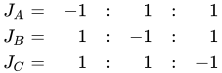
The excentral triangle of a reference triangle has vertices at the centers of the reference triangle's excircles. Its sides are on the external angle bisectors of the reference triangle (see figure at top of page). Trilinear coordinates for the vertices of the excentral triangle 
![{\begin{array}{rrcrcr}J_{A}=&-1&:&1&:&1\\[2pt]J_{B}=&1&:&-1&:&1\\[2pt]J_{C}=&1&:&1&:&-1\end{array}}](https://wikimedia.org/api/rest_v1/media/math/render/svg/b1dc5d82d234b7a9bf0f2d7a21014e769d3b59bc)

04Equations for four circles
Let 
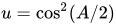
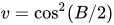
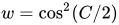
- Incircle:
![{\begin{aligned}u^{2}x^{2}+v^{2}y^{2}+w^{2}z^{2}-2vwyz-2wuzx-2uvxy&=0\\[4pt]{\textstyle \pm {\sqrt {x}}\cos {\tfrac {A}{2}}\pm {\sqrt {y{\vphantom {t}}}}\cos {\tfrac {B}{2}}\pm {\sqrt {z}}\cos {\tfrac {C}{2}}}&=0\end{aligned}}](https://wikimedia.org/api/rest_v1/media/math/render/svg/f2920e55669ed2026e6f5d95a18597f2ffe1a260)
![{\begin{aligned}u^{2}x^{2}+v^{2}y^{2}+w^{2}z^{2}-2vwyz+2wuzx+2uvxy&=0\\[4pt]{\textstyle \pm {\sqrt {-x}}\cos {\tfrac {A}{2}}\pm {\sqrt {y{\vphantom {t}}}}\cos {\tfrac {B}{2}}\pm {\sqrt {z}}\cos {\tfrac {C}{2}}}&=0\end{aligned}}](https://wikimedia.org/api/rest_v1/media/math/render/svg/2d03601071be1531bd0bbbe1ed9d44f8c8bba2b1)
![{\begin{aligned}u^{2}x^{2}+v^{2}y^{2}+w^{2}z^{2}+2vwyz-2wuzx+2uvxy&=0\\[4pt]{\textstyle \pm {\sqrt {x}}\cos {\tfrac {A}{2}}\pm {\sqrt {-y{\vphantom {t}}}}\cos {\tfrac {B}{2}}\pm {\sqrt {z}}\cos {\tfrac {C}{2}}}&=0\end{aligned}}](https://wikimedia.org/api/rest_v1/media/math/render/svg/5c44c4ca2ef6fee4eca0fa7e8a92d3e400f4266b)
![{\begin{aligned}u^{2}x^{2}+v^{2}y^{2}+w^{2}z^{2}+2vwyz+2wuzx-2uvxy&=0\\[4pt]{\textstyle \pm {\sqrt {x}}\cos {\tfrac {A}{2}}\pm {\sqrt {y{\vphantom {t}}}}\cos {\tfrac {B}{2}}\pm {\sqrt {-z}}\cos {\tfrac {C}{2}}}&=0\end{aligned}}](https://wikimedia.org/api/rest_v1/media/math/render/svg/e28aa20f8675ce4680149c36f52266ceca04eeff)
05Euler's theorem
Euler's theorem states that in a triangle:


For excircles the equation is similar:



06Generalization to other polygons
Some (but not all) quadrilaterals have an incircle. These are called tangential quadrilaterals. Among their many properties, perhaps the most important is that their two pairs of opposite sides have equal sums. This is called the Pitot theorem.
More generally, a polygon with any number of sides that has an inscribed circle (that is, one that is tangent to each side) is called a tangential polygon.

07Generalization to topological triangles
If topological triangles are considered, it is still possible to define an inscribed circle. It is no longer described as tangent to all sides, since the topological triangle might not be differentiable everywhere. Rather, it is defined as a circle whose center has the same minimal distance to each side. It has been proven that all topological triangles have an inscribed circle.
Sources and credits
This article is adapted from the Wikipedia article “Incircle and excircles”, written by its contributors and licensed under CC BY-SA 4.0. Fathomly has changed the layout, removed citation markers, navigation and maintenance notices, and adjusted punctuation. This adapted version is shared under the same license. For references, see the original article.
Images, from Wikimedia Commons:
- Incircle and Excircles.svg by Inductiveload, Public domain
- Visual proof triangle area is inradius times semiperimeter.svg by Cmglee, CC BY-SA 4.0
- Intouch Triangle and Gergonne Point.svg by Inductiveload, Public domain
- Extouch Triangle and Nagel Point.svg by Inductiveload, Public domain
- Circ9pnt3.svg by jtico, Public domain
- Visual proof tangential polygon area is inradius times semiperimeter.svg by cmglee, CC BY-SA 4.0
Fathomly is not affiliated with or endorsed by the Wikimedia Foundation. Spotted a problem? Tell us.

