Incenter
Center of the inscribed circle of a triangle

In geometry, the incenter of a triangle is a triangle center, a point defined for any triangle in a way that is independent of the triangle's placement or scale. The incenter may be equivalently defined as the point where the internal angle bisectors of the triangle cross, as the point equidistant from the triangle's sides, as the junction point of the medial axis and innermost point of the grassfire transform of the triangle, and as the center point of the inscribed circle of the triangle.
Together with the centroid, circumcenter, and orthocenter, it is one of the four triangle centers known to the ancient Greeks, and the only one of the four that does not in general lie on the Euler line. It is the first listed center, X(1), in Clark Kimberling's Encyclopedia of Triangle Centers, and the identity element of the multiplicative group of triangle centers.
For polygons with more than three sides, the incenter only exists for tangential polygons: those that have an incircle that is tangent to each side of the polygon. In this case the incenter is the center of this circle and is equally distant from all sides.
01Definition and construction
It is a theorem in Euclidean geometry that the three interior angle bisectors of a triangle meet in a single point. In Euclid's Elements, Proposition 4 of Book IV proves that this point is also the center of the inscribed circle of the triangle. The incircle itself may be constructed by dropping a perpendicular from the incenter to one of the sides of the triangle and drawing a circle with that segment as its radius.
The incenter lies at equal distances from the three line segments forming the sides of the triangle, and also from the three lines containing those segments. It is the only point equally distant from the line segments, but there are three more points equally distant from the lines, the excenters, which form the centers of the excircles of the given triangle. The incenter and excenters together form an orthocentric system.
The medial axis of a polygon is the set of points whose nearest neighbor on the polygon is not unique: these points are equidistant from two or more sides of the polygon. One method for computing medial axes is using the grassfire transform, in which one forms a continuous sequence of offset curves, each at some fixed distance from the polygon; the medial axis is traced out by the vertices of these curves. In the case of a triangle, the medial axis consists of three segments of the angle bisectors, connecting the vertices of the triangle to the incenter, which is the unique point on the innermost offset curve. The straight skeleton, defined in a similar way from a different type of offset curve, coincides with the medial axis for convex polygons and so also has its junction at the incenter.
02Proofs
Ratio proof
Let the bisection of 


And let 


Then we have to prove that 
In 

In 

Therefore, 

So 
Perpendicular proof
A line that is an angle bisector is equidistant from both of its lines when measuring by the perpendicular. At the point where two bisectors intersect, this point is perpendicularly equidistant from the final angle's forming lines (because they are the same distance from this angles opposite edge), and therefore lies on its angle bisector line.
03Relation to triangle sides and vertices
Trilinear coordinates
The trilinear coordinates for a point in the triangle give the ratio of distances to the triangle sides. Trilinear coordinates
for the incenter are given by

The collection of triangle centers may be given the structure of a group under coordinatewise multiplication of trilinear coordinates; in this group, the incenter forms the identity element.
Barycentric coordinates
The barycentric coordinates for a point in a triangle give weights such that the point is the weighted average of the triangle vertex positions.
Barycentric coordinates for the incenter are given by





Cartesian coordinates
The Cartesian coordinates of the incenter are a weighted average of the coordinates of the three vertices using the side lengths of the triangle relative to the perimeter, i.e., using the barycentric coordinates given above, normalized to sum to unity, as weights. (The weights are positive so the incenter lies inside the triangle as stated above.) If the three vertices are located at 



Distances to vertices
Denoting the incenter of triangle 





04Related constructions
Other centers
The distance from the incenter to the centroid is less than one third the length of the longest median of the triangle.
By Euler's theorem in geometry, the squared distance from the incenter 

The distance from the incenter to the center 
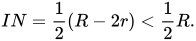
The squared distance from the incenter to the orthocenter 

Inequalities include:

The incenter is the Nagel point of the medial triangle (the triangle whose vertices are the midpoints of the sides) and therefore lies inside this triangle. Conversely the Nagel point of any triangle is the incenter of its anticomplementary triangle.
The incenter must lie in the interior of a disk whose diameter connects the centroid 
Euler line
The Euler line of a triangle is a line passing through its circumcenter, centroid, and orthocenter, among other points. The incenter generally does not lie on the Euler line; it is on the Euler line only for isosceles triangles, for which the Euler line coincides with the symmetry axis of the triangle and contains all triangle centers.
Denoting the distance from the incenter to the Euler line as 


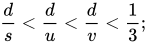


Area and perimeter splitters
Any line through a triangle that splits both the triangle's area and its perimeter in half goes through the triangle's incenter; every line through the incenter that splits the area in half also splits the perimeter in half. There are either one, two, or three of these lines for any given triangle.
Relative distances from an angle bisector
Let 


Sources and credits
This article is adapted from the Wikipedia article “Incenter”, written by its contributors and licensed under CC BY-SA 4.0. Fathomly has changed the layout, removed citation markers, navigation and maintenance notices, and adjusted punctuation. This adapted version is shared under the same license. For references, see the original article.
Images, from Wikimedia Commons:
- Incircle.svg by Lampak, Inductiveload, Public domain
Fathomly is not affiliated with or endorsed by the Wikimedia Foundation. Spotted a problem? Tell us.