Uniform norm
Function in mathematical analysis

In mathematical analysis, the uniform norm (or sup norm) assigns, to real- or complex-valued bounded functions defined on a set
, the non-negative number
This norm is also called the supremum norm, the Chebyshev norm, the infinity norm, or, when the supremum is in fact the maximum, the max norm. The name "uniform norm" derives from the fact that a sequence of functions converges to
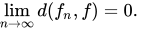
under the metric derived from the uniform norm if and only if
converges to
uniformly.
If is a continuous function on a closed and bounded interval, or more generally a compact set, then it is bounded and the supremum in the above definition is attained by the Weierstrass extreme value theorem, so we can replace the supremum by the maximum. In this case, the norm is also called the maximum norm.
In particular, if
is some vector such that
in finite dimensional coordinate space, it takes the form:
This is called the -norm.
01Definition
Uniform norms are defined, in general, for bounded functions valued in a normed space. Let be a set and let
be a normed space. On the set
of functions from
to
, there is an extended norm defined by
This is in general an extended norm since the function may not be bounded. Restricting this extended norm to the bounded functions (i.e., the functions with finite above extended norm) yields a (finite-valued) norm, called the uniform norm on
. Note that the definition of uniform norm does not rely on any additional structure on the set
, although in practice
is often at least a topological space.
The convergence on in the topology induced by the uniform extended norm is the uniform convergence, for sequences, and also for nets and filters on
.
We can define closed sets and closures of sets with respect to this metric topology; closed sets in the uniform norm are sometimes called uniformly closed and closures uniform closures. The uniform closure of a set of functions A is the space of all functions that can be approximated by a sequence of uniformly-converging functions on For instance, one restatement of the Stone-Weierstrass theorem is that the set of all continuous functions on
is the uniform closure of the set of polynomials on
For complex continuous functions over a compact space, this turns it into a C* algebra (cf. Gelfand representation).
02Weaker structures inducing the topology of uniform convergence
Uniform metric
The uniform metric between two bounded functions from a set
to a metric space
is defined by
The uniform metric is also called the Chebyshev metric, after Pafnuty Chebyshev, who was first to systematically study it. In this case, is bounded precisely if
is finite for some constant function
. If we allow unbounded functions, this formula does not yield a norm or metric in a strict sense, although the obtained so-called extended metric still allows one to define a topology on the function space in question; the convergence is then still the uniform convergence. In particular, a sequence
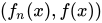
converges uniformly to a function
if and only if
If is a normed space, then it is a metric space in a natural way. The extended metric on
induced by the uniform extended norm is the same as the uniform extended metric
on
Uniformity of uniform convergence
Let be a set and let
be a uniform space. A sequence
of functions from
to
is said to converge uniformly to a function
if for each entourage
there is a natural number
such that,
belongs to
whenever
and
. Similarly for a net. This is a convergence in a topology on
. In fact, the sets
where runs through entourages of
form a fundamental system of entourages of a uniformity on
, called the uniformity of uniform convergence on
. The uniform convergence is precisely the convergence under its uniform topology.
If is a metric space, then it is by default equipped with the metric uniformity. The metric uniformity on
with respect to the uniform extended metric is then the uniformity of uniform convergence on
.
03Properties
The set of vectors whose infinity norm is a given constant, forms the surface of a hypercube with edge length
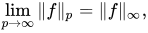
The reason for the subscript “” is that whenever
is continuous and
for some
, then
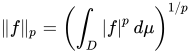
where
where
is the domain of
; the integral amounts to a sum if
is a discrete set (see p-norm).
Sources and credits
This article is adapted from the Wikipedia article “Uniform norm”, written by its contributors and licensed under CC BY-SA 4.0. Fathomly has changed the layout, removed citation markers, navigation and maintenance notices, and adjusted punctuation. This adapted version is shared under the same license. For references, see the original article.
Images, from Wikimedia Commons:
- Vector norm sup.svg by Unknown author, Public domain
Fathomly is not affiliated with or endorsed by the Wikimedia Foundation. Spotted a problem? Tell us.