Infinite-dimensional vector function
Whose values lie in an infinite-dimensional vector space
An infinite-dimensional vector function is a function whose values lie in an infinite-dimensional topological vector space, such as a Hilbert space or a Banach space.
Such functions are applied in most sciences including physics.
01Example
Set 






As a number of different topologies can be defined on the space 


Moreover, for any set 


02Integral and derivative
Most theorems on integration and differentiation of scalar functions can be generalized to vector-valued functions, often using essentially the same proofs. Perhaps the most important exception is that absolutely continuous functions need not equal the integrals of their (a.e.) derivatives (unless, for example,
A curve is a continuous map of the unit interval (or more generally, of a non−degenerate closed interval of real numbers) into a topological space. An arc is a curve that is also a topological embedding. A curve valued in a Hausdorff space is an arc if and only if it is injective.
Derivatives
If ![f:[0,1]\to X,](https://wikimedia.org/api/rest_v1/media/math/render/svg/0ea525f9daec257a2f4241e11a4818f8a0278f0c)
Functions with values in a Hilbert space
If 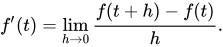


If 




Most of the above hold for other topological vector spaces
Crinkled arcs
If ![[a,b]](https://wikimedia.org/api/rest_v1/media/math/render/svg/9c4b788fc5c637e26ee98b45f89a5c08c85f7935)

![[c,d]](https://wikimedia.org/api/rest_v1/media/math/render/svg/d85b3b21d6d891d97f85e263d394e3c90287586f)


![{\begin{alignedat}{4}f:\;&&[0,1]&&\;\to \;&L^{2}(0,1)\\[0.3ex]&&t&&\;\mapsto \;&\mathbb {1} _{[0,t]}\\\end{alignedat}}](https://wikimedia.org/api/rest_v1/media/math/render/svg/2d38de7377653803ccdb1b67417db0deecae1d58)
![\mathbb {1} _{[0,\,t]}:(0,1)\to \{0,1\}](https://wikimedia.org/api/rest_v1/media/math/render/svg/c52b8941933c498a838087efc639cd035d322bcb)
![x\;\mapsto \;{\begin{cases}1&{\text{ if }}x\in [0,t]\\0&{\text{ otherwise }}\end{cases}}](https://wikimedia.org/api/rest_v1/media/math/render/svg/be3cb31724a85e7e3066eee1794e64476a28034a)

![f:[0,1]\to X](https://wikimedia.org/api/rest_v1/media/math/render/svg/ebe010ee7ddd6d0aeff0b2b0fc720cb06cdb7c99)


![f([0,1])](https://wikimedia.org/api/rest_v1/media/math/render/svg/f7bf65bbc0feaaa6e1bcb74946b3e133791fd819)
Proposition, Given any two normalized crinkled arcs in a Hilbert space, each is unitarily equivalent to a reparameterization of the other.
If ![h:[0,1]\to [0,1]](https://wikimedia.org/api/rest_v1/media/math/render/svg/ecccadfd27977e6ab1fe9717fb99a67d56ecb320)

![f:[0,1]\to X.](https://wikimedia.org/api/rest_v1/media/math/render/svg/a2ce91ea1acf8afefe223d58eaa5be3dee7c2ac1)


Measurability
The measurability of
Integrals
The most important integrals of 
Sources and credits
This article is adapted from the Wikipedia article “Infinite-dimensional vector function”, written by its contributors and licensed under CC BY-SA 4.0. Fathomly has changed the layout, removed citation markers, navigation and maintenance notices, and adjusted punctuation. This adapted version is shared under the same license. For references, see the original article.
Fathomly is not affiliated with or endorsed by the Wikimedia Foundation. Spotted a problem? Tell us.