Indirect utility function
Economic function
In economics, a consumer's indirect utility function


This function is called indirect because consumers usually think about their preferences in terms of what they consume rather than prices. A consumer's indirect utility 



The indirect utility function is:
- Continuous on Rn+ × R+ where n is the number of goods;
- Decreasing in prices;
- Strictly increasing in income;
- Homogenous with degree zero in prices and income; if prices and income are all multiplied by a given constant the same bundle of consumption represents a maximum, so optimal utility does not change;
- quasi-convex in (p,w).
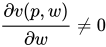
Moreover, Roy's identity states that if v(p,w) is differentiable at 

01Indirect utility and expenditure
The indirect utility function is the inverse of the expenditure function when the prices are kept constant. I.e, for every price vector 

02Example
Let's say the utility function is the Cobb-Douglas function 

where 

where 
Sources and credits
This article is adapted from the Wikipedia article “Indirect utility function”, written by its contributors and licensed under CC BY-SA 4.0. Fathomly has changed the layout, removed citation markers, navigation and maintenance notices, and adjusted punctuation. This adapted version is shared under the same license. For references, see the original article.
Fathomly is not affiliated with or endorsed by the Wikimedia Foundation. Spotted a problem? Tell us.