Lebesgue measure
Broadest definition of sizes in integer-dimensional spaces
In mathematics, Lebesgue measure is the standard way of assigning a notion of length to subsets of the real line, area to regions of the Euclidean plane, and volume to subsets of Euclidean space in dimensions three and higher. Often denoted 
Lebesgue measure extends ordinary geometric length (or volume) in a way that is compatible with countable unions and other kinds of countable limits of sets. For example, every countable subset of the real line has Lebesgue measure zero, being a countable union of points, which have no length, while many uncountable sets also have measure zero. The measure is not defined on every subset of the real line (or Euclidean space) under the usual axioms of set theory: the sets to which it applies are called Lebesgue-measurable.
One way to characterize the Lebesgue measure is to first define it on Borel sets, that is all sets that can be obtained by countably many operations of unions, set complement, and intersections, from the collection open intervals, so that it assigns the usual length to open intervals, and satisfies natural properties under taking limits of intervals. The Lebesgue measure can then be obtained by completing this Borel measure, by assigning zero measure to all subsets of Borel sets that already have zero measure.
Henri Lebesgue described this measure in the year 1901 which, a year after, was followed up by his description of the Lebesgue integral. Both were published as part of his dissertation Intégrale, Longueur, Aire in 1902.
01Elementary construction
Lebesgue measure may be introduced as an extension of ordinary length, area, and volume. On the real line, the starting point is that an interval such as ![[a,b]](https://wikimedia.org/api/rest_v1/media/math/render/svg/9c4b788fc5c637e26ee98b45f89a5c08c85f7935)


Lebesgue measure extends this assignment from intervals and boxes to a sufficiently large class of more complicated sets while preserving the basic rule of countable additivity: if 

The first domain for the measure is the collection of Borel sets. The Borel sets in 
There is a unique measure on the Borel subsets of
The Lebesgue-measurable sets are obtained by completing this Borel measure. That is, one adds to the Borel sets all subsets of Borel sets of measure zero, and all sets that differ from a Borel set by such a null set. Equivalently, a set 


For example, the Cantor set is a Borel set of Lebesgue measure zero. Every subset of the Cantor set is therefore Lebesgue-measurable, even though not every such subset is a Borel set. Thus the Lebesgue-measurable sets form a larger

02Carathéodory characterization
For any interval ![I=[a,b]](https://wikimedia.org/api/rest_v1/media/math/render/svg/6d6214bb3ce7f00e496c0706edd1464ac60b73b5)



The above definition can be generalised to higher dimensions as follows. For any rectangular cuboid 




A set 

Here, 
The Lebesgue measure of such a set is defined as its Lebesgue outer measure:
.
ZFC proves that non-measurable sets do exist; examples are the Vitali sets.
Intuition
The first part of the definition states that the subset 

That characterizes the Lebesgue outer measure. Whether this outer measure translates to the Lebesgue measure proper depends on an additional condition. This condition is tested by taking subsets 
03Examples
- Any closed interval
of real numbers is Lebesgue-measurable, and its Lebesgue measure is the length
. The open interval
has the same measure, since the difference between the two sets consists only of the end points
and
, which each have measure zero.
- Any Cartesian product of intervals
is Lebesgue-measurable, and its Lebesgue measure is
, the area of the corresponding rectangle.
- Moreover, every Borel set is Lebesgue-measurable. However, there are Lebesgue-measurable sets which are not Borel sets.
- Any countable set of real numbers has Lebesgue measure 0. In particular, the Lebesgue measure of the set of algebraic numbers is 0, even though the set is dense in
- The Cantor set and the set of Liouville numbers are examples of uncountable sets that have Lebesgue measure 0.
- If the axiom of determinacy holds then all sets of reals are Lebesgue-measurable. Determinacy is however not compatible with the axiom of choice.
- Vitali sets are examples of sets that are not measurable with respect to the Lebesgue measure. Their existence relies on the axiom of choice.
- Osgood curves are simple plane curves with positive Lebesgue measure (it can be obtained by small variation of the Peano curve construction). The dragon curve is another unusual example.
- Any line in
, has a zero Lebesgue measure. In general, every proper hyperplane has a zero Lebesgue measure in its ambient space.
- The volume of an n-ball can be calculated in terms of Euler's gamma function.
04Properties
The Lebesgue measure on
- If
is a cartesian product of intervals
, then A is Lebesgue-measurable and
- If
is equal to the sum (or infinite series) of the measures of the involved measurable sets.
- If
for every Lebesgue-measurable set
- If
are Lebesgue-measurable and
. (A consequence of 2.)
- Countable unions and intersections of Lebesgue-measurable sets are Lebesgue-measurable. (Not a consequence of 2 and 3, because a family of sets that is closed under complements and disjoint countable unions does not need to be closed under countable unions:
.)
- If
- If
- A Lebesgue-measurable set can be "squeezed" between a containing open set and a contained closed set. This property has been used as an alternative definition of Lebesgue measurability. More precisely,
is Lebesgue-measurable if and only if for every
there exist an open set
and a closed set
such that
and
.
- A Lebesgue-measurable set can be "squeezed" between a containing G δ set and a contained F σ. I.e., if
and an F σ
such that
and
.
- Lebesgue measure is both locally finite and inner regular, and so it is a Radon measure.
- Lebesgue measure is strictly positive on non-empty open sets, and so its support is the whole of
- If
(a null set), then every subset of
- If
, defined by
, is also Lebesgue-measurable and has the same measure as
- If
, then the dilation of
defined by
is also Lebesgue-measurable and has measure
- More generally, if
is a linear transformation and
is also Lebesgue-measurable and has the measure
.


All the above may be succinctly summarized as follows (although the last two assertions are non-trivially linked to the following):
The Lebesgue-measurable sets form a σ-algebra containing all products of intervals, and is the unique complete translation-invariant measure on that σ-algebra with
 ![\lambda ([0,1]\times [0,1]\times \cdots \times [0,1])=1.](https://wikimedia.org/api/rest_v1/media/math/render/svg/b84bbe364e54d0b444b22063633f15ae0b10cbcf)
The Lebesgue measure also has the property of being σ-finite.
05Null sets
A subset of 
If a subset of
In order to show that a given set 
06Construction of the Lebesgue measure
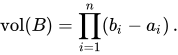
The modern construction of the Lebesgue measure is an application of Carathéodory's extension theorem. It proceeds as follows.
Fix 
![B=\prod _{i=1}^{n}[a_{i},b_{i}]\,,](https://wikimedia.org/api/rest_v1/media/math/render/svg/df761b205be454e38767d0e3e9ce223ce3f826c0)





The existence of sets that are not Lebesgue-measurable is a consequence of the set-theoretical axiom of choice, which is independent from many of the conventional systems of axioms for set theory. The Vitali theorem, which follows from the axiom, states that there exist subsets of
In 1970, Robert M. Solovay showed that the existence of sets that are not Lebesgue-measurable is not provable within the framework of Zermelo-Fraenkel set theory in the absence of the axiom of choice (see Solovay's model).
07Relation to other measures
The Borel measure agrees with the Lebesgue measure on those sets for which it is defined; however, there are many more Lebesgue-measurable sets than there are Borel measurable sets. While the Lebesgue measure on
The Haar measure can be defined on any locally compact group and is a generalization of the Lebesgue measure (
The Hausdorff measure is a generalization of the Lebesgue measure that is useful for measuring the subsets of 
It can be shown that there is no infinite-dimensional analogue of Lebesgue measure.
Sources and credits
This article is adapted from the Wikipedia article “Lebesgue measure”, written by its contributors and licensed under CC BY-SA 4.0. Fathomly has changed the layout, removed citation markers, navigation and maintenance notices, and adjusted punctuation. This adapted version is shared under the same license. For references, see the original article.
Images, from Wikimedia Commons:
- Translation of a set.svg by Stephan Kulla, CC BY 3.0
Fathomly is not affiliated with or endorsed by the Wikimedia Foundation. Spotted a problem? Tell us.


