Homotopy group
Algebraic construct classifying topological spaces
In mathematics, homotopy groups are used in algebraic topology to classify topological spaces. The first and simplest homotopy group is the fundamental group, denoted 
To define the nth homotopy group, the base-point-preserving maps from an n-dimensional sphere (with base point) into a given space (with base point) are collected into equivalence classes, called homotopy classes. Two mappings are homotopic if one can be continuously deformed into the other. These homotopy classes form a group, called the nth homotopy group, 
The notion of homotopy of paths was introduced by Camille Jordan.
01Introduction
In modern mathematics it is common to study a category by associating to every object of this category a simpler object that still retains sufficient information about the object of interest. Homotopy groups are such a way of associating groups to topological spaces.
That link between topology and groups lets mathematicians apply insights from group theory to topology. For example, if two topological objects have different homotopy groups, they cannot have the same topological structure, a fact that may be difficult to prove using only topological means. For example, the torus is different from the sphere: the torus has a "hole"; the sphere doesn't. However, since continuity (the basic notion of topology) only deals with the local structure, it can be difficult to formally define the obvious global difference. The homotopy groups, however, carry information about the global structure.
As for the example: the first homotopy group of the torus 


02Definition
In the n-sphere 


![g:[0,1]^{n}\to X](https://wikimedia.org/api/rest_v1/media/math/render/svg/660a78f158cadce2c445a3a603ce866b318d4bb6)
For 

![f,g:[0,1]\to X](https://wikimedia.org/api/rest_v1/media/math/render/svg/a920e0286bc83e6886f12d67baa3c379609686c1)
![(f*g)(t)={\begin{cases}f(2t)&t\in \left[0,{\tfrac {1}{2}}\right]\\g(2t-1)&t\in \left[{\tfrac {1}{2}},1\right]\end{cases}}](https://wikimedia.org/api/rest_v1/media/math/render/svg/c5d02d73b00d09151b61f59abba80bf6d4b2e879)
The idea of composition in the fundamental group is that of traveling the first path and the second in succession, or, equivalently, setting their two domains together. The concept of composition that we want for the nth homotopy group is the same, except that now the domains that we stick together are cubes, and we must glue them along a face. We therefore define the sum of maps ![f,g:[0,1]^{n}\to X](https://wikimedia.org/api/rest_v1/media/math/render/svg/42a801f149dc7c105ade1c13fd90ed52aeb1faf9)
![(f+g)(t_{1},t_{2},\ldots ,t_{n})={\begin{cases}f(2t_{1},t_{2},\ldots ,t_{n})&t_{1}\in \left[0,{\tfrac {1}{2}}\right]\\g(2t_{1}-1,t_{2},\ldots ,t_{n})&t_{1}\in \left[{\tfrac {1}{2}},1\right]\end{cases}}](https://wikimedia.org/api/rest_v1/media/math/render/svg/d292ba059108f5c62b4abe9edb1bb2776cb22cf8)
For the corresponding definition in terms of spheres, define the sum 


If 


It is tempting to try to simplify the definition of homotopy groups by omitting the base points, but this does not usually work for spaces that are not simply connected, even for path-connected spaces. The set of homotopy classes of maps from a sphere to a path connected space is not the homotopy group, but is essentially the set of orbits of the fundamental group on the homotopy group, and in general has no natural group structure.
A way out of these difficulties has been found by defining higher homotopy groupoids of filtered spaces and of n-cubes of spaces. These are related to relative homotopy groups and to n-adic homotopy groups respectively. A higher homotopy van Kampen theorem then enables one to derive some new information on homotopy groups and even on homotopy types. For more background and references, see "Higher dimensional group theory"[link removed] and the references below.
03Long exact sequence of a fibration
Let 


Here the maps involving 
Example: the Hopf fibration. Let B equal 


and the fact that 



In the case of a cover space, when the fiber is discrete, we have that 


When the fibration is the mapping fibre, or dually, the cofibration is the mapping cone, then the resulting exact (or dually, coexact) sequence is given by the Puppe sequence.
Homogeneous spaces and spheres
There are many realizations of spheres as homogeneous spaces, which provide good tools for computing homotopy groups of Lie groups, and the classification of principal bundles on spaces made out of spheres.
Special orthogonal group
There is a fibration





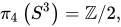

Since 




Application to sphere bundles
Milnor used the fact 


Complex projective space
There is a fibration



04Methods of calculation
Calculation of homotopy groups is in general much more difficult than some of the other homotopy invariants learned in algebraic topology. Unlike the Seifert-van Kampen theorem for the fundamental group and the excision theorem for singular homology and cohomology, there is no simple known way to calculate the homotopy groups of a space by breaking it up into smaller spaces. However, methods developed in the 1980s involving a van Kampen type theorem for higher homotopy groupoids have allowed new calculations on homotopy types and so on homotopy groups. See for a sample result the 2010 paper by Ellis and Mikhailov.
For some spaces, such as tori, all higher homotopy groups (that is, second and higher homotopy groups) are trivial. These are the so-called aspherical spaces. However, despite intense research in calculating the homotopy groups of spheres, even in two dimensions a complete list is not known. To calculate even the fourth homotopy group of
Certain homotopy groups of n-connected spaces can be calculated by comparison with homology groups via the Hurewicz theorem.
05A list of methods for calculating homotopy groups
- The long exact sequence of homotopy groups of a fibration.
- Hurewicz theorem, which has several versions.
- Blakers-Massey theorem, also known as excision for homotopy groups.
- Freudenthal suspension theorem, a corollary of excision for homotopy groups.

06Relative homotopy groups
There is also a useful generalization of homotopy groups, 


The construction is motivated by the observation that for an inclusion 





The elements of such a group are homotopy classes of based maps 

![F:D_{n}\times [0,1]\to X](https://wikimedia.org/api/rest_v1/media/math/render/svg/8095f5cecbe640b492ed73617ea7bb0427a67a19)
![[0,1]](https://wikimedia.org/api/rest_v1/media/math/render/svg/738f7d23bb2d9642bab520020873cccbef49768d)


These groups are abelian for 


There is also a long exact sequence of relative homotopy groups that can be obtained via the Puppe sequence:

07Related notions
The homotopy groups are fundamental to homotopy theory, which in turn stimulated the development of model categories. It is possible to define abstract homotopy groups for simplicial sets.
Homology groups are similar to homotopy groups in that they can represent "holes" in a topological space. However, homotopy groups are often very complex and hard to compute. In contrast, homology groups are commutative (as are the higher homotopy groups). Given a topological space 


Sources and credits
This article is adapted from the Wikipedia article “Homotopy group”, written by its contributors and licensed under CC BY-SA 4.0. Fathomly has changed the layout, removed citation markers, navigation and maintenance notices, and adjusted punctuation. This adapted version is shared under the same license. For references, see the original article.
Images, from Wikimedia Commons:
- Torus.png by Lucas Vieira, Public domain
- 2sphere 2.png by Jakob.scholbach (talk) (Uploads), CC BY-SA 3.0
- Homotopy group addition.svg by Archibald, Public domain
Fathomly is not affiliated with or endorsed by the Wikimedia Foundation. Spotted a problem? Tell us.
