Reference articles on history, science, culture and more
Encyclopedia

Homothety

Generalized scaling operation in geometry

Image credit is listed at the end of this article.

In mathematics, a homothety (or homothecy, or homogeneous dilation) is a transformation of an affine space determined by a point S called its center and a nonzero number k called its ratio, which sends point X to a point X by the rule, {\overrightarrow {SX'}}=k{\overrightarrow {SX}} for a fixed number k\neq 0. Using position vectors: \mathbf {x} '=\mathbf {s} +k(\mathbf {x} -\mathbf {s} ).

In case of S=O (Origin): \mathbf {x} '=k\mathbf {x} , which is a uniform scaling and shows the meaning of special choices for k:

  • for k=1 one gets the identity mapping;
  • for k=-1 one gets the reflection at the center;
  • for 1/k one gets the inverse mapping defined by k.

In Euclidean geometry homotheties are the similarities that fix a point and either preserve (if k>0) or reverse (if k<0) the direction of all vectors. Together with the translations, all homotheties of an affine (or Euclidean) space form a group, the group of dilations or homothety-translations. These are precisely the affine transformations with the property that the image of every line g is a line parallel to g.

In projective geometry, a homothetic transformation is a similarity transformation (i.e., fixes a given elliptic involution) that leaves the line at infinity pointwise invariant.

In Euclidean geometry, a homothety of ratio k multiplies distances between points by \vert k\vert, areas by k^{2} and volumes by {\vert k\vert }^{3}. Here k is the ratio of magnification or dilation factor or scale factor or similitude ratio. Such a transformation can be called an enlargement if the scale factor exceeds 1. The above-mentioned fixed point S is called homothetic center or center of similarity or center of similitude.

The term, coined by French mathematician Michel Chasles, is derived from two Greek elements: the prefix homo- (όμο 'similar'); and thesis (Θέσις) 'position'). It describes the relationship between two figures of the same shape and orientation. For example, two Russian dolls looking in the same direction can be considered homothetic.

Homotheties are used to scale the contents of computer screens; for example, smartphones, notebooks, and laptops.

01Properties

The following properties hold in any dimension.

Mapping lines, line segments and angles

A homothety has the following properties:

  • A line is mapped onto a parallel line. Hence: angles remain unchanged.
  • The ratio of two line segments is preserved.

Both properties show that a homothety is a similarity.

Derivation of the properties

In order to make calculations easy it is assumed that the center S is the origin: \mathbf {x} \to k\mathbf {x}. A line g with parametric representation \mathbf {x} =\mathbf {p} +t\mathbf {v} is mapped onto the point set g' with equation \mathbf {x} =k(\mathbf {p} +t\mathbf {v} )=k\mathbf {p} +tk\mathbf {v} , which is a line parallel to g.

The distance of two points P:\mathbf {p} ,\;Q:\mathbf {q} is |\mathbf {p} -\mathbf {q} | and {1}, the distance between their images. Hence, the ratio (quotient) of two line segments remains unchanged.

In case of S\neq O the calculation is analogous but a little extensive.

Consequences: A triangle is mapped on a similar one. The homothetic image of a circle is a circle. The image of an ellipse is a similar one. i.e. the ratio of the two axes is unchanged.

Graphical construction (using the intercept theorem)

If for a homothety with center S the image Q_{1} of a point P_{1} is given (see diagram) then the image Q_{2} of a second point P_{2}, which lies not on line SP_{1} can be constructed graphically using the intercept theorem: Q_{2} is the common point of two lines {\overline {P_{1}P_{2}}} and {\overline {SP_{2}}}. The image of a point collinear with P_{1},Q_{1} can be determined using P_{2},Q_{2}.

Graphical construction (using a pantograph)

Before computers became ubiquitous, scalings of drawings were done by using a pantograph, a tool similar to a compass.

  1. Take 4 rods and assemble a mobile parallelogram with vertices P_{0},Q_{0},H,P such that the two rods meeting at Q_{0} are prolonged at the other end as shown in the diagram. Choose the ratio k.
  2. On the prolonged rods mark the two points S,Q such that |SQ_{0}|=k|SP_{0}| and |QQ_{0}|=k|HQ_{0}|. This is the case if |SQ_{0}|={\tfrac {k}{k-1}}|P_{0}Q_{0}|. (Instead of k the location of the center S can be prescribed. In this case the ratio is k=|SQ_{0}|/|SP_{0}|.)
  3. Attach the mobile rods rotatable at point S.
  4. Vary the location of point P and mark at each time point Q.

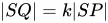
Because of |SQ_{0}|/|SP_{0}|=|Q_{0}Q|/|PP_{0}| (see diagram) one gets from the intercept theorem that the points S,P,Q are collinear (lie on a line) and equation |SQ|=k|SP| holds. That shows: the mapping P\to Q is a homothety with center S and ratio k.

Composition

Composition of two homotheties with the same center

The composition of two homotheties with the same center S is again a homothety with center S. The homotheties with center S form a group.

Composition of two homotheties with different centers

The composition of two homotheties with different centers S_{1},S_{2} and its ratios k_{1},k_{2} is:

Derivation

For the composition \sigma _{2}\sigma _{1} of the two homotheties \sigma _{1},\sigma _{2} with centers S_{1},S_{2} with {\begin{aligned}\sigma _{1}:\mathbf {x} &\to \mathbf {s} _{1}+k_{1}(\mathbf {x} -\mathbf {s} _{1}),\\\sigma _{2}:\mathbf {x} &\to \mathbf {s} _{2}+k_{2}(\mathbf {x} -\mathbf {s} _{2})\end{aligned}} one gets by calculation for the image of point X:\mathbf {x}: {\begin{aligned}(\sigma _{2}\sigma _{1})(\mathbf {x} )&=\mathbf {s} _{2}+k_{2}{\big (}\mathbf {s} _{1}+k_{1}(\mathbf {x} -\mathbf {s} _{1})-\mathbf {s} _{2}{\big )}\\&=(1-k_{1})k_{2}\mathbf {s} _{1}+(1-k_{2})\mathbf {s} _{2}+k_{1}k_{2}\mathbf {x} .\end{aligned}} Hence, the composition is

  • in case of k_{1}k_{2}=1, a translation in direction {\overrightarrow {S_{1}S_{2}}} by vector (1-k_{2})(\mathbf {s} _{2}-\mathbf {s} _{1});
  • in case of k_{1}k_{2}\neq 1 point S_{3}:\mathbf {s} _{3}={\frac {(1-k_{1})k_{2}\mathbf {s} _{1}+(1-k_{2})\mathbf {s} _{2}}{1-k_{1}k_{2}}}=\mathbf {s} _{1}+{\frac {1-k_{2}}{1-k_{1}k_{2}}}(\mathbf {s} _{2}-\mathbf {s} _{1}) is a fixpoint (is not moved), and the composition \sigma _{2}\sigma _{1}:\ \mathbf {x} \to \mathbf {s} _{3}+k_{1}k_{2}(\mathbf {x} -\mathbf {s} _{3}) is a homothety with center S_{3} and ratio k_{1}k_{2}. S_{3} lies on line {\overline {S_{1}S_{2}}}.

Composition of a homothety and a translation

The composition of a homothety and a translation is a homothety.

Derivation

The composition of the homothety \sigma :\mathbf {x} \to \mathbf {s} +k(\mathbf {x} -\mathbf {s} ),\;k\neq 1, and the translation \tau :\mathbf {x} \to \mathbf {x} +\mathbf {v} is {\begin{aligned}\tau \sigma :\mathbf {x} &\to \mathbf {s} +\mathbf {v} +k(\mathbf {x} -\mathbf {s} )\\&=\mathbf {s} +{\frac {\mathbf {v} }{1-k}}+k\left(\mathbf {x} -\left(\mathbf {s} +{\frac {\mathbf {v} }{1-k}}\right)\right)\end{aligned}} which is a homothety with center {\textstyle \mathbf {s} '=\mathbf {s} +{\frac {\mathbf {v} }{1-k}} and ratio k.

In homogeneous coordinates

The homothety \sigma :\mathbf {x} \to \mathbf {s} +k(\mathbf {x} -\mathbf {s} ) with center S=(u,v) can be written as the composition of a homothety with center O and a translation: \mathbf {x} \to k\mathbf {x} +(1-k)\mathbf {s} . Hence \sigma can be represented in homogeneous coordinates by the matrix: {\begin{pmatrix}k&0&(1-k)u\\0&k&(1-k)v\\0&0&1\end{pmatrix}}

A pure homothety linear transformation is also conformal because it is composed of translation and uniform scale.

Example with k &lt; 0. k = −1 corresponds to a point reflection at point S
Homothety of a pyramid
With intercept theorem
Pantograph
Pantograph
Geometrical background
Pantograph 3d rendering
The composition of two homotheties with centers S1, S2 and ratios k1 = 2, k2 = 0.3 mapping Pi → Qi → Ri is a homothety again with its center S3 on line S1 S2 with ratio k ⋅ l = 0.6.
Watch videos about HomothetyExplainers and documentaries on YouTube (opens in a new tab)

Sources and credits

This article is adapted from the Wikipedia article Homothety, written by its contributors and licensed under CC BY-SA 4.0. Fathomly has changed the layout, removed citation markers, navigation and maintenance notices, and adjusted punctuation. This adapted version is shared under the same license. For references, see the original article.

Images, from Wikimedia Commons:

Fathomly is not affiliated with or endorsed by the Wikimedia Foundation. Spotted a problem? Tell us.