Intercept theorem
Theorem concerning ratios of line segments
The intercept theorem, also known as Thales's theorem, basic proportionality theorem or side splitter theorem, is an important theorem in elementary geometry about the ratios of various line segments that are created if two rays with a common starting point are intercepted by a pair of parallels. It is equivalent to the theorem about ratios in similar triangles. It is traditionally attributed to Greek mathematician Thales. It was known to the ancient Babylonians and Egyptians, although its first known proof appears in Euclid's Elements. A mechanical device which produces geometrically-similar shapes is known as a pantograph.
01Formulation of the theorem
Suppose S is the common starting point of two rays, and two parallel lines are intersecting those two rays (see figure). Let A, B be the intersections of the first ray with the two parallels, such that B is further away from S than A, and similarly C, D are the intersections of the second ray with the two parallels such that D is further away from S than C. In this configuration the following statements hold:
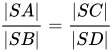
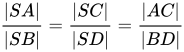
- The ratio of any two segments on the first ray equals the ratio of the according segments on the second ray:
,
,
- The ratio of the two segments on the same ray starting at S equals the ratio of the segments on the parallels:
- The converse of the first statement is true as well, i.e. if the two rays are intercepted by two arbitrary lines and


02Extensions and conclusions
The first two statements remain true if the two rays get replaced by two lines intersecting in 


The third statement (converse) however does not remain true for lines instead of rays. However, if one replaces ratio of lengths with signed ratios of directed line segments, all statements of the intercept theorem including the converse remain valid for lines as well. More precisely if 


If there are more than two rays starting at 

,
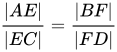
For the second equation the converse is true as well, that is if the 3 rays are intercepted by two lines and the ratios of the according line segments on each line are equal, then those 2 lines must be parallel.

03Related concepts
Homotheties
An homothety of positive ratio k with center O maps a point A to the point B located on the ray OA such that

The converse of the theorem implies that a homothety transforms a line in a parallel line.
Conversely, the direct statement of the intercept theorem implies that a geometric transformation is always a homothety of center O, if it fixes the lines passing through O and transforms every other line into a parallel line.
Similarity and similar triangles
The intercept theorem is closely related to similarity. It is equivalent to the concept of similar triangles, i.e. it can be used to prove the properties of similar triangles and similar triangles can be used to prove the intercept theorem. By matching identical angles you can always place two similar triangles in one another so that you get the configuration in which the intercept theorem applies; and conversely the intercept theorem configuration always contains two similar triangles.
Scalar multiplication in vector spaces
In a normed vector space, the axioms concerning the scalar multiplication (in particular 



04Applications
Algebraic formulation of compass and ruler constructions
There are three famous problems in elementary geometry which were posed by the Greeks in terms of compass and straightedge constructions:
It took more than 2000 years until all three of them were finally shown to be impossible. This was achieved in the 19th century with the help of algebraic methods, that had become available by then. In order to reformulate the three problems in algebraic terms using field extensions, one needs to match field operations with compass and straightedge constructions (see constructible number). In particular it is important to assure that for two given line segments, a new line segment can be constructed, such that its length equals the product of lengths of the other two. Similarly one needs to be able to construct, for a line segment of length 

|
Construction of a product |
Construction of an inverse |
Dividing a line segment in a given ratio
To divide an arbitrary line segment 


Measuring and survey
Height of the Cheops pyramid
According to some historical sources the Greek mathematician Thales applied the intercept theorem to determine the height of the Cheops' pyramid. The following description illustrates the use of the intercept theorem to compute the height of the pyramid. It does not, however, recount Thales' original work, which was lost.
Thales measured the length of the pyramid's base and the height of his pole. Then at the same time of the day he measured the length of the pyramid's shadow and the length of the pole's shadow. This yielded the following data:
- height of the pole (A): 1.63 m
- shadow of the pole (B): 2 m
- length of the pyramid base: 230 m
- shadow of the pyramid: 65 m
From this he computed

Knowing A, B and C he was now able to apply the intercept theorem to compute

Measuring the width of a river
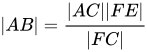
The intercept theorem can be used to determine a distance that cannot be measured directly, such as the width of a river or a lake, the height of tall buildings or similar. The graphic to the right illustrates measuring the width of a river. The segments 


Parallel lines in triangles and trapezoids
The intercept theorem can be used to prove that a certain construction yields parallel line (segment)s.
|
If the midpoints of two triangle sides are connected then the resulting line segment is parallel to the third triangle side (Midpoint theorem of triangles). |
If the midpoints of the two non-parallel sides of a trapezoid are connected, then the resulting line segment is parallel to the other two sides of the trapezoid. |


05Historical aspects
The theorem is traditionally attributed to the Greek mathematician Thales of Miletus, who may have used some form of the theorem to determine heights of pyramids in Egypt and to compute the distance of ship from the shore.

06Proof
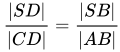
An elementary proof of the theorem uses triangles of equal area to derive the basic statements about the ratios (claim 1). The other claims then follow by applying the first claim and contradiction.
Claim 1
|
Notation: For a triangle the vertical bars ( Proof: Since
Plugging in the formula for triangle areas (
Canceling the common factors results in: (a) Now use (b) to replace Using (b) again this simplifies to:
(c) |
 ) denote its area and for a line segment its length.
 , the altitudes of
  and
and  are of equal length. As those triangles share the same baseline, their areas are identical. So we have
  . Now, we add the area of triangle
  to both sides of this equality. On the left-hand side, the union of
  , and on the right-hand side, the union of
  . Hence, we obtain
  as well. This yields
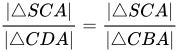 and
and 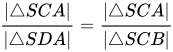
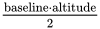 ) transforms that into
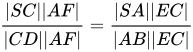 and
and 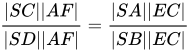
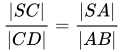 and (b)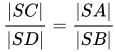
 and
and  in (a):
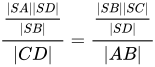

Claim 2
|
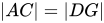
Draw an additional parallel to |
 through A. This parallel intersects
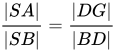
  in G. Then one has
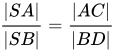
  and due to claim 1
  and therefore

Claim 3
|
Assume |
 and
and  in
in  . Since
  is true, we have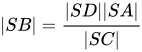
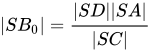 .
.  are on the same side of
  . This is a contradiction, so the assumption could not have been true, which means
Sources and credits
This article is adapted from the Wikipedia article “Intercept theorem”, written by its contributors and licensed under CC BY-SA 4.0. Fathomly has changed the layout, removed citation markers, navigation and maintenance notices, and adjusted punctuation. This adapted version is shared under the same license. For references, see the original article.
Images, from Wikimedia Commons:
- Intercept theorem a.svg by Kmhkmh, CC BY 4.0
- Strahlensatz gegenbeispiel umkehrung 2ter satz.svg by Kmhkmh, CC BY 4.0
- Intercept theorem4.svg by Kmhkmh, CC BY 4.0
- Intercept theorem3.svg by Kmhkmh, CC BY 4.0
- Intercept theorem- Triangles.svg by ZooFari, Public domain
- Dividing segment.svg by ZooFari, Public domain
- Thales Theorem 6.svg by Fred the Oyster, CC BY-SA 4.0
- Thales Theorem 7.svg by Fred the Oyster, CC BY-SA 4.0
Fathomly is not affiliated with or endorsed by the Wikimedia Foundation. Spotted a problem? Tell us.