Hann function
Mathematical function used in signal processing

The Hann function is named after the Austrian meteorologist Julius von Hann. It is a window function used to perform Hann smoothing or hanning. The function, with length 


For digital signal processing, the function is sampled symmetrically (with spacing 

![\left.{\begin{aligned}w[n]=L\cdot w_{0}\left({\tfrac {L}{N}}(n-N/2)\right)&={\tfrac {1}{2}}\left[1-\cos \left({\tfrac {2\pi n}{N}}\right)\right]\\&=\sin ^{2}\left({\tfrac {\pi n}{N}}\right)\end{aligned}}\right\},\quad 0\leq n\leq N,](https://wikimedia.org/api/rest_v1/media/math/render/svg/83b723018aa0923be6327c07fed4753f1ed7d033)
which is a sequence of 

01Fourier transform
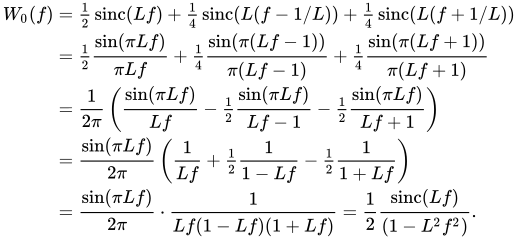
The Fourier transform of 

Using Euler's formula to expand the cosine term in 

which is a linear combination of modulated rectangular windows:

Transforming each term:

02Discrete transforms
The discrete-time Fourier transform (DTFT) of the
![{\begin{aligned}{\mathcal {F}}\{w[n]\}&\triangleq \sum _{n=0}^{N}w[n]\cdot e^{-i2\pi fn}\\&=e^{-i\pi fN}\left[{\tfrac {1}{2}}{\frac {\sin(\pi (N+1)f)}{\sin(\pi f)}}+{\tfrac {1}{4}}{\frac {\sin(\pi (N+1)(f-{\tfrac {1}{N}}))}{\sin(\pi (f-{\tfrac {1}{N}}))}}+{\tfrac {1}{4}}{\frac {\sin(\pi (N+1)(f+{\tfrac {1}{N}}))}{\sin(\pi (f+{\tfrac {1}{N}}))}}\right].\end{aligned}}](https://wikimedia.org/api/rest_v1/media/math/render/svg/833f432fd5ae9ae88eb7ef4247952f92c7aef4ae)
The truncated sequence ![\{w[n],\ 0\leq n\leq N-1\}](https://wikimedia.org/api/rest_v1/media/math/render/svg/bd1c0e1f3c303a9cac460a10ca4b6e00339befb1)
![{\mathcal {F}}\{w[n]\}=e^{-i\pi f(N-1)}\left[{\tfrac {1}{2}}{\frac {\sin(\pi Nf)}{\sin(\pi f)}}+{\tfrac {1}{4}}e^{-i\pi /N}{\frac {\sin(\pi N(f-{\tfrac {1}{N}}))}{\sin(\pi (f-{\tfrac {1}{N}}))}}+{\tfrac {1}{4}}e^{i\pi /N}{\frac {\sin(\pi N(f+{\tfrac {1}{N}}))}{\sin(\pi (f+{\tfrac {1}{N}}))}}\right].](https://wikimedia.org/api/rest_v1/media/math/render/svg/366f2cccda229534d868deeaa79031fef7368df7)
An N-length DFT of the window function samples the DTFT at frequencies 

03Name
The function is named in honor of von Hann, who used the three-term weighted average smoothing technique on meteorological data. However, the term Hanning function is also conventionally used, derived from the paper in which the term hanning a signal was used to mean applying the Hann window to it. It is distinct from the similarly-named Hamming function, named after Richard Hamming.
Sources and credits
This article is adapted from the Wikipedia article “Hann function”, written by its contributors and licensed under CC BY-SA 4.0. Fathomly has changed the layout, removed citation markers, navigation and maintenance notices, and adjusted punctuation. This adapted version is shared under the same license. For references, see the original article.
Images, from Wikimedia Commons:
- Window function and its Fourier transform – Hann (n = 0...N).svg by Olli Niemitalo, CC0
- DFT-even Hann window & spectral leakage.png by Bob K, CC0
Fathomly is not affiliated with or endorsed by the Wikimedia Foundation. Spotted a problem? Tell us.


