Hall algebra
In mathematics, the Hall algebra is an associative algebra with a basis corresponding to isomorphism classes of finite abelian p-groups. It was first discussed by Steinitz (1901) but forgotten until it was rediscovered by Philip Hall (1959), both of whom published no more than brief summaries of their work. The Hall polynomials are the structure constants of the Hall algebra. The Hall algebra plays an important role in the theory of Masaki Kashiwara and George Lusztig regarding canonical bases in quantum groups. Ringel (1990) generalized Hall algebras to more general categories, such as the category of representations of a quiver.
01Construction
A finite abelian p-group M is a direct sum of cyclic p-power components 



![g_{\mu ,\nu }^{\lambda }(q)\in \mathbb {Z} [q].\,](https://wikimedia.org/api/rest_v1/media/math/render/svg/0aa620098df8c1a631f503b93fe27a5365f18364)
Hall next constructs an associative ring 
![\mathbb {Z} [q]](https://wikimedia.org/api/rest_v1/media/math/render/svg/49df083527751a6c1b1eb2a4876db5115c0356db)

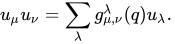
It turns out that H is a commutative ring, freely generated by the elements 

(where en is the nth elementary symmetric function) uniquely extends to a ring homomorphism and the images of the basis elements
Sources and credits
This article is adapted from the Wikipedia article “Hall algebra”, written by its contributors and licensed under CC BY-SA 4.0. Fathomly has changed the layout, removed citation markers, navigation and maintenance notices, and adjusted punctuation. This adapted version is shared under the same license. For references, see the original article.
Fathomly is not affiliated with or endorsed by the Wikimedia Foundation. Spotted a problem? Tell us.