Generalized normal distribution
Probability distribution
The generalized normal distribution (GND) or generalized Gaussian distribution (GGD) is either of two parametric families of continuous probability distributions on the real line. Both families add a shape parameter to the normal distribution. To distinguish the two families, they are referred to below as "symmetric" and "asymmetric"; however, this is not a standard nomenclature.
01Symmetric version
The symmetric generalized normal distribution, also known as the Subbotin distribution, exponential power distribution or the generalized error distribution, is a parametric family of symmetric distributions. It includes all normal and Laplace distributions, and as limiting cases it includes all continuous uniform distributions on bounded intervals of the real line.
This family includes the normal distribution when 


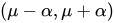
This family allows for tails that are either heavier than normal (when 


Parameter estimation
Parameter estimation via maximum likelihood and the method of moments has been studied. The estimates do not have a closed form and must be obtained numerically. Estimators that do not require numerical calculation have also been proposed.
The generalized normal log-likelihood function has infinitely many continuous derivates (i.e. it belongs to the class 


Maximum likelihood estimator
It is possible to fit the generalized normal distribution adopting an approximate maximum likelihood method. With 


where
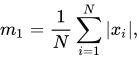
is the first statistical moment of the absolute values and 
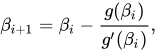
where

![{\begin{aligned}g'(\beta )={}&-{\frac {\psi (1/\beta )}{\beta ^{2}}}-{\frac {\psi '(1/\beta )}{\beta ^{3}}}+{\frac {1}{\beta ^{2}}}-{\frac {K_{\beta }}{S_{\beta }}}\\[6pt]&{}+{\frac {L_{\beta }^{2}}{S_{\beta }^{2}}}+{\frac {L_{\beta }}{\beta S_{\beta }}}-{\frac {\log \left({\frac {\beta }{N}}S_{\beta }\right)}{\beta ^{2}}},\end{aligned}}](https://wikimedia.org/api/rest_v1/media/math/render/svg/bc40f066e712087efe15a7ed51abd9ea12a77d27)


Given a value for
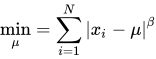
Finally 
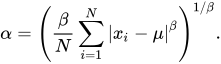
For 

Applications
The symmetric generalized normal distribution has been used in modeling when the concentration of values around the mean and the tail behavior are of particular interest. Other families of distributions can be used if the focus is on other deviations from normality. If the symmetry of the distribution is the main interest, the skew normal family or asymmetric version of the generalized normal family discussed below can be used. If the tail behavior is the main interest, the student t family can be used, which approximates the normal distribution as the degrees of freedom grows to infinity. The t distribution, unlike this generalized normal distribution, obtains heavier than normal tails without acquiring a cusp at the origin. It finds uses in plasma physics under the name of Langdon Distribution resulting from inverse bremsstrahlung.
In a linear regression problem modeled as 

Properties
Moments
Let 


![\operatorname {E} \left[X_{\beta }^{k}\right]={\begin{cases}0&{\text{if }}k{\text{ is odd,}}\\\alpha ^{k}\Gamma \left({\frac {k+1}{\beta }}\right){\Big /}\,\Gamma \left({\frac {1}{\beta }}\right)&{\text{if }}k{\text{ is even.}}\end{cases}}](https://wikimedia.org/api/rest_v1/media/math/render/svg/08b61932a558eb204bfd8310603a9bb4c3ca5ef2)
Connection to positive-definite functions
The probability density function of the symmetric generalized normal distribution is a positive-definite function for ![\beta \in (0,2]](https://wikimedia.org/api/rest_v1/media/math/render/svg/0da4e43d7bbe6cec9b435f914615dc3e71f2b5b9)
Infinite divisibility
The symmetric generalized Gaussian distribution is an infinitely divisible distribution if and only if ![\beta \in (0,1]\cup \{2\}](https://wikimedia.org/api/rest_v1/media/math/render/svg/60617d643b8dfeab3fa5c69b1affd3b5b591c189)
Generalizations
The multivariate generalized normal distribution, i.e. the product of 

02Asymmetric version
| Asymmetric generalized normal | |||
|---|---|---|---|
| Probability density function | |||
| Cumulative distribution function | |||
| Parameters |
 location (real) location (real) scale (positive, real) scale (positive, real) shape (real) shape (real) | ||
| Support |
   | ||
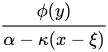 , where , where ![y={\begin{cases}-{\frac {1}{\kappa }}\log \left[1-{\frac {\kappa (x-\xi )}{\alpha }}\right]&{\text{if }}\kappa \neq 0\\{\frac {x-\xi }{\alpha }}&{\text{if }}\kappa =0\end{cases}}](https://wikimedia.org/api/rest_v1/media/math/render/svg/f27df77b4ee166d197260fc595f61dba5868d907)  is the standard normal pdf is the standard normal pdf | |||
| CDF |
 , where , where  is the standard normal CDF is the standard normal CDF | ||
| Mean |
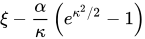 | ||
| Median |
| ||
| Variance |
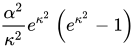 | ||
| Skewness |
 | ||
| Excess kurtosis |
 | ||
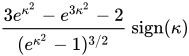
The asymmetric generalized normal distribution is a family of continuous probability distributions in which the shape parameter can be used to introduce asymmetry or skewness. When the shape parameter is zero, the normal distribution results. Positive values of the shape parameter yield left-skewed distributions bounded to the right, and negative values of the shape parameter yield right-skewed distributions bounded to the left. Only when the shape parameter is zero is the density function for this distribution positive over the whole real line: in this case the distribution is a normal distribution, otherwise the distributions are shifted and possibly reversed log-normal distributions.
Parameter estimation
Parameters can be estimated via maximum likelihood estimation or the method of moments. The parameter estimates do not have a closed form, so numerical calculations must be used to compute the estimates. Since the sample space (the set of real numbers where the density is non-zero) depends on the true value of the parameter, some standard results about the performance of parameter estimates will not automatically apply when working with this family.
Applications
The asymmetric generalized normal distribution can be used to model values that may be normally distributed, or that may be either right-skewed or left-skewed relative to the normal distribution. The skew normal distribution is another distribution that is useful for modeling deviations from normality due to skew. Other distributions used to model skewed data include the gamma, lognormal, and Weibull distributions, but these do not include the normal distributions as special cases.
03Kullback-Leibler divergence between two PDFs
Kullback-Leibler divergence (KLD) is a method using for compute the divergence or similarity between two probability density functions.
Let 


Sources and credits
This article is adapted from the Wikipedia article “Generalized normal distribution”, written by its contributors and licensed under CC BY-SA 4.0. Fathomly has changed the layout, removed citation markers, navigation and maintenance notices, and adjusted punctuation. This adapted version is shared under the same license. For references, see the original article.
Fathomly is not affiliated with or endorsed by the Wikimedia Foundation. Spotted a problem? Tell us.
