Reference articles on history, science, culture and more
Encyclopedia

Fractional programming

In mathematical optimization, fractional programming is a generalization of linear-fractional programming. The objective function in a fractional program is a ratio of two functions that are in general nonlinear. The ratio to be optimized often describes some kind of efficiency of a system.

01Definition

Let f,g,h_{j},j=1,\ldots ,m be real-valued functions defined on a set \mathbf {S} _{0}\subset \mathbb {R} ^{n}. Let \mathbf {S} =\{{\boldsymbol {x}}\in \mathbf {S} _{0}:h_{j}({\boldsymbol {x}})\leq 0,j=1,\ldots ,m\}. The nonlinear program

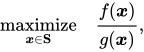
{\underset {{\boldsymbol {x}}\in \mathbf {S} }{\text{maximize}}}\quad {\frac {f({\boldsymbol {x}})}{g({\boldsymbol {x}})}},

where g({\boldsymbol {x}})>0 on \mathbf {S}, is called a fractional program.

02Concave fractional programs

A fractional program in which f is nonnegative and concave, g is positive and convex, and S is a convex set is called a concave fractional program. If g is affine, f does not have to be restricted in sign. The linear fractional program is a special case of a concave fractional program where all functions f,g,h_{j},j=1,\ldots ,m are affine.

Properties

The function q({\boldsymbol {x}})=f({\boldsymbol {x}})/g({\boldsymbol {x}}) is semistrictly quasiconcave on S. If f and g are differentiable, then q is pseudoconcave. In a linear fractional program, the objective function is pseudolinear.

Transformation to a concave program

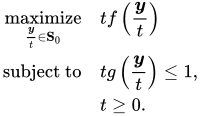
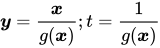
By the transformation {\boldsymbol {y}}={\frac {\boldsymbol {x}}{g({\boldsymbol {x}})}};t={\frac {1}{g({\boldsymbol {x}})}}, any concave fractional program can be transformed to the equivalent parameter-free concave program
{\begin{aligned}{\underset {{\frac {\boldsymbol {y}}{t}}\in \mathbf {S} _{0}}{\text{maximize}}}\quad &tf\left({\frac {\boldsymbol {y}}{t}}\right)\\{\text{subject to}}\quad &tg\left({\frac {\boldsymbol {y}}{t}}\right)\leq 1,\\&t\geq 0.\end{aligned}}

If g is affine, the first constraint is changed to tg({\frac {\boldsymbol {y}}{t}})=1 and the assumption that g is positive may be dropped. Also, it simplifies to g({\boldsymbol {y}})=1.

Duality

The Lagrangian dual of the equivalent concave program is
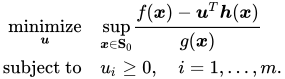
{\begin{aligned}{\underset {\boldsymbol {u}}{\text{minimize}}}\quad &{\underset {{\boldsymbol {x}}\in \mathbf {S} _{0}}{\operatorname {sup} }}{\frac {f({\boldsymbol {x}})-{\boldsymbol {u}}^{T}{\boldsymbol {h}}({\boldsymbol {x}})}{g({\boldsymbol {x}})}}\\{\text{subject to}}\quad &u_{i}\geq 0,\quad i=1,\dots ,m.\end{aligned}}
Watch videos about Fractional programmingExplainers and documentaries on YouTube (opens in a new tab)

Sources and credits

This article is adapted from the Wikipedia article Fractional programming, written by its contributors and licensed under CC BY-SA 4.0. Fathomly has changed the layout, removed citation markers, navigation and maintenance notices, and adjusted punctuation. This adapted version is shared under the same license. For references, see the original article.

Fathomly is not affiliated with or endorsed by the Wikimedia Foundation. Spotted a problem? Tell us.