Pseudoconvex function
Type of function
In convex analysis and the calculus of variations, both branches of mathematics, a pseudoconvex function is a function that behaves like a convex function with respect to finding its local minima, but need not actually be convex. Informally, a differentiable function is pseudoconvex if it is increasing in any direction where it has a positive directional derivative. The property must hold in all of the function domain, and not only for nearby points.
01Formal definition
Consider a differentiable function 


- for all

Equivalently:
- for all

Here 

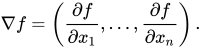
Note that the definition may also be stated in terms of the directional derivative of 


02Properties
Relation to other types of "convexity"
Every convex function is pseudoconvex, but the converse is not true. For example, the function 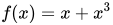

- convex
pseudoconvex
To see that 


In particular it should be true for 

Sufficient optimality condition
For any differentiable function, we have the Fermat's theorem necessary condition of optimality, which states that: if 

Pseudoconvexity is of great interest in the area of optimization, because the converse is also true for any pseudoconvex function. That is: if
This last result is also true for a convex function, but it is not true for a quasiconvex function. Consider for example the quasiconvex function:

This function is not pseudoconvex, but it is quasiconvex. Also, the point
Finally, note that a pseudoconvex function may not have any critical point. Take for example the pseudoconvex function: 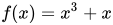


03Examples
An example of a function that is pseudoconvex, but not convex, is: 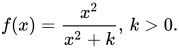

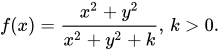
The previous example may be modified to obtain a function that is not convex, nor pseudoconvex, but is quasiconvex:

The figure shows this function for the case where 

04Generalization to nondifferentiable functions
The notion of pseudoconvexity can be generalized to nondifferentiable functions as follows. Given any function 

where u is any unit vector. The function is said to be pseudoconvex if it is increasing in any direction where the upper Dini derivative is positive. More precisely, this is characterized in terms of the subdifferential 
- For all
: if
is such that
, then
, for all
;
where ![[x,y]](https://wikimedia.org/api/rest_v1/media/math/render/svg/1b7bd6292c6023626c6358bfd3943a031b27d663)

05Related notions
A pseudoconcave function is a function whose negative is pseudoconvex. A pseudolinear function is a function that is both pseudoconvex and pseudoconcave. For example, linear-fractional programs have pseudolinear objective functions and linear-inequality constraints. These properties allow fractional-linear problems to be solved by a variant of the simplex algorithm (of George B. Dantzig).
Given a vector-valued function 

Sources and credits
This article is adapted from the Wikipedia article “Pseudoconvex function”, written by its contributors and licensed under CC BY-SA 4.0. Fathomly has changed the layout, removed citation markers, navigation and maintenance notices, and adjusted punctuation. This adapted version is shared under the same license. For references, see the original article.
Images, from Wikimedia Commons:
- Pseudoquasiconvex.png by Matiasvd, CC BY-SA 4.0
- Quasiconvex optimality.png by Matiasvd, CC BY-SA 4.0
- Pseudoconvex.png by Matiasvd, CC BY-SA 4.0
- Quasiconvex.png by Matiasvd, CC BY-SA 4.0
Fathomly is not affiliated with or endorsed by the Wikimedia Foundation. Spotted a problem? Tell us.

