Reference articles on history, science, culture and more
Encyclopedia

Filtration (probability theory)

Model of information available at a given point of a random process

In the theory of stochastic processes, a subdiscipline of probability theory, filtrations are totally ordered collections of subsets that are used to model the information that is available at a given point and therefore play an important role in the formalization of random (stochastic) processes.

01Definition

Let (\Omega ,{\mathcal {A}},P) be a probability space and let I be an index set with a total order \leq (often \mathbb {N}, \mathbb {R} ^{+}, or a subset of \mathbb {R} ^{+}).

For every i\in I let {\mathcal {F}}_{i} be a sub-σ-algebra of {\mathcal {A}}. Then

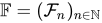
\mathbb {F} :=({\mathcal {F}}_{i})_{i\in I}

is called a filtration, if {\mathcal {F}}_{k}\subseteq {\mathcal {F}}_{\ell } for all k\leq \ell. So filtrations are families of σ-algebras that are ordered non-decreasingly. If \mathbb {F} is a filtration, then (\Omega ,{\mathcal {A}},\mathbb {F} ,P) is called a filtered probability space.

02Example

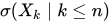
Let (X_{n})_{n\in \mathbb {N} } be a stochastic process on the probability space (\Omega ,{\mathcal {A}},P). Let \sigma (X_{k}\mid k\leq n) denote the σ-algebra generated by the random variables X_{1},X_{2},\dots ,X_{n}. Then

{\mathcal {F}}_{n}:=\sigma (X_{k}\mid k\leq n)

is a σ-algebra and \mathbb {F} =({\mathcal {F}}_{n})_{n\in \mathbb {N} } is a filtration.

\mathbb {F} really is a filtration, since by definition all {\mathcal {F}}_{n} are σ-algebras and

\sigma (X_{k}\mid k\leq n)\subseteq \sigma (X_{k}\mid k\leq n+1).

This is known as the natural filtration of {\mathcal {A}} with respect to (X_{n})_{n\in \mathbb {N} }.

03Types of filtrations

Right-continuous filtration

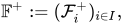
If \mathbb {F} =({\mathcal {F}}_{i})_{i\in I} is a filtration, then the corresponding right-continuous filtration is defined as

\mathbb {F} ^{+}:=({\mathcal {F}}_{i}^{+})_{i\in I},

with

{\mathcal {F}}_{i}^{+}:=\bigcap _{z>i}{\mathcal {F}}_{z}.

The filtration \mathbb {F} itself is called right-continuous if \mathbb {F} ^{+}=\mathbb {F}.

Complete filtration

Let (\Omega ,{\mathcal {F}},P) be a probability space, and let

{\mathcal {N}}_{P}:=\{A\subseteq \Omega \mid A\subseteq B{\text{ for some }}B\in {\mathcal {F}}{\text{ with }}P(B)=0\}

be the set of all sets that are contained within a P-null set.

A filtration \mathbb {F} =({\mathcal {F}}_{i})_{i\in I} is called a complete filtration, if every {\mathcal {F}}_{i} contains {\mathcal {N}}_{P}. This implies (\Omega ,{\mathcal {F}}_{i},P) is a complete measure space for every i\in I. (The converse is not necessarily true.)

Augmented filtration

A filtration is called an augmented filtration if it is complete and right continuous. For every filtration \mathbb {F} there exists a smallest augmented filtration {\tilde {\mathbb {F} }} refining \mathbb {F}.

If a filtration is an augmented filtration, it is said to satisfy the usual hypotheses or the usual conditions.

Watch videos about Filtration (probability theory)Explainers and documentaries on YouTube (opens in a new tab)

Sources and credits

This article is adapted from the Wikipedia article Filtration (probability theory), written by its contributors and licensed under CC BY-SA 4.0. Fathomly has changed the layout, removed citation markers, navigation and maintenance notices, and adjusted punctuation. This adapted version is shared under the same license. For references, see the original article.

Fathomly is not affiliated with or endorsed by the Wikimedia Foundation. Spotted a problem? Tell us.