Feller process
Stochastic process
In probability theory relating to stochastic processes, a Feller process is a particular kind of Markov process.
01Definitions
Let 


A Feller semigroup on 
for all
and
where
, i.e., each
is a positive operator;
for all
and
for all
, i.e., it is a semigroup;
for every
from
to
.
Warning: This terminology is not uniform across the literature. In particular, the assumption that 
A Feller transition function is a probability transition function associated with a Feller semigroup.
A Feller process is a Markov process with a Feller transition function.
02Generator
Feller processes (or transition semigroups) can be described by their infinitesimal generator. A function
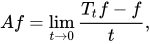
exists. The operator 

A characterization of operators that can occur as the infinitesimal generator of Feller processes is given by the Hille-Yosida theorem. This uses the resolvent of the Feller semigroup, defined below.
03Resolvent
The resolvent of a Feller process (or semigroup) is a collection of maps 
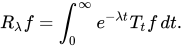
It can be shown that it satisfies the identity

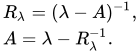
Furthermore, for any fixed 

04Examples
- Brownian motion and the Poisson process are examples of Feller processes (with Feller semigroups given by
). More generally, every Lévy process is a Feller process.
- Bessel processes are Feller processes.
- Solutions to stochastic differential equations with Lipschitz continuous coefficients are Feller processes.
- Every adapted right continuous Feller process on a filtered probability space
satisfies the strong Markov property with respect to the filtration
, i.e., for each
, conditioned on the event
, we have that for each
,
is independent of
given
.
Sources and credits
This article is adapted from the Wikipedia article “Feller process”, written by its contributors and licensed under CC BY-SA 4.0. Fathomly has changed the layout, removed citation markers, navigation and maintenance notices, and adjusted punctuation. This adapted version is shared under the same license. For references, see the original article.
Fathomly is not affiliated with or endorsed by the Wikimedia Foundation. Spotted a problem? Tell us.
