Equivalent rectangular bandwidth
Measure used in psychoacoustics
The equivalent rectangular bandwidth or ERB is a measure used in psychoacoustics, which gives an approximation to the bandwidths of the filters in human hearing, using the unrealistic but convenient simplification of modeling the filters as rectangular band-pass filters, or band-stop filters, like in tailor-made notched music training (TMNMT).
01Approximations
For moderate sound levels and young listeners, Moore & Glasberg (1983) suggest that the bandwidth of human auditory filters can be approximated by the polynomial equation:
 | Eq.1 |
where F is the center frequency of the filter, in kHz, and ERB( F ) is the bandwidth of the filter in Hz. The approximation is based on the results of a number of published simultaneous masking experiments and is valid from 100, 6500Hz.
Seven years later, Glasberg & Moore (1990) published another, simpler approximation:
 | Eq.2 |
where f is in kHz and ERB(f) is also in kHz. The approximation is applicable at moderate sound levels and for values of f between 100 and 10000Hz.
02ERB-rate scale
The ERB-rate scale, or ERB-number scale, can be defined as a function ERBS(f) which returns the number of equivalent rectangular bandwidths below the given frequency f. The units of the ERB-number scale are known ERBs, or as Cams, following a suggestion by Hartmann. The scale can be constructed by solving the following differential system of equations:
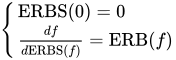
The solution for ERBS(f) is the integral of the reciprocal of ERB(f) with the constant of integration set in such a way that ERBS(0) = 0.
Using the second order polynomial approximation (Eq.1) for ERB(f) yields:

where f is in kHz. The VOICEBOX speech processing toolbox for MATLAB implements the conversion and its inverse as:


where f is in Hz.
Using the linear approximation (Eq.2) for ERB(f) yields:

where f is in kHz.
Sources and credits
This article is adapted from the Wikipedia article “Equivalent rectangular bandwidth”, written by its contributors and licensed under CC BY-SA 4.0. Fathomly has changed the layout, removed citation markers, navigation and maintenance notices, and adjusted punctuation. This adapted version is shared under the same license. For references, see the original article.
Fathomly is not affiliated with or endorsed by the Wikimedia Foundation. Spotted a problem? Tell us.
