Egorychev method
The Egorychev method is a collection of techniques introduced by Georgy Egorychev for finding identities among sums of binomial coefficients, Stirling numbers, Bernoulli numbers, Harmonic numbers, Catalan numbers and other combinatorial numbers. The method relies on two observations. First, many identities can be proved by extracting coefficients of generating functions. Second, many generating functions are convergent power series, and coefficient extraction can be done using the Cauchy residue theorem (usually this is done by integrating over a small circular contour enclosing the origin). The sought-for identity can now be found using manipulations of integrals. Some of these manipulations are not clear from the generating function perspective. For instance, the integrand is usually a rational function, and the sum of the residues of a rational function is zero, yielding a new expression for the original sum. The residue at infinity is particularly important in these considerations. Should a series appear during summation that is not finite the contours must be chosen such as to make the series converge. Some of the integrals employed by the Egorychev method are:
- First binomial coefficient integral

where

- Second binomial coefficient integral

where


where
![[[k\leq n]]={\underset {z}{\mathrm {res} }}\;{\frac {z^{k}}{z^{n+1}}}{\frac {1}{1-z}}={\frac {1}{2\pi i}}\int _{|z|=\rho }{\frac {z^{k}}{z^{n+1}}}{\frac {1}{1-z}}\;dz](https://wikimedia.org/api/rest_v1/media/math/render/svg/af4c988bb4e371b0a624433d0b91bacfbfbc2292)
where
![\left[{n \atop k}\right]={\frac {n!}{k!}}\;{\underset {z}{\mathrm {res} }}\;{\frac {1}{z^{n+1}}}\left(\log {\frac {1}{1-z}}\right)^{k}={\frac {n!}{k!}}{\frac {1}{2\pi i}}\int _{|z|=\rho }{\frac {1}{z^{n+1}}}\left(\log {\frac {1}{1-z}}\right)^{k}\;dz](https://wikimedia.org/api/rest_v1/media/math/render/svg/f50f5166d4a3d2a09ecc91705e7dc3042d489c73)
where

where

01Example I
Suppose we seek to evaluate

which is claimed to be :
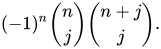
Introduce :

and :
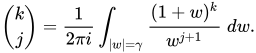
This yields for the sum :
![{\begin{aligned}&{\frac {1}{2\pi i}}\int _{|z|=\varepsilon }{\frac {(1+z)^{n}}{z}}{\frac {1}{2\pi i}}\int _{|w|=\gamma }{\frac {1}{w^{j+1}}}\sum _{k=0}^{n}(-1)^{k}{n \choose k}{\frac {(1+z)^{k}(1+w)^{k}}{z^{k}}}\;dw\;dz\\[6pt]={}&{\frac {1}{2\pi i}}\int _{|z|=\varepsilon }{\frac {(1+z)^{n}}{z}}{\frac {1}{2\pi i}}\int _{|w|=\gamma }{\frac {1}{w^{j+1}}}\left(1-{\frac {(1+w)(1+z)}{z}}\right)^{n}\;dw\;dz\\[6pt]={}&{\frac {1}{2\pi i}}\int _{|z|=\varepsilon }{\frac {(1+z)^{n}}{z^{n+1}}}{\frac {1}{2\pi i}}\int _{|w|=\gamma }{\frac {1}{w^{j+1}}}(-1-w-wz)^{n}\;dw\;dz\\[6pt]={}&{\frac {(-1)^{n}}{2\pi i}}\int _{|z|=\varepsilon }{\frac {(1+z)^{n}}{z^{n+1}}}{\frac {1}{2\pi i}}\int _{|w|=\gamma }{\frac {1}{w^{j+1}}}(1+w+wz)^{n}\;dw\;dz.\end{aligned}}](https://wikimedia.org/api/rest_v1/media/math/render/svg/af7a0b3e628c66d6880088bf9480701016d9cc7e)
This is

Extracting the residue at 
![{\begin{aligned}&{\frac {(-1)^{n}}{2\pi i}}\int _{|z|=\varepsilon }{\frac {(1+z)^{n}}{z^{n+1}}}{n \choose j}(1+z)^{j}\;dz\\[6pt]={}&{n \choose j}{\frac {(-1)^{n}}{2\pi i}}\int _{|z|=\varepsilon }{\frac {(1+z)^{n+j}}{z^{n+1}}}\;dz\\[6pt]={}&(-1)^{n}{n \choose j}{n+j \choose n}\end{aligned}}](https://wikimedia.org/api/rest_v1/media/math/render/svg/73160d71da4c8dd07aa85b343727ab06d27b877b)
thus proving the claim. There are no convergence issues here as the
sums involved are finite and with 


02Example II
Suppose we seek to evaluate
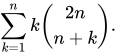
Introduce

Observe that this is zero when 
![{\begin{aligned}&{\frac {1}{2\pi i}}\int _{|z|=\varepsilon }{\frac {1}{z^{n+1}}}{\frac {1}{(1-z)^{n+1}}}\sum _{k\geq 1}k{\frac {z^{k}}{(1-z)^{k}}}\;dz\\[6pt]={}&{\frac {1}{2\pi i}}\int _{|z|=\varepsilon }{\frac {1}{z^{n+1}}}{\frac {1}{(1-z)^{n+1}}}{\frac {z/(1-z)}{(1-z/(1-z))^{2}}}\;dz\\[6pt]={}&{\frac {1}{2\pi i}}\int _{|z|=\varepsilon }{\frac {1}{z^{n}}}{\frac {1}{(1-z)^{n}}}{\frac {1}{(1-2z)^{2}}}\;dz.\end{aligned}}](https://wikimedia.org/api/rest_v1/media/math/render/svg/841229c38319f357d7d8113c05d96486eabd5af6)
Now put 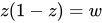



and furthermore

to get for the integral

This evaluates by inspection to (use the Newton binomial)
![{\begin{aligned}&4^{n-1}{n-1+1/2 \choose n-1}=4^{n-1}{n-1/2 \choose n-1}={\frac {4^{n-1}}{(n-1)!}}\prod _{q=0}^{n-2}(n-1/2-q)\\={}&{\frac {2^{n-1}}{(n-1)!}}\prod _{q=0}^{n-2}(2n-2q-1)={\frac {2^{n-1}}{(n-1)!}}{\frac {(2n-1)!}{2^{n-1}(n-1)!}}\\[6pt]={}&{\frac {n^{2}}{2n}}{2n \choose n}={\frac {1}{2}}n{2n \choose n}.\end{aligned}}](https://wikimedia.org/api/rest_v1/media/math/render/svg/7831d1aaeef12fb765ae5d5c5af0c68fe86f14bd)
Here the mapping from 


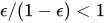


This example also yields to simpler methods but was included here to demonstrate the effect of substituting into the variable of integration.
Computation using formal power series
We may use the change of variables rule 1.8 (5) from the Egorychev text
(page 16) on the integral (recall that by the convergence requirement
the poles at 



with 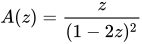
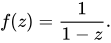

![{\underset {w}{\mathrm {res} }}{\frac {1}{w^{n+1}}}\left.\left[{\frac {A(z)}{f(z)h'(z)}}\right]\right|_{z=g(w).}](https://wikimedia.org/api/rest_v1/media/math/render/svg/94e76ce0f0b04a2dde6ed256f9c36df84a5e7413)
with 

This becomes
![{\underset {w}{\mathrm {res} }}{\frac {1}{w^{n+1}}}\left.\left[{\frac {z/(1-2z)^{2}}{(1-2z)/(1-z)}}\right]\right|_{z=g(w)}](https://wikimedia.org/api/rest_v1/media/math/render/svg/b46cf3f78c93573c5d7bba275ed3404448e8520b)
or alternatively
![{\underset {w}{\mathrm {res} }}{\frac {1}{w^{n+1}}}\left.\left[{\frac {z(1-z)}{(1-2z)^{3}}}\right]\right|_{z=g(w)}={\underset {w}{\mathrm {res} }}{\frac {1}{w^{n}}}\left.\left[{\frac {1}{(1-2z)^{3}}}\right]\right|_{z=g(w).}](https://wikimedia.org/api/rest_v1/media/math/render/svg/ba26e00532c75f79704b3df98a27d882a315f227)
Observe that 
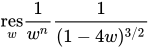
and the rest of the computation continues as before.
Sources and credits
This article is adapted from the Wikipedia article “Egorychev method”, written by its contributors and licensed under CC BY-SA 4.0. Fathomly has changed the layout, removed citation markers, navigation and maintenance notices, and adjusted punctuation. This adapted version is shared under the same license. For references, see the original article.
Fathomly is not affiliated with or endorsed by the Wikimedia Foundation. Spotted a problem? Tell us.