Dualizing sheaf
Concept from algebraic geometry
In algebraic geometry, the dualizing sheaf on a proper scheme X of dimension n over a field k is a coherent sheaf 

that induces a natural isomorphism of vector spaces

for each coherent sheaf F on X (the superscript * refers to a dual vector space). The linear functional 
A pair 

For a normal projective variety X, the dualizing sheaf exists and it is in fact the canonical sheaf: 

There is the following variant of Serre's duality theorem: for a projective scheme X of pure dimension n and a Cohen-Macaulay sheaf F on X such that 
.
In particular, if X itself is a Cohen-Macaulay scheme, then the above duality holds for any locally free sheaf.
01Relative dualizing sheaf
Given a proper finitely presented morphism of schemes 


,
which is functorial in
Example:
If 

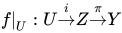



where 


02Examples
Dualizing sheaf of a nodal curve
For a smooth curve C, its dualizing sheaf 

For a nodal curve C with a node p, we may consider the normalization 


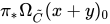
This is used in the construction of the Hodge bundle on the compactified moduli space of curves: it allows us to extend the relative canonical sheaf over the boundary which parametrizes nodal curves. The Hodge bundle is then defined as the direct image of a relative dualizing sheaf.
Dualizing sheaf of projective schemes
As mentioned above, the dualizing sheaf exists for all projective schemes. For X a closed subscheme of Pn of codimension r, its dualizing sheaf can be given as 
Sources and credits
This article is adapted from the Wikipedia article “Dualizing sheaf”, written by its contributors and licensed under CC BY-SA 4.0. Fathomly has changed the layout, removed citation markers, navigation and maintenance notices, and adjusted punctuation. This adapted version is shared under the same license. For references, see the original article.
Fathomly is not affiliated with or endorsed by the Wikimedia Foundation. Spotted a problem? Tell us.