Distribution function (physics)
Function of seven variables
In molecular kinetic theory in physics, a system's distribution function is a function of seven variables, 
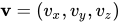


01Formula
The usual normalization of the distribution function is

A distribution function may be specialised with respect to a particular set of dimensions. E.g. take the quantum mechanical six-dimensional phase space, 

Particle distribution functions are often used in plasma physics to describe wave-particle interactions and velocity-space instabilities. Distribution functions are also used in fluid mechanics, statistical mechanics and nuclear physics.
02Maxwellian distribution
The basic distribution function uses the Boltzmann constant 

![{\begin{aligned}f&=n\left({\frac {m}{2\pi kT}}\right)^{3/2}\exp \left(-{\frac {mv^{2}}{2kT}}\right)\\[2pt]&=n\left({\frac {m}{2\pi kT}}\right)^{3/2}\exp \left(-{\frac {m(v_{x}^{2}+v_{y}^{2}+v_{z}^{2})}{2kT}}\right).\end{aligned}}](https://wikimedia.org/api/rest_v1/media/math/render/svg/4b0e44d8ada8a7b24ea3bc7ff9d397eb619a896f)
Related distribution functions may allow bulk fluid flow, in which case the velocity origin is shifted, so that the exponent's numerator is 

Plasma theories such as magnetohydrodynamics may assume the particles to be in thermodynamic equilibrium. In this case, the distribution function is Maxwellian. This distribution function allows fluid flow and different temperatures in the directions parallel to, and perpendicular to, the local magnetic field. More complex distribution functions may also be used, since plasmas are rarely in thermal equilibrium.
The mathematical analogue of a distribution is a measure; the time evolution of a measure on a phase space is the topic of study in dynamical systems.
Sources and credits
This article is adapted from the Wikipedia article “Distribution function (physics)”, written by its contributors and licensed under CC BY-SA 4.0. Fathomly has changed the layout, removed citation markers, navigation and maintenance notices, and adjusted punctuation. This adapted version is shared under the same license. For references, see the original article.
Fathomly is not affiliated with or endorsed by the Wikimedia Foundation. Spotted a problem? Tell us.