Dirichlet function
Indicator function of rational numbers
In mathematics, the Dirichlet function is the indicator function 


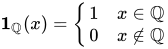
It is named after the mathematician Peter Gustav Lejeune Dirichlet. It is an example of a pathological function which provides counterexamples to many situations.
01Topological properties
- The Dirichlet function is nowhere continuous. We can prove this by reference to the definition of a continuous function to show that it violates the continuity properties at both rational and irrational arguments:
Proof
- If y is rational, then f(y) = 1. To show the function is not continuous at y, we need to find an ε such that no matter how small we choose δ, there will be points z within δ of y such that f(z) is not within ε of f(y) = 1. In fact, 1⁄2 is such an ε. Because the irrational numbers are dense in the reals, no matter what δ we choose we can always find an irrational z within δ of y, and f(z) = 0 is at least 1⁄2 away from 1.
- If y is irrational, then f(y) = 0. Again, we can take ε = 1⁄2, and this time, because the rational numbers are dense in the reals, we can pick z to be a rational number as close to y as is required. Again, f(z) = 1 is more than 1⁄2 away from f(y) = 0.
- The Dirichlet function can be constructed as the double pointwise limit of a sequence of continuous functions, as follows:
for integer j and k. This shows that the Dirichlet function is a Baire class 2 function. It cannot be a Baire class 1 function because a Baire class 1 function can only be discontinuous on a meagre set.
02Periodicity
For any real number x and any positive rational number T, 
03Integration properties
- The Dirichlet function is not Riemann-integrable on any segment of
- The Dirichlet function has both an upper Darboux integral (namely,
) and a lower Darboux integral (0) over any bounded interval
, but they are not equal if
, so the Dirichlet function is not Darboux-integrable (and therefore not Riemann-integrable) over any nondegenerate interval.
- The Dirichlet function provides a counterexample showing that the monotone convergence theorem is not true in the context of the Riemann integral.
Proof
Using an enumeration of the rational numbers between 0 and 1, we define the function fn (for all nonnegative integer n) as the indicator function of the set of the first n terms of this sequence of rational numbers. The increasing sequence of functions fn (which are nonnegative, Riemann-integrable with a vanishing integral) pointwise converges to the Dirichlet function which is not Riemann-integrable.
- The Dirichlet function is Lebesgue-integrable on
Sources and credits
This article is adapted from the Wikipedia article “Dirichlet function”, written by its contributors and licensed under CC BY-SA 4.0. Fathomly has changed the layout, removed citation markers, navigation and maintenance notices, and adjusted punctuation. This adapted version is shared under the same license. For references, see the original article.
Fathomly is not affiliated with or endorsed by the Wikimedia Foundation. Spotted a problem? Tell us.
