Reference articles on history, science, culture and more
Encyclopedia

Nowhere continuous function

Function which is not continuous at any point of its domain

In mathematics, a nowhere continuous function, also called an everywhere discontinuous function, is a function that is not continuous at any point of its domain. If f is a function from real numbers to real numbers, then f is nowhere continuous if for each point x there is some \varepsilon >0 such that for every \delta >0, we can find a point y such that |x-y|<\delta and |f(x)-f(y)|\geq \varepsilon. Therefore, no matter how close it gets to any fixed point, there are even closer points at which the function takes not-nearby values.

More general definitions of this kind of function can be obtained, by replacing the absolute value by the distance function in a metric space, or by using the definition of continuity in a topological space.

01Examples

Dirichlet function

One example of such a function is the indicator function of the rational numbers, also known as the Dirichlet function. This function is denoted as \mathbf {1} _{\mathbb {Q} } and has domain and codomain both equal to the real numbers. By definition, \mathbf {1} _{\mathbb {Q} }(x) is equal to 1 if x is a rational number and it is 0 otherwise.

More generally, if E is any subset of a topological space X such that both E and the complement of E are dense in X, then the real-valued function which takes the value 1 on E and 0 on the complement of E will be nowhere continuous. Functions of this type were originally investigated by Peter Gustav Lejeune Dirichlet.

Non-trivial additive functions

A function f:\mathbb {R} \to \mathbb {R} is called an additive function if it satisfies Cauchy's functional equation: f(x+y)=f(x)+f(y)\quad {\text{ for all }}x,y\in \mathbb {R} . For example, every map of form x\mapsto cx, where c\in \mathbb {R} is some constant, is additive (in fact, it is linear and continuous). Furthermore, every linear map L:\mathbb {R} \to \mathbb {R} is of this form (by taking c:=L(1)).

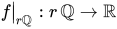
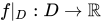
Although every linear map is additive, not all additive maps are linear. An additive map f:\mathbb {R} \to \mathbb {R} is linear if and only if there exists a point at which it is continuous, in which case it is continuous everywhere. Consequently, every non-linear additive function \mathbb {R} \to \mathbb {R} is discontinuous at every point of its domain. Nevertheless, the restriction of any additive function f:\mathbb {R} \to \mathbb {R} to any real scalar multiple of the rational numbers \mathbb {Q} is continuous; explicitly, this means that for every real r\in \mathbb {R} , the restriction f{\big \vert }_{r\mathbb {Q} }:r\,\mathbb {Q} \to \mathbb {R} to the set r\,\mathbb {Q} :=\{rq:q\in \mathbb {Q} \} is a continuous function. Thus if f:\mathbb {R} \to \mathbb {R} is a non-linear additive function then for every point x\in \mathbb {R} , f is discontinuous at x but x is also contained in some dense subset D\subseteq \mathbb {R} on which f's restriction f\vert _{D}:D\to \mathbb {R} is continuous (specifically, take D:=x\,\mathbb {Q} if x\neq 0, and take D:=\mathbb {Q} if x=0).

Discontinuous linear maps

A linear map between two topological vector spaces, such as normed spaces for example, is continuous (everywhere) if and only if there exists a point at which it is continuous, in which case it is even uniformly continuous. Consequently, every linear map is either continuous everywhere or else continuous nowhere. Every linear functional is a linear map and on every infinite-dimensional normed space, there exists some discontinuous linear functional.

Other functions

Conway's base 13 function is discontinuous at every point.

02Hyperreal characterisation

A real function f is nowhere continuous if its natural hyperreal extension has the property that every x is infinitely close to a y such that the difference f(x)-f(y) is appreciable (that is, not infinitesimal).

Watch videos about Nowhere continuous functionExplainers and documentaries on YouTube (opens in a new tab)

Sources and credits

This article is adapted from the Wikipedia article Nowhere continuous function, written by its contributors and licensed under CC BY-SA 4.0. Fathomly has changed the layout, removed citation markers, navigation and maintenance notices, and adjusted punctuation. This adapted version is shared under the same license. For references, see the original article.

Fathomly is not affiliated with or endorsed by the Wikimedia Foundation. Spotted a problem? Tell us.