Differential coding
Technique in digital communications
In digital communications, differential coding is a technique used to provide unambiguous signal reception when using some types of modulation. It makes transmissible data dependent on both the current and previous signal (or symbol) states.
The common types of modulation that may be used with differential coding include phase-shift keying and quadrature amplitude modulation.
01Purposes of differential coding
When data is transmitted over balanced lines, it is easy to accidentally invert polarity in the cable between the transmitter and the receiver.
Similarly for BPSK. To demodulate BPSK, one needs to make a local oscillator synchronous with the remote one. This is accomplished by a carrier recovery circuit. However, the integer part of the recovered carrier is ambiguous. There are n valid but not equivalent phase shifts between the two oscillators. For BPSK, n = 2; the symbols appear inverted or not.
Differential encoding prevents inversion of the signal and symbols, respectively, from affecting the data.
Assuming that 

 | 1 |
where 
 | 2 |
That is, 
There are several different line codes designed to be polarity insensitive - whether the data stream is inverted or not, the decoded data will always be correct.
The line codes with this property include differential Manchester encoding, bipolar encoding, NRZI, biphase mark code, coded mark inversion, and MLT-3 encoding.

02Conventional differential coding
A method illustrated above can deal with a data stream inversion (it is called 180° ambiguity). Sometimes it is enough (e.g. if BPSK is used or if other ambiguities are detected by other circuits, such as a Viterbi decoder or a frame synchronizer) and sometimes it isn't.
Generally speaking, a differential coding applies to symbols (these are not necessary the same symbols as used in the modulator). To resolve 180° ambiguity only, bits are used as these symbols. When dealing with 90° ambiguity, pairs of bits are used, and triplets of bits are used to resolve 45° ambiguity (e.g. in 8PSK).
A differential encoder provides the (1) operation, a differential decoder - the (2) operation.
Both differential encoder and differential decoder are discrete linear time-invariant systems. The former is recursive and IIR, the latter is non-recursive and thus FIR. They can be analyzed as digital filters.
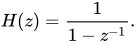
A differential encoder is similar to an analog integrator. It has an impulse response

and a transfer function
A differential decoder is thus similar to an analog differentiator, its impulse response being

and its transfer function

Note that in binary (modulo-2) arithmetic, addition and subtraction (and positive and negative numbers) are equivalent.
03Generalized differential coding
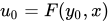
Using the relation 



04Applications
Differential coding is widely used in satellite and radio relay communications together with PSK and QAM modulations.

05Drawbacks
Differential coding has one significant drawback: it leads to error multiplication. That is, if one symbol such as 


06Other techniques to resolve a phase ambiguity
07External links and references
Sources and credits
This article is adapted from the Wikipedia article “Differential coding”, written by its contributors and licensed under CC BY-SA 4.0. Fathomly has changed the layout, removed citation markers, navigation and maintenance notices, and adjusted punctuation. This adapted version is shared under the same license. For references, see the original article.
Images, from Wikimedia Commons:
- Differential coding encoder.png by Alexey Kuznetsov - Ring0, Public domain
- Differential coding decoder 2.png by Ring0, wikipedia user, Public domain
Fathomly is not affiliated with or endorsed by the Wikimedia Foundation. Spotted a problem? Tell us.