Base (topology)
Collection of open sets used to define a topology
In mathematics, a base (or basis; pl.: bases) for the topology of a topological space
is a family
of open subsets of
such that every open set of the topology is equal to the union of some sub-family of
. For example, the set of all open intervals in the real number line
is a basis for the Euclidean topology on
because every open interval is an open set, and also every open subset of
can be written as a union of some family of open intervals.
Bases are ubiquitous throughout topology. The sets in a base for a topology, which are called basic open sets, are often easier to describe and use than arbitrary open sets. Many important topological definitions such as continuity and convergence can be checked using only basic open sets instead of arbitrary open sets. Some topologies have a base of open sets with specific useful properties that may make checking such topological definitions easier.
Not all families of subsets of a set form a base for a topology on
. Under some conditions detailed below, a family of subsets will form a base for a (unique) topology on
, obtained by taking all possible unions of subfamilies. Such families of sets are very frequently used to define topologies. A weaker notion related to bases is that of a subbase for a topology. Bases for topologies are also closely related to neighborhood bases.
01Definition and basic properties
Given a topological space , a base (or basis) for the topology
(also called a base for
if the topology is understood) is a family
of open sets such that every open set of the topology can be represented as the union of some subfamily of
. The elements of
are called basic open sets.
Equivalently, a family
of subsets of
is a base for the topology
if and only if
and for every open set
in
and point
there is some basic open set
such that
.
For example, the collection of all open intervals in the real line forms a base for the standard topology on the real numbers. More generally, in a metric space the collection of all open balls about points of
forms a base for the topology.
In general, a topological space can have many bases. The whole topology
is always a base for itself (that is,
is a base for
). For the real line, the collection of all open intervals is a base for the topology. So is the collection of all open intervals with rational endpoints, or the collection of all open intervals with irrational endpoints, for example. Note that two different bases need not have any basic open set in common. One of the topological properties of a space
is the minimum cardinality of a base for its topology, called the weight of
and denoted
. From the examples above, the real line has countable weight.
If is a base for the topology
of a space
, it satisfies the following properties:
- (B1) The elements of
cover
, i.e., every point
belongs to some element of
.
- (B2) For every
and every point
, there exists some
such that
.
Property (B1) corresponds to the fact that is an open set; property (B2) corresponds to the fact that
is an open set.
Conversely, suppose is just a set without any topology and
is a family of subsets of
satisfying properties (B1) and (B2). Then
is a base for the topology that it generates. More precisely, let
be the family of all subsets of
that are unions of subfamilies of
Then
is a topology on
and
is a base for
.
(Sketch:
defines a topology because it is stable under arbitrary unions by construction, it is stable under finite intersections by (B2), it contains
by (B1), and it contains the empty set as the union of the empty subfamily of
. The family
is then a base for
by construction.) Such families of sets are a very common way of defining a topology.
In general, if is a set and
is an arbitrary collection of subsets of
, there is a (unique) smallest topology
on
containing
. (This topology is the intersection of all topologies on
containing
.) The topology
is called the topology generated by
, and
is called a subbase for
.
The topology
consists of
together with all arbitrary unions of finite intersections of elements of
(see the article about subbase.) Now, if
also satisfies properties (B1) and (B2), the topology generated by
can be described in a simpler way without having to take intersections:
is the set of all unions of elements of
(and
is a base for
in that case).
There is often an easy way to check condition (B2). If the intersection of any two elements of is itself an element of

or is empty, then condition (B2) is automatically satisfied (by taking
). For example, the Euclidean topology on the plane admits as a base the set of all open rectangles with horizontal and vertical sides, and a nonempty intersection of two such basic open sets is also a basic open set. But another base for the same topology is the collection of all open disks; and here the full (B2) condition is necessary.
An example of a collection of open sets that is not a base is the set of all semi-infinite intervals of the forms
and
with
. The topology generated by
contains all open intervals
, hence
generates the standard topology on the real line. But
is only a subbase for the topology, not a base: a finite open interval
does not contain any element of
(equivalently, property (B2) does not hold).
02Examples
The set of all open intervals in
forms a basis for the Euclidean topology on
.
A non-empty family of subsets of a set that is closed under finite intersections of two or more sets, which is called a
-system on
, is necessarily a base for a topology on
if and only if it covers
. By definition, every σ-algebra, every filter (and so in particular, every neighborhood filter), and every topology is a covering
-system and so also a base for a topology. In fact, if
is a filter on
then
is a topology on
and
is a basis for it. A base for a topology does not have to be closed under finite intersections and many are not. But nevertheless, many topologies are defined by bases that are also closed under finite intersections. For example, each of the following families of subset of
is closed under finite intersections and so each forms a basis for some topology on
:
- The set
of all bounded open intervals in
generates the usual Euclidean topology on
.
- The set
of all bounded closed intervals in
generates the discrete topology on
and so the Euclidean topology is a subset of this topology. This is despite the fact that
is not a subset of
. Consequently, the topology generated by
, which is the Euclidean topology on
, is coarser than the topology generated by
. In fact, it is strictly coarser because
contains non-empty compact sets which are never open in the Euclidean topology.
- The set
of all intervals in
such that both endpoints of the interval are rational numbers generates the same topology as
. This remains true if each instance of the symbol
is replaced by
.
generates a topology that is strictly coarser than the topology generated by
. No element of
is open in the Euclidean topology on
.
generates a topology that is strictly coarser than both the Euclidean topology and the topology generated by
. The sets
and
are disjoint, but nevertheless
is a subset of the topology generated by
.
Objects defined in terms of bases
- The order topology on a totally ordered set admits a collection of open-interval-like sets as a base.
- In a metric space the collection of all open balls forms a base for the topology.
- The discrete topology has the collection of all singletons as a base.
- A second-countable space is one that has a countable base.
The Zariski topology on the spectrum of a ring has a base consisting of open sets that have specific useful properties. For the usual base for this topology, every finite intersection of basic open sets is a basic open set.
- The Zariski topology of
is the topology that has the algebraic sets as closed sets. It has a base formed by the set complements of algebraic hypersurfaces.
- The Zariski topology of the spectrum of a ring (the set of the prime ideals) has a base such that each element consists of all prime ideals that do not contain a given element of the ring.
03Theorems
- A topology
is finer than a topology
if and only if for each
and each basic open set
of
containing
, there is a basic open set of
containing
and contained in
.
- If
are bases for the topologies
then the collection of all set products
with each
is a base for the product topology
In the case of an infinite product, this still applies, except that all but finitely many of the base elements must be the entire space.
- Let
be a base for
and let
be a subspace of
. Then if we intersect each element of
with
, the resulting collection of sets is a base for the subspace
.
- If a function
maps every basic open set of
into an open set of
, it is an open map. Similarly, if every preimage of a basic open set of
is open in
, then
is continuous.
is a base for a topological space
if and only if the subcollection of elements of
which contain
form a local base at
, for any point
.
04Base for the closed sets
Closed sets are equally adept at describing the topology of a space. There is, therefore, a dual notion of a base for the closed sets of a topological space. Given a topological space a family
of closed sets forms a base for the closed sets if and only if for each closed set
and each point
not in
there exists an element of
containing
but not containing
A family
is a base for the closed sets of
if and only if its dual in
that is the family
of complements of members of
, is a base for the open sets of
Let be a base for the closed sets of
Then
- For each
the union
is the intersection of some subfamily of
(that is, for any
not in
there is some
containing
and not containing
).
Any collection of subsets of a set satisfying these properties forms a base for the closed sets of a topology on
The closed sets of this topology are precisely the intersections of members of
In some cases it is more convenient to use a base for the closed sets rather than the open ones. For example, a space is completely regular if and only if the zero sets form a base for the closed sets. Given any topological space the zero sets form the base for the closed sets of some topology on
This topology will be the finest completely regular topology on
coarser than the original one. In a similar vein, the Zariski topology on
is defined by taking the zero sets of polynomial functions as a base for the closed sets.
05Weight and character
We shall work with notions established in (Engelking 1989, p. 12, pp. 127-128).
Fix a topological space. Here, a network is a family
of sets, for which, for all points
and open neighbourhoods U containing
, there exists
in
for which
Note that, unlike a basis, the sets in a network need not be open.
We define the weight, , as the minimum cardinality of a basis; we define the network weight,
, as the minimum cardinality of a network; the character of a point,
as the minimum cardinality of a neighbourhood basis for
in
; and the character of
to be
The point of computing the character and weight is to be able to tell what sort of bases and local bases can exist. We have the following facts:
.
- if
is discrete, then
.
- if
is Hausdorff, then
is finite if and only if
is finite discrete.
- if
is a basis of
then there is a basis
of size
- if
is a neighbourhood basis for
in
then there is a neighbourhood basis
of size
- if
is a continuous surjection, then
. (Simply consider the
-network
for each basis
of
.)
- if
is Hausdorff, then there exists a weaker Hausdorff topology
so that
So a fortiori, if
is also compact, then such topologies coincide and hence we have, combined with the first fact,
.
- if
a continuous surjective map from a compact metrizable space to an Hausdorff space, then
is compact metrizable.
The last fact follows from being compact Hausdorff, and hence
(since compact metrizable spaces are necessarily second countable); as well as the fact that compact Hausdorff spaces are metrizable exactly in case they are second countable. (An application of this, for instance, is that every path in a Hausdorff space is compact metrizable.)
Increasing chains of open sets
Using the above notation, suppose that some infinite cardinal. Then there does not exist a strictly increasing sequence of open sets (equivalently strictly decreasing sequence of closed sets) of length
.
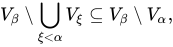
To see this (without the axiom of choice), fix
as a basis of open sets. And suppose per contra, that
were a strictly increasing sequence of open sets. This means
For
we may use the basis to find some
with
in
. In this way we may well-define a map,
mapping each
to the least
for which
and meets
This map is injective, otherwise there would be with
, which would further imply
but also meets
which is a contradiction. But this would go to show that
, a contradiction.
Sources and credits
This article is adapted from the Wikipedia article “Base (topology)”, written by its contributors and licensed under CC BY-SA 4.0. Fathomly has changed the layout, removed citation markers, navigation and maintenance notices, and adjusted punctuation. This adapted version is shared under the same license. For references, see the original article.
Fathomly is not affiliated with or endorsed by the Wikimedia Foundation. Spotted a problem? Tell us.