Coproduct
Category-theoretic construction
In category theory, the coproduct, or categorical sum, is a construction which includes as examples the disjoint union of sets and of topological spaces, the free product of groups, and the direct sum of modules and vector spaces. The coproduct of a family of objects is essentially the "least specific" object to which each object in the family admits a morphism. It is the category-theoretic dual notion to the categorical product, which means the definition is the same as the product but with all arrows reversed. Despite this seemingly innocuous change in the name and notation, coproducts can be and typically are dramatically different from products within a given category.
01Definition
Let 










The unique arrow 


![\left[f_{1},f_{2}\right].](https://wikimedia.org/api/rest_v1/media/math/render/svg/ad50929aab7cbf67b44632c8309dc398e3ff76dc)


The definition of a coproduct can be extended to an arbitrary family of objects indexed by a set 


The coproduct 


Sometimes the morphism 

02Examples
The coproduct in the category of sets is simply the disjoint union with the maps ij being the inclusion maps. Unlike direct products, coproducts in other categories are not all obviously based on the notion for sets, because unions don't behave well with respect to preserving operations (e.g. the union of two groups need not be a group), and so coproducts in different categories can be dramatically different from each other. For example, the coproduct in the category of groups, called the free product, is quite complicated. On the other hand, in the category of abelian groups (and equally for vector spaces), the coproduct, called the direct sum, consists of the elements of the direct product which have only finitely many nonzero terms. (It therefore coincides exactly with the direct product in the case of finitely many factors.)
Given a commutative ring R, the coproduct in the category of commutative R-algebras is the tensor product. In the category of (noncommutative) R-algebras, the coproduct is a quotient of the tensor algebra (see Free product of associative algebras).
In the case of topological spaces, coproducts are disjoint unions with their disjoint union topologies. That is, it is a disjoint union of the underlying sets, and the open sets are sets open in each of the spaces, in a rather evident sense. In the category of pointed spaces, fundamental in homotopy theory, the coproduct is the wedge sum (which amounts to joining a collection of spaces with base points at a common base point).
The concept of disjoint union secretly underlies the above examples: the direct sum of abelian groups is the group generated by the "almost" disjoint union (disjoint union of all nonzero elements, together with a common zero), similarly for vector spaces: the space spanned by the "almost" disjoint union; the free product for groups is generated by the set of all letters from a similar "almost disjoint" union where no two elements from different sets are allowed to commute. This pattern holds for any variety in the sense of universal algebra.
The coproduct in the category of Banach spaces with short maps is the l1 sum, which cannot be so easily conceptualized as an "almost disjoint" sum, but does have a unit ball almost-disjointly generated by the unit ball is the cofactors.
The coproduct of a poset category is the join operation.
03Discussion
The coproduct construction given above is actually a special case of a colimit in category theory. The coproduct in a category 


As with any universal property, the coproduct can be understood as a universal morphism. Let 


The coproduct indexed by the empty set (that is, an empty coproduct) is the same as an initial object in
If 
and the maps 
Letting 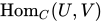



given by the bijection which maps every tuple of morphisms
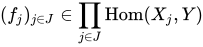
(a product in Set, the category of sets, which is the Cartesian product, so it is a tuple of morphisms) to the morphism
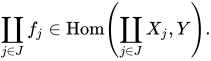
That this map is a surjection follows from the commutativity of the diagram: any morphism

That it is an injection follows from the universal construction which stipulates the uniqueness of such maps. The naturality of the isomorphism is also a consequence of the diagram. Thus the contravariant hom-functor changes coproducts into products. Stated another way, the hom-functor, viewed as a functor from the opposite category 
If 





These properties are formally similar to those of a commutative monoid; a category with finite coproducts is an example of a symmetric monoidal category.
If the category has a zero object 





If all families of objects indexed by
Sources and credits
This article is adapted from the Wikipedia article “Coproduct”, written by its contributors and licensed under CC BY-SA 4.0. Fathomly has changed the layout, removed citation markers, navigation and maintenance notices, and adjusted punctuation. This adapted version is shared under the same license. For references, see the original article.
Fathomly is not affiliated with or endorsed by the Wikimedia Foundation. Spotted a problem? Tell us.