Complex-base system
Positional numeral system
In arithmetic, a complex-base system is a positional numeral system whose radix is an imaginary (proposed by Donald Knuth in 1955) or complex number (proposed by S. Khmelnik in 1964 and Walter F. Penney in 1965).
01In general
Let 


A number 
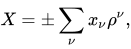
where
is the radix (or base) with ,
is the exponent (position or place), are digits from the finite set of digits , usually with


The cardinality 
A positional number system or coding system is a pair

with radix 


Desirable are coding systems with the features:
- Every number in
, the Gaussian integers
or the integers
, is uniquely representable as a finite code, possibly with a sign ±.
- Every number in the field of fractions
, which possibly is completed for the metric given by
or
, is representable as an infinite series
which converges under
, and the measure of the set of numbers with more than one representation is 0. The latter requires that the set
for real numbers and
for complex numbers.

02In the real numbers
In this notation our standard decimal coding scheme is denoted by

the standard binary system is

the negabinary system is

and the balanced ternary system is

All these coding systems have the mentioned features for 
03In the complex numbers
Well-known positional number systems for the complex numbers include the following (
, e.g.
and
, the quater-imaginary base, proposed by Donald Knuth in 1955.
and
(see also the section Base −1 ± i below).
, where
,
and
is a positive integer that can take multiple values at a given
and
this is the system
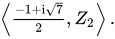
.
, where the set
consists of complex numbers
, and numbers
, e.g.

, where
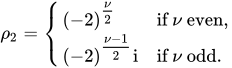
04Binary systems
Binary coding systems of complex numbers, i.e. systems with the digits 

| Radix | , 1 ← | 2 ← | , 2 ← | i ← | Twins and triplets | |
|---|---|---|---|---|---|---|
| 2 | , 1 | 10 | , 10 | i | 1 ← | 0.1 = 1.0 |
| , 2 | 11 | 110 | 10 | i | 1/3 ← | 0.01 = 1.10 |
 | 101 | 10100 | 100 | 10.101010100... |  ← ← | 0.0011 = 11.1100 |
 | 111 | 1010 | 110 | 11.110001100... |  ← ← | 1.011 = 11.101 = 11100.110 |
 | 101 | 10100 | 100 | 10 | 1/3 + 1/3i ← | 0.0011 = 11.1100 |
| , 1+i | 11101 | 1100 | 11100 | 11 | 1/5 + 3/5i ← | 0.010 = 11.001 = 1110.100 |
| 2i | 103 | 2 | 102 | 10.2 | 1/5 + 2/5i ← | 0.0033 = 1.3003 = 10.0330 = 11.3300 |
As in all positional number systems with an Archimedean absolute value, there are some numbers with multiple representations. Examples of such numbers are shown in the right column of the table. All of them are repeating fractions with the repetend marked by a horizontal line above it.
If the set of digits is minimal, the set of such numbers has a measure of 0. This is the case with all the mentioned coding systems.
The almost binary quater-imaginary system is listed in the bottom line for comparison purposes. There, real and imaginary part interleave each other.
05Base −1 ± i
Of particular interest are the quater-imaginary base (base 2i) and the base −1 ± i systems discussed below, both of which can be used to finitely represent the Gaussian integers without sign.
Base −1 ± i, using digits 0 and 1, was proposed by S. Khmelnik in 1964 and Walter F. Penney in 1965.
Connection to the twindragon
The rounding region of an integer, i.e., a set 





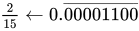
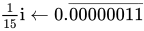
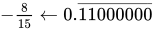

As a consequence, there is an injection of the complex rectangle
![[-{\tfrac {8}{15}},{\tfrac {2}{15}}]\times [-{\tfrac {4}{15}},{\tfrac {1}{15}}]\mathrm {i}](https://wikimedia.org/api/rest_v1/media/math/render/svg/c1169f246ca710e557a9ff51c42d43f199b1100f)
into the interval 

with 
Furthermore, there are the two mappings
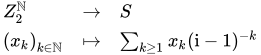
and
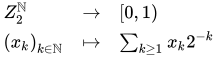
both surjective, which give rise to a surjective (thus space-filling) mapping

which, however, is not continuous and thus not a space-filling curve. But a very close relative, the Davis-Knuth dragon, is continuous and a space-filling curve.
Sources and credits
This article is adapted from the Wikipedia article “Complex-base system”, written by its contributors and licensed under CC BY-SA 4.0. Fathomly has changed the layout, removed citation markers, navigation and maintenance notices, and adjusted punctuation. This adapted version is shared under the same license. For references, see the original article.
Images, from Wikimedia Commons:
- ComplexTwindragon.svg by user:Maksim, CC BY-SA 3.0
Fathomly is not affiliated with or endorsed by the Wikimedia Foundation. Spotted a problem? Tell us.
