Additive function
Function that can be written as a sum over prime factors
In number theory, an additive function is an arithmetic function f(n) of the positive integer variable n such that whenever a and b are coprime, the function applied to the product ab is the sum of the values of the function applied to a and b:


01Completely additive
An additive function f(n) is said to be completely additive if 
Every completely additive function is additive, but not vice versa.
02Examples
Examples of arithmetic functions which are completely additive are:
- The restriction of the logarithmic function to
- The multiplicity of a prime factor p in n, that is the largest exponent m for which pm divides n.
- a0(n), the sum of primes dividing n counting multiplicity, sometimes called sopfr(n), the potency of n or the integer logarithm of n (sequence A001414 in the OEIS). For example:

- a0(4) = 2 + 2 = 4
- a0(20) = a0(22 · 5) = 2 + 2 + 5 = 9
- a0(27) = 3 + 3 + 3 = 9
- a0(144) = a0(24 · 32) = a0(24) + a0(32) = 8 + 6 = 14
- a0(2000) = a0(24 · 53) = a0(24) + a0(53) = 8 + 15 = 23
- a0(2003) = 2003
- a0(54,032,858,972,279) = 1240658
- a0(54,032,858,972,302) = 1780417
- a0(20,802,650,704,327,415) = 1240681
- The function Ω(n), defined as the total number of prime factors of n, counting multiple factors multiple times, sometimes called the "Big Omega function" (sequence A001222 in the OEIS). For example;
- Ω(1) = 0, since 1 has no prime factors
- Ω(4) = 2
- Ω(16) = Ω(2·2·2·2) = 4
- Ω(20) = Ω(2·2·5) = 3
- Ω(27) = Ω(3·3·3) = 3
- Ω(144) = Ω(24 · 32) = Ω(24) + Ω(32) = 4 + 2 = 6
- Ω(2000) = Ω(24 · 53) = Ω(24) + Ω(53) = 4 + 3 = 7
- Ω(2001) = 3
- Ω(2002) = 4
- Ω(2003) = 1
- Ω(54,032,858,972,279) = Ω(11 ⋅ 19932 ⋅ 1236661) = 4
- Ω(54,032,858,972,302) = Ω(2 ⋅ 72 ⋅ 149 ⋅ 2081 ⋅ 1778171) = 6
- Ω(20,802,650,704,327,415) = Ω(5 ⋅ 7 ⋅ 112 ⋅ 19932 ⋅ 1236661) = 7.
Examples of arithmetic functions which are additive but not completely additive are:
- ω(n), defined as the total number of distinct prime factors of n (sequence A001221 in the OEIS). For example:
- ω(4) = 1
- ω(16) = ω(24) = 1
- ω(20) = ω(22 · 5) = 2
- ω(27) = ω(33) = 1
- ω(144) = ω(24 · 32) = ω(24) + ω(32) = 1 + 1 = 2
- ω(2000) = ω(24 · 53) = ω(24) + ω(53) = 1 + 1 = 2
- ω(2001) = 3
- ω(2002) = 4
- ω(2003) = 1
- ω(54,032,858,972,279) = 3
- ω(54,032,858,972,302) = 5
- ω(20,802,650,704,327,415) = 5
- a1(n), the sum of the distinct primes dividing n, sometimes called sopf(n) (sequence A008472 in the OEIS). For example:
- a1(1) = 0
- a1(4) = 2
- a1(20) = 2 + 5 = 7
- a1(27) = 3
- a1(144) = a1(24 · 32) = a1(24) + a1(32) = 2 + 3 = 5
- a1(2000) = a1(24 · 53) = a1(24) + a1(53) = 2 + 5 = 7
- a1(2001) = 55
- a1(2002) = 33
- a1(2003) = 2003
- a1(54,032,858,972,279) = 1238665
- a1(54,032,858,972,302) = 1780410
- a1(20,802,650,704,327,415) = 1238677
03Multiplicative functions
From any additive function 



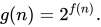


04Summatory functions
Given an additive function 


The summatory functions over 
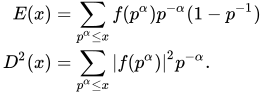
The average of the function 

There is always an absolute constant 


Let

Suppose that 

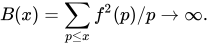
Then 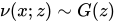

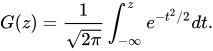
Examples of this result related to the prime omega function and the numbers of prime divisors of shifted primes include the following for fixed 



Sources and credits
This article is adapted from the Wikipedia article “Additive function”, written by its contributors and licensed under CC BY-SA 4.0. Fathomly has changed the layout, removed citation markers, navigation and maintenance notices, and adjusted punctuation. This adapted version is shared under the same license. For references, see the original article.
Fathomly is not affiliated with or endorsed by the Wikimedia Foundation. Spotted a problem? Tell us.