Collision frequency
Physics calculation for collisions
Collision frequency describes the rate of collisions between two atomic or molecular species in a given volume, per unit time. In an ideal gas, assuming that the species behave like hard spheres, the collision frequency between entities of species A and species B is
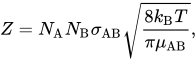
is the number of A particles in the volume,
is the number of B particles in the volume,
is the collision cross section, the "effective area" seen by two colliding molecules (for hard spheres,
, where
is the radius of A, and
is the radius of B),
is the Boltzmann constant,
is the thermodynamic temperature,
is the reduced mass of A and B particles.
01Collision in diluted solution
In the case of equal-size particles at a concentration 


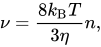
is the Boltzmann constant,
Here the frequency is independent of particle size, a result noted as counter-intuitive. For particles of different size, more elaborate expressions can be derived for estimating
Sources and credits
This article is adapted from the Wikipedia article “Collision frequency”, written by its contributors and licensed under CC BY-SA 4.0. Fathomly has changed the layout, removed citation markers, navigation and maintenance notices, and adjusted punctuation. This adapted version is shared under the same license. For references, see the original article.
Fathomly is not affiliated with or endorsed by the Wikimedia Foundation. Spotted a problem? Tell us.