Closed graph theorem
Theorem relating continuity to graphs

In mathematics, the closed graph theorem may refer to one of several basic results characterizing continuous functions in terms of their graphs. Each gives conditions when functions with closed graphs are necessarily continuous.
A blog post by T. Tao lists several closed graph theorems throughout mathematics.
01Graphs and maps with closed graphs
If 


Any continuous function into a Hausdorff space has a closed graph (see § Closed graph theorem in point-set topology)
Any linear map, 

Examples of continuous maps that do not have a closed graph
If 


Let 


02Closed graph theorem in point-set topology
In point-set topology, the closed graph theorem states the following:
Closed graph theorem, If 
First part: just note that the graph of 


Second part:
For any open 


Since the graph of 


Naively attempting to take 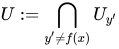
Since 
Now take 
Suppose not, then there is some unruly 



If X, Y are compact Hausdorff spaces, then the theorem can also be deduced from the open mapping theorem for such spaces; see § Relation to the open mapping theorem.
Non-Hausdorff spaces are rarely seen, but non-compact spaces are common. An example of non-compact 
Also, closed linear operators in functional analysis (linear operators with closed graphs) are typically not continuous.
For set-valued functions
Closed graph theorem for set-valued functions, For a Hausdorff compact range space 

03In functional analysis
If 

The closed graph theorem is an important result in functional analysis that guarantees that a closed linear operator is continuous under certain conditions. The original result has been generalized many times. A well known version of the closed graph theorems is the following.
Theorem, A linear map between two F-spaces (e.g. Banach spaces) is continuous if and only if its graph is closed.
The theorem is a consequence of the open mapping theorem; see § Relation to the open mapping theorem below (conversely, the open mapping theorem in turn can be deduced from the closed graph theorem).
04Relation to the open mapping theorem
Often, the closed graph theorems are obtained as corollaries of the open mapping theorems in the following way. Let
.
Now, 

For example, the above argument applies if
Sources and credits
This article is adapted from the Wikipedia article “Closed graph theorem”, written by its contributors and licensed under CC BY-SA 4.0. Fathomly has changed the layout, removed citation markers, navigation and maintenance notices, and adjusted punctuation. This adapted version is shared under the same license. For references, see the original article.
Images, from Wikimedia Commons:
- Cubicpoly.png by Unknown author, Public domain
Fathomly is not affiliated with or endorsed by the Wikimedia Foundation. Spotted a problem? Tell us.
