Circulation problem
Generalization of network flow problems
The circulation problem and its variants are a generalisation of network flow problems, with the added constraint of a lower bound on edge flows, and with flow conservation also being required for the source and sink (i.e. there are no special nodes). In variants of the problem, there are multiple commodities flowing through the network, and a cost on the flow.
01Definition
Given flow network 
, lower bound on flow from node
to node
,
, upper bound on flow from node
, cost of a unit of flow on

and the constraints:
,
(flow cannot appear or disappear in nodes).
Finding a flow assignment satisfying the constraints gives a solution to the given circulation problem.
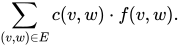
In the minimum cost variant of the problem, minimize
Multi-commodity circulation
In a multi-commodity circulation problem, you also need to keep track of the flow of the individual commodities:
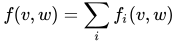
The flow of commodity from
The total flow.

There is also a lower bound on each flow of commodity.

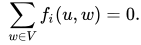
The conservation constraint must be upheld individually for the commodities:
02Solution
For the circulation problem, many polynomial algorithms have been developed (e.g., Edmonds-Karp algorithm, 1972; Tarjan 1987-1988). Tardos found the first strongly polynomial algorithm.
For the case of multiple commodities, the problem is NP-complete for integer flows. For fractional flows, it is solvable in polynomial time, as one can formulate the problem as a linear program.
03Related problems
Below are given some problems, and how to solve them with the general circulation setup given above.
- Minimum cost multi-commodity circulation problem - Using all constraints given above.
- Minimum cost circulation problem - Use a single commodity
- Multi-commodity circulation - Solve without optimising cost.
- Simple circulation - Just use one commodity, and no cost.
- Multi-commodity flow - If
denotes a demand of
for commodity
to
, create an edge
with
for all commodities
for all other edges.
- Minimum cost multi-commodity flow problem - As above, but minimize the cost.
- Minimum cost flow problem - As above, with 1 commodity.
- Maximum flow problem - Set all costs to 0, and add an edge from the sink
to the source
with
,
∞ and
.
- Minimum cost maximum flow problem - First find the maximum flow amount
. Then solve with
and
.
- Single-source shortest path - Let
and
for all edges in the graph, and add an edge
with
and
- All-pairs shortest path - Let all capacities be unlimited, and find a flow of 1 for
commodities, one for each pair of nodes.
Sources and credits
This article is adapted from the Wikipedia article “Circulation problem”, written by its contributors and licensed under CC BY-SA 4.0. Fathomly has changed the layout, removed citation markers, navigation and maintenance notices, and adjusted punctuation. This adapted version is shared under the same license. For references, see the original article.
Fathomly is not affiliated with or endorsed by the Wikimedia Foundation. Spotted a problem? Tell us.